

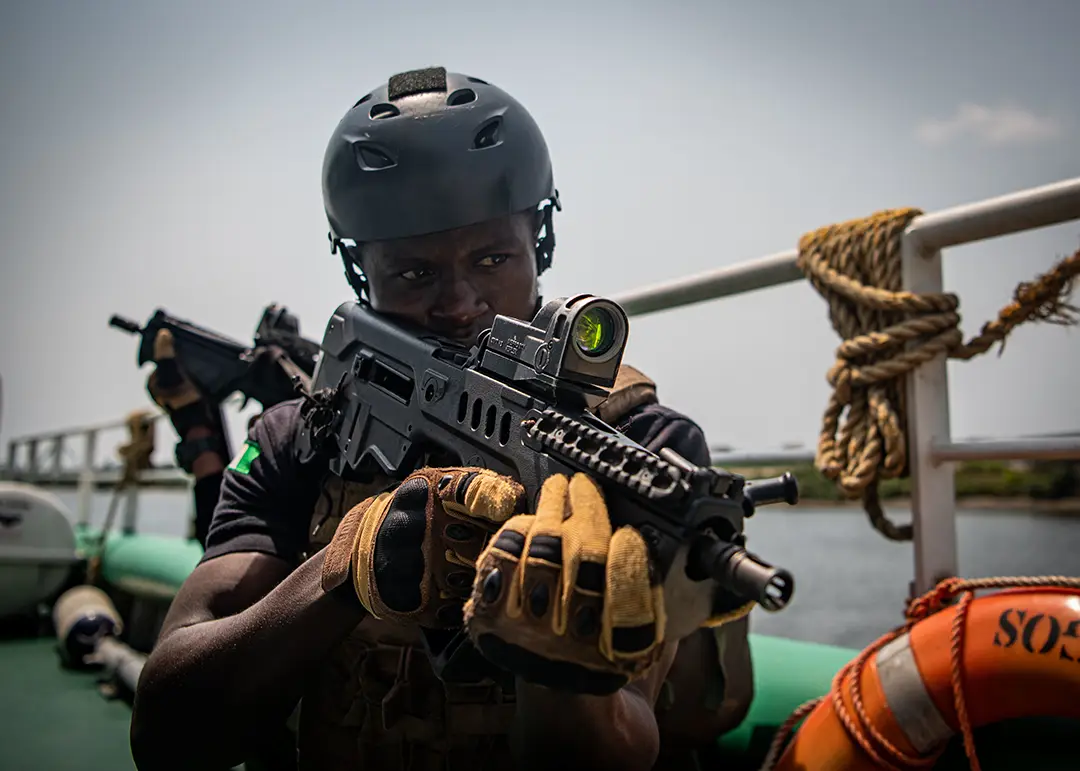
The Nigerian Navy and Federal Department of Fisheries and Aquaculture (FDFA) arrested 33 people, including three Chinese nationals, in late August as part of a three-day initiative known as Exercise Coastal Grip II and Operation Abo Eja.
It was not immediately clear what the Chinese nationals did on the vessels, but Chinese fishing captains have committed illegal, unregulated and unreported (IUU) fishing in the Gulf of Guinea for decades. Also arrested were two Ghanaians and 28 Nigerians. Chinese captains routinely hire African workers.
The operation involved naval ships, helicopters, Special Boat Service personnel and maritime surveillance assets, and was coordinated through the Western Naval Command Mission Control Centre, Nigeria’s Channels Television reported. Fisheries officials offered technical guidance.
“The Operation has demonstrated the importance of maintaining a strong presence at sea, as regular and credible surveillance creates deterrent and encourages compliance amongst the legitimate operators and provides the authorities with valuable information on the activities taking place on the Nigerian maritime jurisdictions,” Adeleke Adegoke, FDFA deputy director, said in a Radio Nigeria report.
After the arrests, Nigerian Navy Rear Adm. Abubakar Mustapha told reporters that IUU fishing has reduced the country’s fish stocks to the extent that it now imports more than 70% of its “fishery needs.”
“So, the partnership between the Nigerian Navy and the [FDFA] is a step in the right direction,” Mustapha said in a Channels Television report. “In fact, the days of illegal fishers and poachers are numbered because the intersection of security, which the Navy brings, and regulation, which the [FDFA] brings to the table, would translate to the denial of these criminal activities, and which will also translate to more revenue and more food security.”
Nigeria loses about $70 million annually to illegal fishing perpetrated by a host of foreign fleets. Beijing commands the world’s largest distant-water fishing fleet and is the world’s worst illegal fishing offender, according to the IUU Fishing Risk Index. Due mostly to illegal Chinese fishing vessels, West Africa has become the world’s epicenter for IUU fishing. It costs the region an estimated $10 billion a year, according to a Stimson Center think tank report.
Chinese vessels commit many fishing violations, including bottom trawling, which involves dragging a net along the sea floor, indiscriminately scooping up marine life. This kills juvenile fish, decimates fish stocks and destroys ecosystems.
Beijing’s vessels also commonly fish illegally in countries’ exclusive economic zones and abuse local rules to enter African fishing registries under local flags. This is known as flagging in, or flying a flag of convenience. It helps a vessel’s owners dodge financial charges and other regulations.
Beijing recently refused to sign the Mombasa Declaration, an agreement meant to improve efforts to combat illegal fishing in East Africa. Steve Trent, CEO and co-founder of the Environmental Justice Foundation, said the Chinese government has taken a disingenuous approach regarding its fishing fleet.
“It’s simply not credible for them to carry on in this way,” Trent told the BBC in July. “China, to date, still is not doing nearly enough to control its fleet. In fact, I would say they’re enabling it, through subsidies, through a lack of oversight and control.”
Nigeria and other West African nations are collaborating to halt illegal fishing. On June 1, the Combined Maritime Task Force (CMTF) was established to address IUU fishing and other regional sea crimes. Côte d’Ivoire, The Gambia, Ghana, Liberia and Sierra Leone joined Nigeria in signing the pact. The CMTF will be the first joint, African-led maritime security effort to include a rapid response force.
The force will be headquartered in Lagos and is expected to conduct intelligence, interdiction, patrols, surveillance, search and rescue missions, and other security operations. According to the Institute for Security Studies, Nigeria is the only country so far to contribute to the fleet, with one helicopter, two vans, two pickup trucks, three ships and three military trucks. The force will work closely with the West Africa Regional Maritime Security Center and the Central African Regional Maritime Safety Center.