

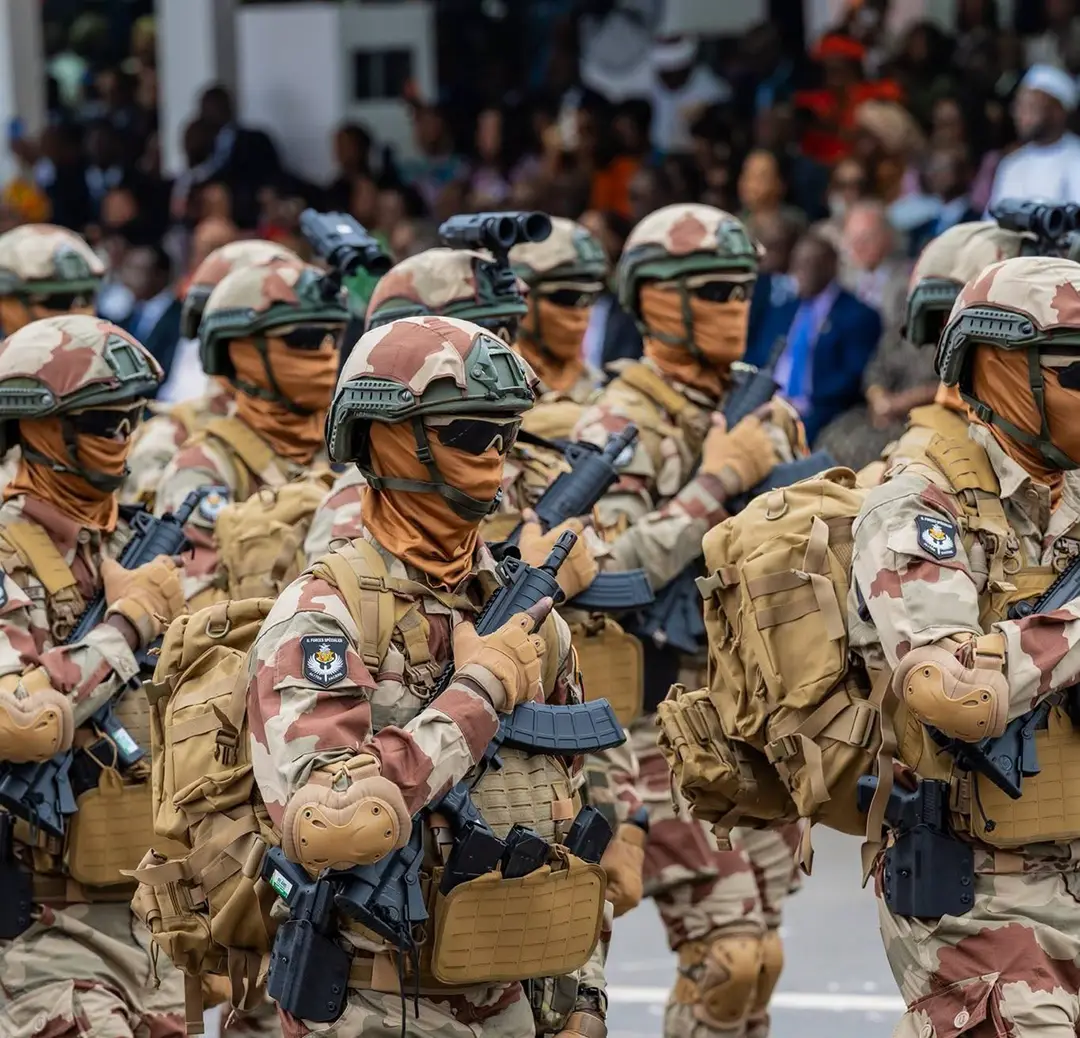
The discovery and dismantling of a terrorist cell linked to the al-Qaida-affiliated Jama’at Nusrat al-Islam wal-Muslimin (JNIM) was surprising news in Guinea in March. Weeks later, the government announced the creation of an interagency Special Operations Command to prevent and counter the spread of terrorism.
Chief of the General Staff of the Armed Forces Gen. Ibrahima Sory Bangoura hailed the command as symbolic of the modernization of Guinea’s defense forces in the face of new security challenges.
“The creation of this new command tool responds to a major challenge: the need to confront threats that have become more complex and hybrid,” he said during a September 4 ceremony to inaugurate the command’s new leader, Brig. Gen. Mouctar Kaba. In a speech, Kaba explained that the special operations command will complement and coordinate, not replace, existing structures within Guinea’s security forces.
“On the contrary, it must help unite expertise, strengthen coordination, develop interoperability and provide the national command with a specialized, responsive and coherent capability,” he said. “We must make interoperability a true working culture.”
Experts say JNIM attacks near Mali’s vast, porous border with Guinea have increased in frequency over the last two years. But the biggest change in 2026 has come with JNIM’s economic blockade of Mali’s capital, Bamako. Since early May, militants have attacked and disrupted cargo convoys moving through Kourémalé, a town that straddles the Mali-Guinea border and serves as a major economic artery between Bamako and Guinea’s capital, Conakry.
Until May, it was a relatively safe corridor for commerce. Today, JNIM’s blockade has pushed much of that traffic into the informal and illicit economies, as the militant group is poised to expand into Guinea’s borderlands.
Researchers Hassane Koné, Paulin Maurice Toupane and Felix Fodé Bongono with the Institute for Security Studies’ West African regional office in Dakar praised Guinea’s proactive approach to expanding special forces and collaborating between agencies. They also warned of areas of weakness that JNIM will look to exploit.
“These important security initiatives assume the threat is an external phenomenon to be neutralised by force when it crosses the border into Guinea,” they wrote in an August 11 report. “This approach overlooks the country’s inherent internal vulnerabilities, some of which require non-security interventions to prevent armed groups from gaining a foothold.”
Officials in the Sahel have been sounding alarms for years that JNIM and the Islamic State group are trying to expand into coastal countries in West Africa with their bustling ports and well-established trafficking networks. Former Mauritanian intelligence officer Ahmed Mbarek said militant expansion has been slow but steady.
“Mali remains the center of gravity, but the pressure within it is pushing the parties to expand rather than contract,” he told Arab news portal Voice of Emirates for a May article. “As this path continues, it is no longer sufficient to talk about a local threat within the Sahel, but rather about a gradual reshaping of a wider security space that extends towards West Africa and the Sahel, with all the implications that this has for regional stability in the coming years.”
The ISS researchers said communal tensions along the Guinea-Mali border are fueled in part by disputes over gold mining and the lack of regulation and oversight by both countries. Extremist groups typically exploit local grievances as they embed themselves in illicit economies.
“Illicit arms trafficking and smuggling networks, which are highly prevalent in this border region, present a tangible security risk,” they wrote. “Capitalising on porous borders, violent extremists could plug into these illegal economies to sustain their own logistics requirements, mirroring a pattern documented across the wider region.”
The researchers called for Guinean authorities to work with their counterparts in Mali and Senegal to formalize, regulate and monitor artisanal mining to prevent it from becoming a source of terrorist financing.
They also recommended a concerted effort to involve local communities in surveillance and information sharing. Improving civil-military cooperation, they said, will build trust and give locals an active role in preventing terrorist recruitment.
“A holistic national counter-terrorism strategy that integrates military operations with broader governance reforms is needed,” they wrote. “Under the auspices of the new Special Operations Command, this strategy should, in the immediate term, fortify border security and scale up surveillance to neutralise dormant cells and block terrorist infiltration.”