
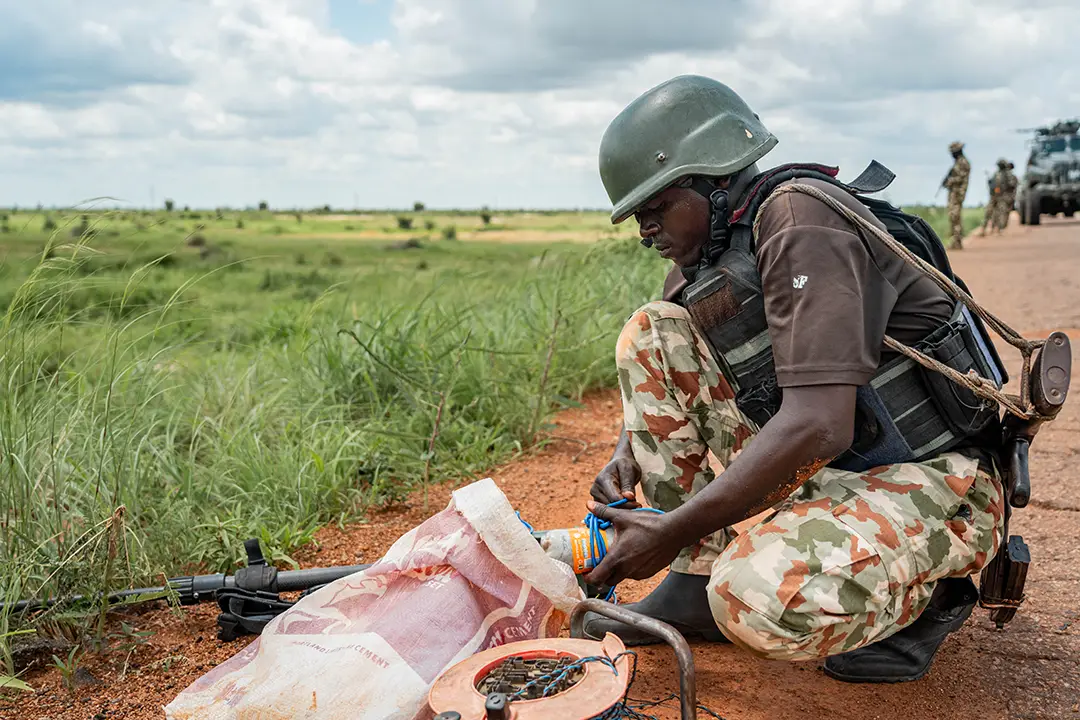
For more than a decade, the Islamic State West Africa Province (ISWAP) has waged an intense insurgency across the Lake Chad region, affecting communities in Chad, Cameroon, Niger and Nigeria. But the geographic nature of this threat is changing.
An analysis of conflict data from 2015 to 2025 reveals that although the insurgency initially targeted urban centers, it has increasingly expanded deeper into rural areas. This ruralization mirrors the growing concentration of government troops in fortified camps.
In the Sahel, terrorist groups have gone through several expansions. Before ISWAP officially splintered from Boko Haram in 2016, major Lake Chad Basin cities served as active battlegrounds as the group contested state authority.
Combining data from the Armed Conflict Location and Event Database project (ACLED) with city data from the Organisation for Economic Co-operation and Development’s Africapolis shows that half of all violent events involving ISWAP occurred within urban areas in 2015.
As ISWAP expanded in the late 2010s, the share of urban attacks declined. Unlike Boko Haram, which gained infamy for indiscriminate attacks targeting marketplaces, mosques and civilian infrastructure, ISWAP sought to pose as a more governance-oriented alternative in rural areas often left underserved by the government.
This first period of ruralization was short-lived, however. In the early 2020s, ISWAP gradually intensified attacks in urban centers, briefly returning to the 2015 level of 49% in 2023 before focusing increasingly on rural areas. By 2025, the proportion of events within urban areas had plummeted below 30%.
ISWAP’s recent ruralization does not mean that the group has decided to spare cities. ISWAP has continued to carry out attacks against urban centers in the Lake Chad Basin as its operational capabilities increased at the expense of Boko Haram’s.
The number of urban events peaked in 2020, with 356. This spike represents an intense operational push by ISWAP, with the total number of attacks having expanded so aggressively that its rural campaigns grew at a greater pace than its urban attacks.
After the 2020 spike, the number of urban events stabilized, hovering near 200 per year by 2024 and 2025. This suggests that regional military pressures have reduced the group’s ability to operate freely inside cities. It coincides with the implementation of fortified military camps and the construction of defensive earthen barriers around most cities in northeastern Nigeria. These initiatives are part of a government strategy to prevent or slow terrorist incursions in highly populated areas.
Supercamps and defensive trenches are a double-edged sword, however. They provide short-term protection, but they also can deepen rural insecurity and civilian vulnerability. The daily rate of attacks by Boko Haram and ISWAP has more than doubled since the supercamp strategy was implemented in the late 2010s. The rate of attacks by government forces against insurgents has remained stable. In other words, terrorists have rapidly filled the void left in rural areas and resumed their offensive outside fortified camps.
ISWAP is not just being pushed out of cities but is moving further away from them. Between 2015 and 2021, violence that took place outside urban areas averaged about 15 kilometers from urban centers. This suggests that the terrorists were targeting rural communities just outside fortified towns.
However, after 2021, ISWAP shifted outward. In 2022, the average distance of a nonurban event surged to 20 kilometers from urban areas. This expanded rural footprint has remained consistent through 2025, continuing to hover between 17 and 19 kilometers.
ISWAP has extended its reach deeper into rural spaces, embedding into the Lake Chad islands, the Sambisa forest and along major transport corridors.
ISWAP’s ruralization by 2025 can be viewed as a victory for urban counterinsurgency. However, data suggests that the threat has simply relocated and adapted. By pushing operations deeper into rural areas, ISWAP creates several tactical advantages for itself and challenges for state forces.
To engage the enemy, state military patrols now must venture farther away from fortified urban superbases, exposing them to ambushes and IEDs along rural roads. Human intelligence networks also are significantly harder to maintain and protect in isolated, distant villages. As the conflict moves deeper into the rural communities, international aid organizations find it harder to reach vulnerable populations, which exacerbates food insecurity and displacement.
Ultimately, ISWAP’s expansion into rural areas means that the static urban defense and superbase model may no longer be sufficient. Security frameworks must try to be more agile and community-based to project state authority into the Lake Chad Basin’s rural areas.
ABOUT THE AUTHORS: Finley Walker is a student at Trinity College Dublin in Ireland, pursuing a degree in geography with a minor in sociology. Olivier Walther is an associate professor in the University of Florida’s Department of Geography.