

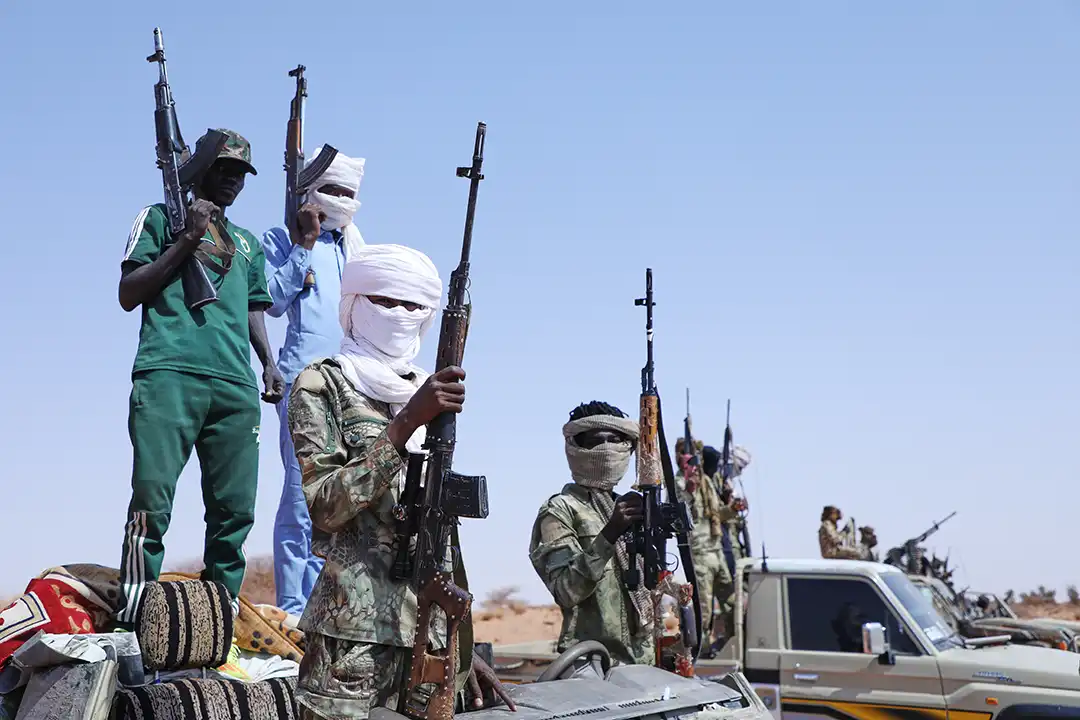
Paramilitary Rapid Support Forces (RSF) fighters continue to defect and join the Sudanese Armed Forces (SAF), raising questions as to whether their movements are due to minor infighting or a more significant erosion of faith inside the rebel group.
Abubakr Hamouda Dahloub, RSF intelligence chief in North Kordofan State, defected in August with 200 fighters in Omdurman. The men brought their weapons and equipment and said they were ready for combat alongside the SAF and its allied forces, the Sudan News Agency reported.
Dahloub said he and his fighters realized “their mistake in following the project being implemented by the RSF militia” and urged remaining RSF commanders to abandon the paramilitary force and fight “for the demands of the Sudanese people to eliminate the rebel RSF militia.”
August was a critical month for defections. On August 12, the RSF-appointed governor of Sudan’s Kordofan region, Hamad Mohammad Hamad Khalifa, resigned from their parallel government, which he said, “regrettably has become merely a political facade for the practices of the Rapid Support Forces.”
“Sudanese people today have no choice but to unite against all attempts to legitimise parallel forces or rogue militias that have squandered an entire generation’s lifetime in the service of individual interests,” he added.
The next day, 21 commanders and 270 fighters abandoned the RSF.
On August 19, Sudanese authorities announced that 318 fighters and four commanders with 50 combat vehicles had switched sides. They were led by Musa “Khamsin” Ali Ahmed, who joined other high-profile defectors in recent months, including field commanders and political officials from the RSF-led Sudan Founding Alliance, known as Tasis.
Khamsin said that after reaching Army-held territory, his group had come from North Darfur State and that Al-Nour “al-Qubba” Ahmed, one of the most prominent RSF defectors, had helped them reach the Sudanese capital, Khartoum.
“He also cited disappointment with the Tasis project, saying they had initially believed it would establish a new state but later reached a different conclusion,” prominent Sudanese journalist Ahmed Younes reported in an August 20 article for the Asharq Al-Awsat newspaper. “Welcoming Khamsin and his fighters, al-Qubba said he expected more commanders and forces to defect. He urged RSF fighters in Darfur and Kordofan to join the army.”
Disillusionment with the RSF is common among defectors. In announcing his resignation during a live interview on Saudi television channel Al Arabiya, Khalifa railed against the humanitarian conditions in RSF-held territory, saying the paramilitary group displayed a “complete inability to provide even the most basic humanitarian needs for the people of Kordofan and Darfur.” He also charged the RSF with continuing “a policy of destroying cities and killing civilians without conscience or moral restraint.”
The Armed Conflict Location and Event Data (ACLED) project said the waves of defections have come amid major Army ground gains, calling it “the beginning of a third phase of the war.”
In an August 13 analysis, ACLED risk methodology lead Nohad Eltayeb and Sudan researcher Ali Mahmoud Ali said the SAF aims to advance on RSF strongholds while the paramilitary group tries to relieve pressure on its western fronts through offensives in Blue Nile State and drone strikes on Khartoum and River Nile State.
“Coupled with a steady trend of RSF fighters defecting to the SAF, these trends point to a significant disruption of the RSF’s supply lines and strike capacity,” they wrote. “It is therefore unlikely that the RSF can withstand offensives on three parallel fronts.”