

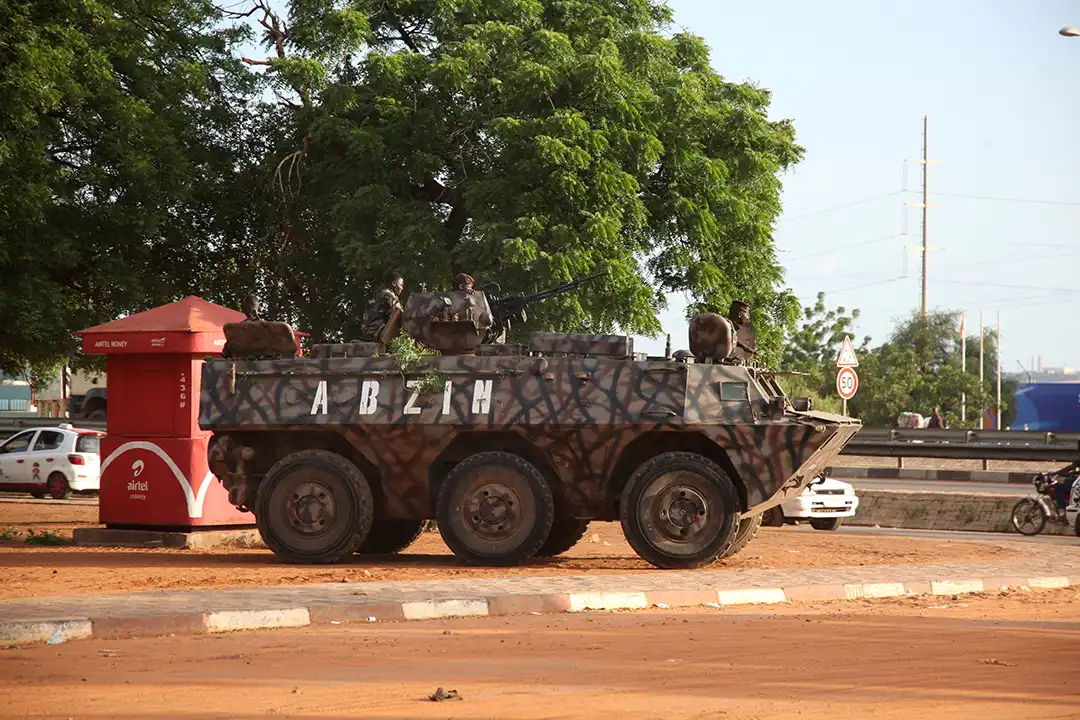
The sound of gunfire and explosions began about 1 a.m. on August 29, setting off a night of intense fighting at Air Base 101, a military installation at Diori Hamani International Airport in Niger’s capital.
The third attack of the year on Niamey, after one in January by an Islamic State group affiliate and another in June by al-Qaida’s Jama’at Nusrat al-Islam wal-Muslimin, was different. This one came from within the Army, and unlike Niger’s conflict with terrorists, it was quelled by Russia’s Africa Corps mercenaries.
According to Héni Nsaibia, West Africa senior analyst at the Armed Conflict Location and Event Data project, the failed mutiny “has exposed serious divisions within Niger’s armed forces.”
“The regime ultimately relied on support from Russia’s Africa Corps to put down the mutiny,” he wrote in a September 1 analysis.
He added: “Even if President Abdourahamane Tiani remains in power, the aftermath of the mutiny could further weaken the Nigerien armed forces. The regime will likely divert resources from fighting jihadist groups to monitor internal threats, while a purge would likely further weaken the cohesion within the Nigerien military.”
Abdel Nasser Elyessa, a research fellow at the Institute for Strategic Studies of the International Academy for the Fight Against Terrorism in Côte d’Ivoire, said calling on mercenaries to resolve a problem within the military was “unprecedented” and exposes the failures of Russia’s Africa Corps to make any significant gains against the ongoing spread of terrorism in the Sahel.
“In West Africa, military coups are becoming a structural risk,” he told Agence France-Presse.
When it seized power in a 2023 coup, the military junta tried to justify its actions with rhetoric about sovereignty and independence from foreign influence. After calling on Russia to rescue it from its own Army, the junta now sits at odds with its original mission, the Timbuktu Institute argued.
“While Abdourahmane Tiani’s government has made security sovereignty one of the pillars of its legitimacy, the intervention of an outside partner to help contain an internal crisis raises a central question: how far can the pursuit of strategic autonomy go when it comes hand in hand with growing dependence on Moscow?” the Dakar-based think tank said in an August 30 report.
Nigerien state television said the assault involved “hundreds of disaffected soldiers.” When it was over, a statement by Defense Minister Gen. Salifou Modi was read on air, describing the uprising as a “fit of temper” by a “group of soldiers who have broken with military regulations.”
Analysts and security sources said the mutineers had served on the front lines of the fight against terrorist groups. Some reportedly were from areas such as Dosso, Ouallam and Tera in southwestern Niger, where the Army has suffered heavy losses.
“Just a week ago, some 18 soldiers were killed in an attack on their position in the southern Dosso region,” Nsaibia told Reuters on August 29. “These mass-casualty overrun attacks on the Nigerien military are becoming commonplace and will continue to fuel unrest and aggravate tensions within the army ranks.”
Analysts say that Africa Corps mercenaries in the Sahel have proved ineffective at fighting terrorism, while witnesses and human rights groups have documented how Russian fighters routinely disregard civilian lives.
“Fighting jihadis comes as a second priority (for the Africa Corps), but the first priority is to sustain regimes, and they are succeeding in this,” Wassim Nasr, a senior research fellow at The Soufan Center, told The Associated Press.
Under Russian influence, Tiani’s government has isolated itself from neighboring countries, withdrawn from its regional bloc, and shunned international partners while repressing civilians and stamping out dissent.
“The jihadist groups will be the only winners in this situation,” Nsaibia told Reuters.