

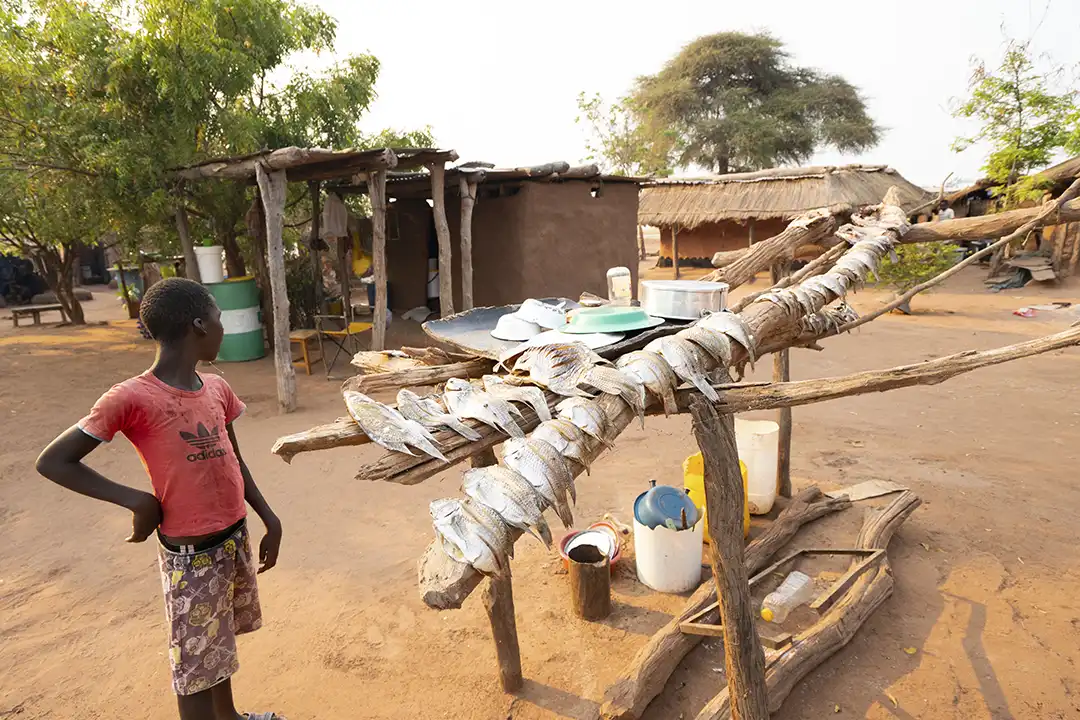
Chinese-owned ZamFresh has become one of the largest fishing companies in southern Africa since it arrived in Zambia in 2018. The tilapia it pulls from Lake Kariba near Jeremiah Island is sold in landlocked Zambia and Zimbabwe and exported globally.
This is profitable for ZamFresh, but it has meant poverty, hunger and despair for the 500 artisanal fishermen on Jeremiah Island who say they were evicted to make room for the company. ZamFresh owns more than 300 large fish cages around the island, which is on the Zambian side of Lake Kariba, the world’s largest artificial lake and water reservoir by volume.
Mike Moonga had worked as an artisanal fisherman on Jeremiah Island for about six years when he and his family heard gunshots about 3 a.m. on February 11, 2023.
“We went out and saw police officers and soldiers shooting and chasing the people,” Moonga told Radio France Internationale (RFI). “They said we have to get out of the island. Then, they burned everything down, our houses, our fish stocks in fridges, our money, our shops, all that we owned. We got out of the island with nothing.”
Moonga said he was beaten after asking why authorities were burning their properties. The fishermen are not allowed to return to the island. Moonga said government representatives told the island’s chief that they were being evicted because the island was needed.
“But they didn’t tell us that the Chinese people secretly bought that island because, in Zambia, islands belong to the people and are not for sale,” Moonga told RFI. “After we left, we saw new buildings on the island which are now guarded by the same soldiers who beat us.”
Vladimir Chilinya, country director for FIAN International Zambia, a human rights organization, said the government should have secured livelihoods for the fishermen before forcing them out.
“Instead of being relocated in a dignified manner, they have been chased away from their land and going through a lot of suffering,” Chilinya told RFI.
He also said it is part of the government’s history of prioritizing Chinese interests in the country’s copper and aquaculture sectors.
“There is a pattern of eviction of local communities in preference for large-scale investment,” Chilinya said.
The Siavonga District Council, which governs areas and waters around Jeremiah Island, did not respond to RFI when asked about the evictions and whether ZamFresh was granted rights to use the island. ZamFresh also declined to comment. Zambian journalists speaking anonymously told RFI that the government threatened to cancel their media licenses if they reported on the island.
In March 2026, two Chinese employees at ZamFresh were caught on video restraining a female worker. Zambia’s Ministry of Labor ordered the Chinese workers’ deportation. ZamFresh is part of the SunShare group, which recently signed a $246 million contract with the Zambian government to invest in solar power.
Analysts say deals related to development, extraction or natural resource use with Chinese companies carry the risk of lost sovereignty and human rights abuses. In late April, the Zambian government abruptly postponed the annual RightsCon human rights conference days before it was scheduled to open in Lusaka, the national capital.
New York-based advocacy group Access Now, the summit’s sponsor, claimed the Chinese government pressured Zambian officials due, partly, to the inclusion of Taiwanese participants. Although Taiwan is self-ruled, Beijing claims it as its own territory. China prohibits its diplomatic partners from maintaining formal ties with Taiwan.
“Zambia has become a case study for how economic investment from China can progress to suppression of dissent, silencing a population that once protested in the streets against such influence,” analyst Shannon Van Sant wrote for The Strategist, an Australian Strategic Policy Institute publication.
In June, China refused to sign the Mombasa Declaration, an agreement meant to improve efforts to combat illegal fishing, during the 11th Our Ocean Conference in Kenya. The conference was marred by claims that Taiwanese representatives were not allowed to attend due to Chinese pressure on Kenya.