

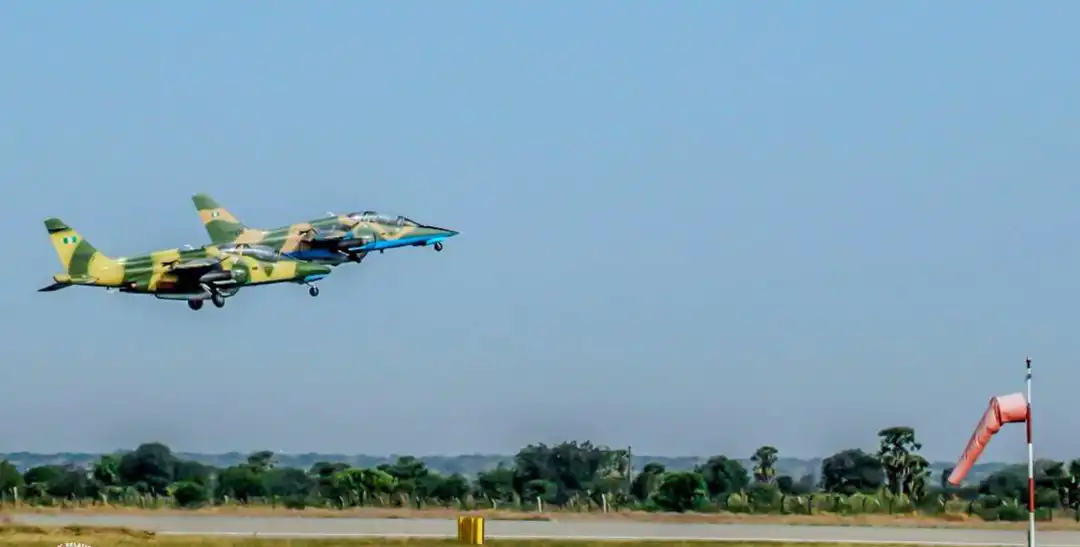
A campaign of airstrikes in Somalia forced al-Shabaab to limit group communications and shift away from large gatherings of top leaders.
In northwest Nigeria, an airstrike against Lakurawa terrorist camps forced fighters to flee to the north. Local sources told researcher Viktor Marsai that many of the terrorists were shocked at being targeted and had previously felt safe from airstrikes.
“Neither example demonstrates a full defeat of terrorist groups, but these cases demonstrate how airstrikes can weaken groups’ coherence and operational capacities — at least for a time,” he wrote for The Soufan Center in an August 4 brief.
Air power can have a significant counterterrorism impact, but experts say there are limits. They warn against sole reliance on air forces and encourage more coordination between air and ground forces.
“Combating violent extremism in Africa requires a more comprehensive strategy; airstrikes eliminating training camps and high-value targets — including senior commanders — alone cannot obliterate terrorist groups,” Marsai wrote.
In the Sahel, terrorist groups use irregular tactics to exploit weaknesses in security forces that adhere to traditional structures. Fatai Alli, a retired major general in the Nigerian Army, said that air and ground forces must integrate intelligence and restructure for better mobility.
“Without ground forces to exploit the effects of air-delivered fires, insurgents simply disperse, regroup, and reconstitute,” he wrote in a February report for the Africa Center for Strategic Studies.“This reveals a deeper structural gap: ISR [intelligence, surveillance, and reconnaissance] assets, already insufficient in number, are not matched by the ground strike capability or the command-and-control architecture needed to act on intelligence at speed. Battlespace management remains slow and fragmented. It often takes hours for headquarters to gain awareness of an unfolding attack, during which time frontline units are left to fight alone with minimal reinforcement or resupply.”
Operations in Somalia and the Lake Chad Basin have shown that airstrikes are more effective when targets are concentrated in a small area. Fighter jets, helicopters and drones deployed relatively close to battlefields that covered a few hundred square kilometers have had more impact than those in vast Sahel deserts.
“In the Mali-Burkina Faso-Niger tri-border area, the Liptako Gourma region covers more than 500,000 square kilometers,” Marsai wrote. “Terrorist groups move relatively fast and freely on this vast terrain, launching attacks sometimes from a distance of hundreds of kilometers.”
The Nigerian Air Force is aiming to modernize its fleet and foster better coordination with other service branches. In August, the NAF said it had increased its presence over Sokoto State to support joint security operations.
Air Commodore Ehimen Ejodame, NAF director of public relations and information, said terrorists and bandits often exploit difficult terrain with mobility and concealment to evade ground forces.
“By leveraging the reach, speed, flexibility and precision of air power, the NAF is better positioned to locate, disrupt and degrade hostile elements, deny them freedom of movement, and create opportunities for surface forces to consolidate gains,” he said in an August 24 statement.
Air Marshal Sunday Aneke, chief of the air staff, added that asymmetric threats demand a responsive NAF to act on intelligence and coordinate quickly with ground troops.
“Our objective is clear: to sustain pressure on criminal elements, deny them freedom of action, and create the conditions for our surface forces to dominate the operational environment,” he said. “We will continue to employ air power intelligently, professionally and decisively in synergy with sister services and other security agencies, while maintaining the highest regard for civilian safety.”
Civilian casualties have been a major issue as the NAF has broadened its campaign of airstrikes against terrorists and bandits. Marsai warned that one of the biggest criticisms against the use of airstrikes is that they can cause collateral damage that can radicalize innocent civilians and strengthen terrorist groups’ propaganda and misinformation efforts.
However, he believes that the evolving fight against terrorism necessitates the integration of air and ground forces.
“While serving as an instrument in governments’ toolboxes, airpower can help shape effective counterterrorism strategies, but alone cannot destroy extremist organizations,” he wrote.