

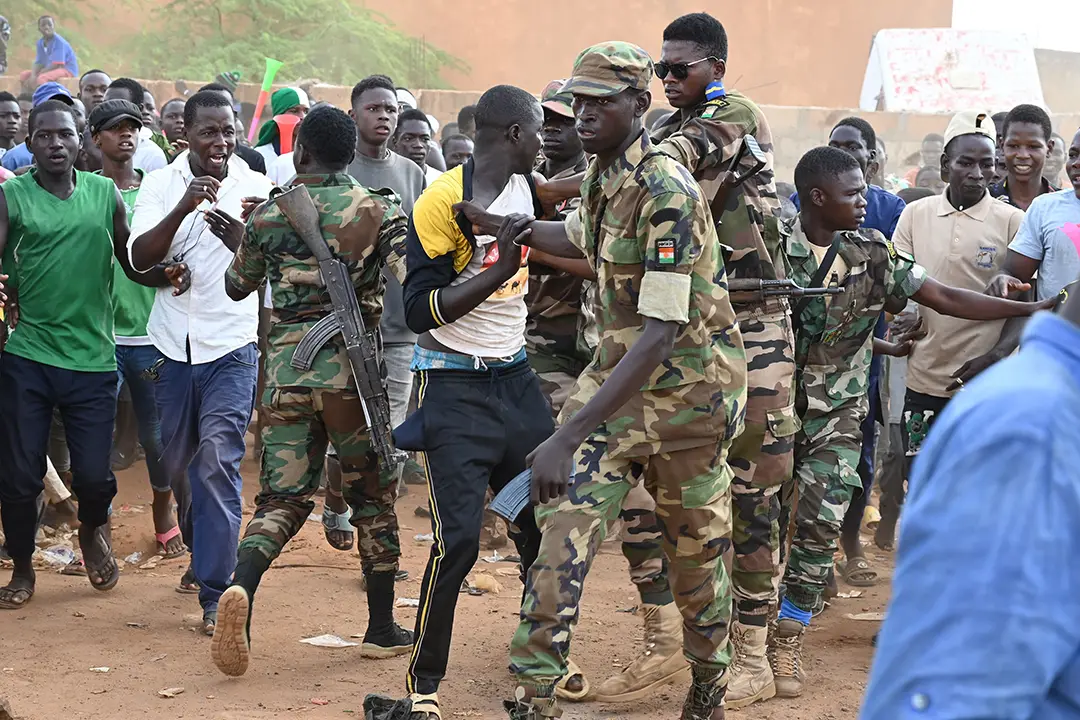
When Civicus, a South Africa-based alliance of civil society organizations from around the world, recently added Burkina Faso to its human rights watch list, the reasons were numerous:
- The junta has dissolved all political parties.
- Critics of the military rulers have been censored, arrested and disappeared.
- Nearly 1,200 civil society organizations have been suspended or dissolved.
“The scale of this assault on civil society is unprecedented,” Pierre-Claver Akolly Amégnikpo Dekpoh of the West African Human Rights Defenders Network told Civicus when it released its report on July 29. “Authorities are using restrictive legislation and ambiguous administrative measures to dismantle organisations.”
The Civicus Monitor, which tracks the latest developments to freedoms of expression, association and peaceful assembly across 198 countries and territories, downgraded Burkina Faso to a status of “repressed,” the same status held by Mali and Niger, two neighbors also led by military juntas.
Civil society groups and experts have documented a host of rights violations in all three countries, where military rulers who once promised an orderly transitionary period back to civilian government instead have banned and dissolved all political parties.
The heads of state of Burkina Faso, Mali and Niger all used the issues of soaring insecurity and expansion of Sahel-based terrorist groups as justification for seizing power through coups. But Daniel Eizenga, a researcher with the Africa Center for Strategic Studies, said the junta leaders have deprioritized national security and eschewed broader regional collaboration to focus on managing domestic dissent.
“The consolidation of political power has taken precedence over the reassessment and adaptation demanded by a rapidly evolving security environment,” he wrote in a July 14 article. “The effect is to compromise national security. Closing spaces for these voices narrows the discussion precisely when a broader assessment of the region’s deteriorating security trajectory is most needed.”
Civicus researcher Nelson Baiye Mbu said Burkina Faso was added to the watch list because of “the sharp scale and intensity of state action against civil society,” including a restrictive 2025 law on freedom of association. Downgrading the country’s status was no surprise, he said: “If you look at the trajectory, it has been very visible since 2023.”
Numerous critics and some journalists have been arrested by mask-wearing men and end up in prison. Others have been forcibly conscripted and sent to the front lines of the fight against terrorists.
One of President Ibrahim Traoré’s latest targets was influential imam Mohamad Ishaq Kindo, who was detained in late May and taken to an unknown location after he publicly criticized a draft law regulating the exercise of religious freedoms in a country where more than 60% of the population is Muslim. After gathering to demand Kindo’s release, about 100 of his supporters were taken to a military camp for what officials called “civic training.”
“The terror has reached its peak,” a Kindo ally told Agence France-Presse in June. “Brutally abducting a religious leader and preventing worshippers from gathering for prayer by firing tear gas even inside the mosque is taking things way too far.”
He added: “What this regime is putting the people of Burkina Faso through is unbearable, all under the pretext of fighting terrorism, when we can’t even see any results.”
As in Burkina Faso, security is deteriorating throughout the Sahel as militant groups make unprecedented territorial gains and launch more coordinated and sophisticated attacks directed at the three military governments.
Days before the three-year anniversary of the military coup in Niger, Human Rights Watch said the junta has dismantled democratic institutions and intensified repression to tighten its grip on power while security incidents, deaths and attacks by terrorist groups have increased.
“There is an extreme curtailment of civic space in Niger,” former Nigerien ambassador Kiari Liman-Tinguiri told Radio France Internationale for a July 27 article. “Freedom of expression has been completely suppressed. Court rulings are being flouted, non-governmental organisations have been dissolved and subjected to an unprecedented system of control.”
“In short, it is an authoritarian regime. That is the reality.”
In Mali, terrorist groups have collaborated with Tuareg separatists to threaten the teetering junta in 2026. The government passed a law repealing basic protections to political participation in 2025, drawing a chorus of international rebuke.
In May 2026, the International Federation for Human Rights called on Malian authorities to end their campaign of arbitrary detentions, forced disappearances and acts of intimidation targeting government critics. “The Malian authorities cannot respond to the growing security crisis with abductions, enforced disappearances and incitement to hatred,” federation leader Drissa Traoré said in a statement on May 7, 2026. “The fight against jihadism cannot be used to justify the disregard for the rule of law.”
To turn the tide of violence and repression in the Sahel, Eizenga said, the junta-led governments must reestablish regional communication and collaboration with their West African neighbors.
“The widening scope and complexity of the threat point toward the need for more comprehensive — and inclusive — responses than those pursued to date,” he wrote. “Reversing these trends will require engaging a broader range of domestic actors, stronger regional cooperation, more effective intelligence sharing, and intensified efforts to mobilize the political, social, and economic resources needed to confront a complex insurgency.”