

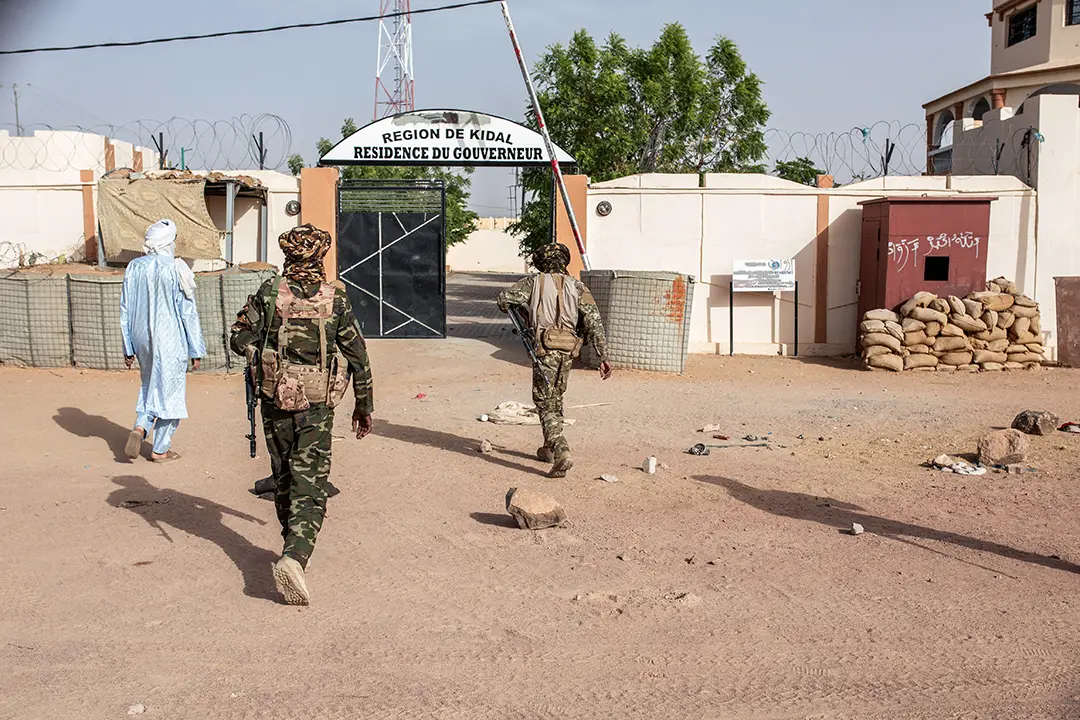
Sahelian terror groups are expanding their reach and influence, conducting large-scale attacks across huge swaths of territory in the junta-led countries of Burkina Faso, Mali and Niger, while steadily encroaching on coastal West African states. In many areas, they impose strict interpretations of Islam on civilians and collect taxes to fund their operations.
Throughout Mali, civilians are now told how to live by the al-Qaida-affiliated Jama’at Nusrat al-Islam wal-Muslimin (JNIM) terror group, which is linked to 78% of fatalities caused by militant Islamist violence in the region over the previous year, the Africa Center for Strategic Studies reported in April. JNIM often works closely with Azawad Liberation Front fighters.
JNIM recently seized the western Malian town of Nioro du Sahel, 441 kilometers northeast of Bamako, the capital. It gained control of the town near the Mauritania border after making agreements with local leaders.
“There are new rules,” one resident told Agence France-Presse (AFP). “A woman must not be seen with a man she isn’t married or related to. She cannot go out without a veil, even to the fields.”
JNIM also collects taxes of about 10% on harvests and income, purportedly for protection.
“Honestly, the town is dying,” the anonymous resident said. “Everything is sad.”
JNIM has imposed a monthslong fuel blockade on Bamako and now controls so many areas that analysts warn that the country might be on the brink of collapse. But the group’s operations are not confined to Mali. JNIM looted and burned the central Burkina Faso town of Dourtenga in April. Residents there say the attack has instilled fear in schoolchildren who recall the sound of approaching motorcycles before the attack unfolded.
“One morning, they dragged a tailor into the square and flogged him” for having cigarettes in his shop, a trader told AFP. “They said it was a warning for everyone.”
JNIM has exploited militaries’ repression and violence against civilians in Burkina Faso and Mali to drive recruitment. In the JNIM-blockaded central Malian town of Farabougou, a resident named Aly said the group acts harshly if rules are broken.
“They are violent when they need to punish,” he told AFP. “But outside that, they are courteous and fair. They don’t commit abuses like the gendarmerie.”
Boko Haram and the Islamic State group (IS) also have uprooted entire communities throughout the region, which now is considered the epicenter of global terrorism. Terror attacks across the Sahel have doubled since 2020, according to the Armed Conflict Location and Event Data project (ACLED).
“What was once concentrated primarily in northern Mali has spread across much of the central Sahel … and increasingly into the borderlands of coastal West Africa,” Heni Nsaibia, a senior ACLED analyst, told AFP. The groups can now work “across vast territories, conduct large-scale attacks and increasingly challenge state control in rural areas.”
IS has exploited a security vacuum created when international troops left the region. It primarily operates in the tri-border region of Burkina Faso, Mali and Niger. IS claimed that 86% of its global operations in early 2026 were in Africa, about twice as many as the same time frame in 2024, AFP reported.
In 2025, the Lake Chad Basin saw a 28% increase in fatalities from militant Islamist violence over the previous year, the Africa Center reported in April. This mostly was due to Boko Haram and Islamic State West Africa Province (ISWAP) attacks in northeast Nigeria.
Boko Haram operates similarly to JNIM and IS. In Nigeria’s Borno State, on the edge of Lake Chad, local leaders also have cut deals to let terrorists operate, while residents say farmers are afraid to tend their fields out of fear of being kidnapped or killed. A truck driver named Goni said he lost all his trucks in terror attacks. He once regularly transported goods between the city of Maiduguri and neighboring Cameroon, but his trucks were all torched.
“Things have gone from bad to worse for me and my family over the past year due to a surge in Boko Haram attacks,” Goni told AFP.
An April attack in northeast Nigeria’s Adamawa State, on the Cameroonian border, killed at least 29 people at a football field. ISWAP claimed responsibility.
The victims were “youths, including some ladies that were watching football,” resident Joshua Usman told AFP. “They also burned places of worship, houses and motorcycles.”