

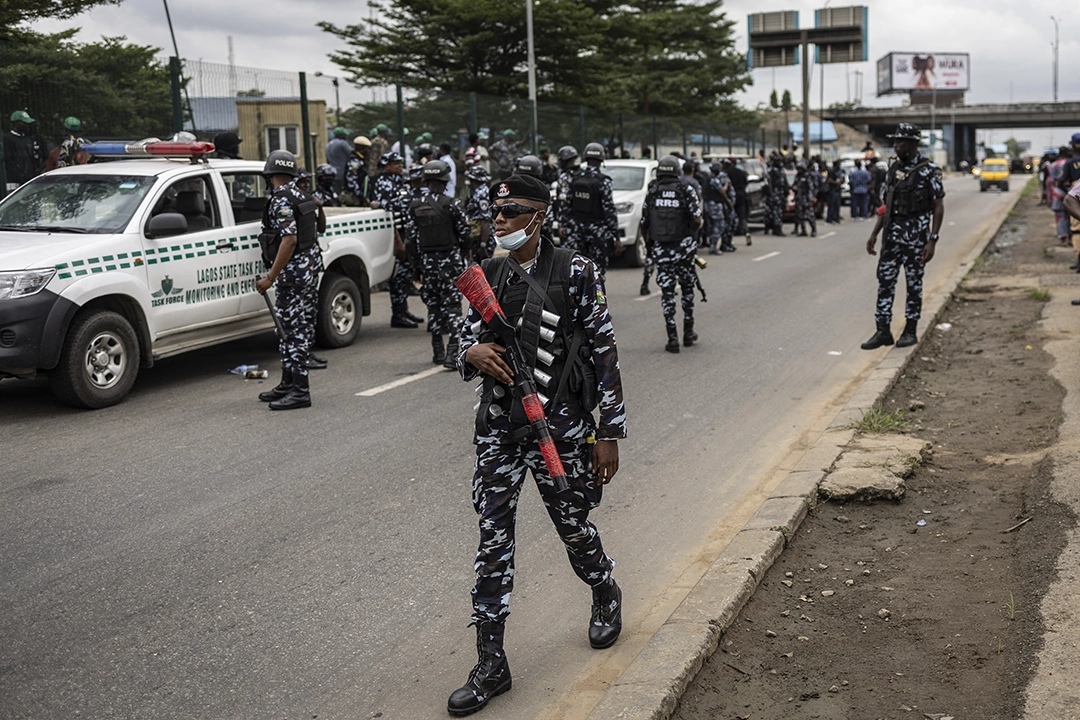
The Nigerian Senate on June 24 passed a bill that will decentralize state police forces if approved by at least 24 of the country’s 36 Houses of Assembly. The proposed constitutional amendment reportedly enjoys broad support amid evolving security challenges that test the capacity of the country’s security forces, particularly in rural areas.
The amendment would replace Nigeria’s central policing structure with a dual system involving a federal police service and independently administered state police services. Senate Leader Opeyemi Bamidele said the vote came after years of consultations, public hearings and stakeholder engagements across the country.
“The state police bill was subjected to intense debates at the Senate and House of Representatives,” Bamidele said in a report by Nigeria’s The Punch newspaper. “Even though the All Progressives Congress is the majority party, opposition legislators actively took part in the process that approved the state police initiative.”
Bamidele added that 84 out of 109 Senate members voted to approve the amendment.
The state police would be led by commissioners appointed by state governors. The bill includes safeguards prohibiting state police from targeting citizens who criticize government officials. It requires recruitment to reflect the diversity of individual states and allows for federal intervention when necessary.
Under the proposal, governors cannot appoint commissioners without a federal recommendation. Bamidele said in The Punch report that appointments would be subject to recommendations by the existing National Police Council and approval by two-thirds of the relevant state House of Assembly. The legislation would establish separate state police service commissions to regulate recruitment, training and discipline.
President Bola Ahmed Tinubu has long pushed for a decentralized state police force and said the initiative will be “guided by the rule of law and human rights principles” to prevent misuse, Nigeria’s tgnews.com reported. The federal government formed a committee to study the framework for state policing in 2024.
“I am reviewing all the aspects of security; I have to create state police,” Tinubu said in a September 2025 report by Nigeria’s Vanguard newspaper. “We are looking at that holistically. We will defeat insecurity. We must protect our children, our people, our livelihood, our places of worship, and our recreational spaces. They can’t intimidate us.”
Nigeria’s police force currently has about 400,000 officers for a population of 237 million citizens, a ratio of about one officer per 600 people. The United Nations’ recommended ratio is one officer per 400 people, The Punch reported.
Critics of the current system have argued that centrally controlled police forces struggle to respond quickly to local threats. Supporters of a decentralized force say it could improve response times, community-based policing and intelligence-gathering by deploying forces closer to the populations they serve.
Nigerian security forces have struggled to contain violence committed by the Boko Haram and Islamic State West Africa Province terror groups, which are known to target civilians and government forces. Kidnappings are also common. More than 80 children were kidnapped during a one-week wave of militant attacks in northeastern Borno State in May.
“In the light of recent mass kidnappings, the calls for a decentralized police have increased due to the sluggish nature of the government’s response to the events, which has been, in part, caused by the structural deficiencies of a centralized policing framework in Nigeria,” Ikemesit Effiong, a partner at SBM Intelligence, a Nigerian risk advisory firm, told The Associated Press.
Speakers of the Houses of Assembly were expected to begin deliberating the proposed constitutional change in early July, but there is no specific timeline for a vote. If the houses approve the amendment, it will be returned to the National Assembly before it can be approved by Tinubu.