

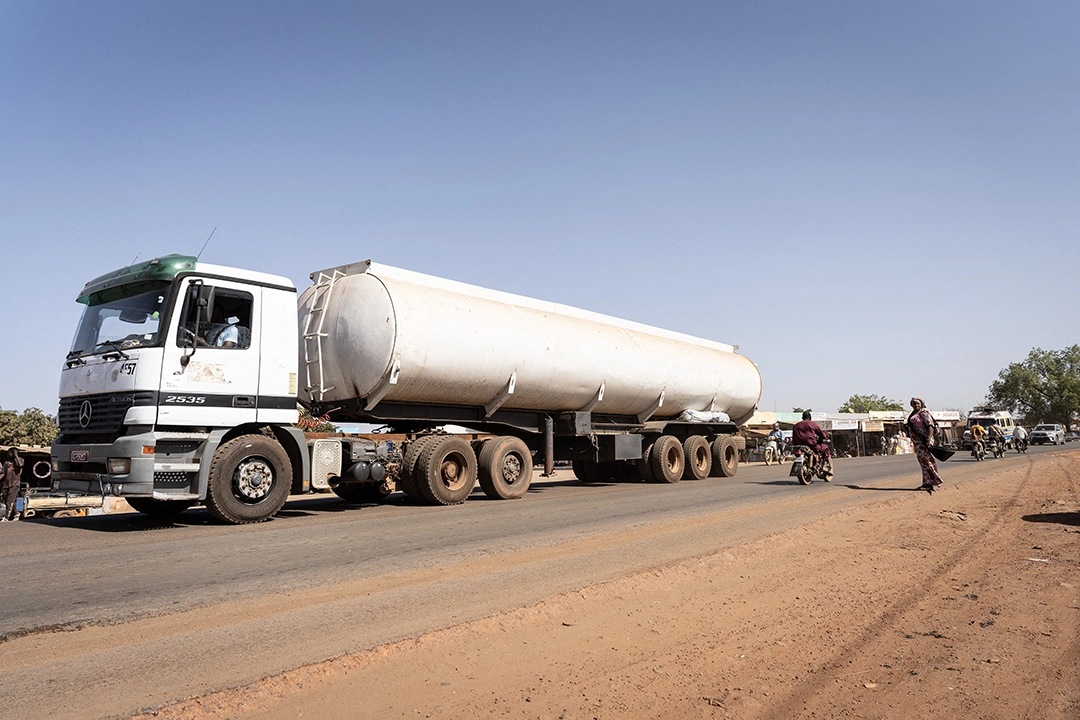
Mali’s Kayes-Bamako corridor from Senegal plays a central role in Jama’at Nusrat al-Islam wal-Muslimin’s ongoing blockade of truck traffic into Mali, which has economic implications for the entirety of West Africa, particularly those countries bordering Mali.
Since September 2025, terrorists have burned hundreds of trucks entering the country from Senegal as well as Côte d’Ivoire and Guinea. Experts describe the blockade as economic warfare designed to disrupt life in the capital and undermine faith in the junta that has ruled the country since overthrowing the democratically elected government in 2021.
So far, the blockade has sharply reduced the amount of fuel reaching the capital city of Bamako, resulting in long lines at fuel stations. It has strained the nation’s food supply and driven up prices for staple items.
“By intensifying offensives against fuel convoys in the south and west, JNIM is paralysing national commerce and trade. But this is extending beyond Malian borders, threatening regional economic activity,” researcher Felix Fodé Bongono wrote recently for the Institute for Security Studies.
The potential economic impact is large. Mali imported $1.67 billion in goods from Côte d’Ivoire and $1.3 billion from Senegal in 2024, according to the United Nations. Guinea did not release detailed export data in 2024. Mali accounted for more than 25% of the $1.42 billion in exports moving through Senegal’s Port of Dakar in 2024, according to the Observatory of Economic Complexity.
Mali imported more than $1.1 billion from Senegal during the first nine months of 2025. From September to November 2025, the Port of Dakar reported losing $2.6 million a month as the blockade took effect. The attacks have forced the Malian junta and mercenaries from Russia’s Africa Corps to focus on protecting trucks, reducing the number of soldiers and mercenaries available to fight JNIM, Islamic State Sahel, and the Tuareg-based Azawad Liberation Front (FLA) directly.
“Their priority is to preserve the regime,” analyst Wassim Nasr of the Soufan Center told ADF in an interview. “JNIM is way stronger. Islamic State is way stronger. The FLA took back the north. [Africa Corps’] job now is to open the road for fuel convoys.”
The Malian government recently reported its military escorted 940 supply trucks between Kayes and Bamako during the week of June 23 to 29. The caravan began with 540 trucks between Kayes and Sandare, then added 400 more that had been stranded near Diema by threatened attacks. The Malian government has taken similar steps to protect deliveries from Côte d’Ivoire’s Autonomous Port of Abidjan entering the country through the southern Sikasso region.
Based on the impact of JNIM’s Malian blockade, other transport routes connecting Sahelian nations to ports in Ghana, Togo and Benin could face similar risks, according to Bongono.
While JNIM and FLA have shown their ability to work together to attack Malian troops and Africa Corps fighters, Mali and its Sahelian neighbors have had less success working with their coastal neighbors since withdrawing from the Economic Community of West African States last year.
That must change, Bongono wrote.
“The regional implications of JNIM’s blockades highlight the need for joint protection of border trade corridors,” Bongono wrote. “Governments and regional institutions … need to prevent the expansion of JNIM tactics to other road corridors.”