

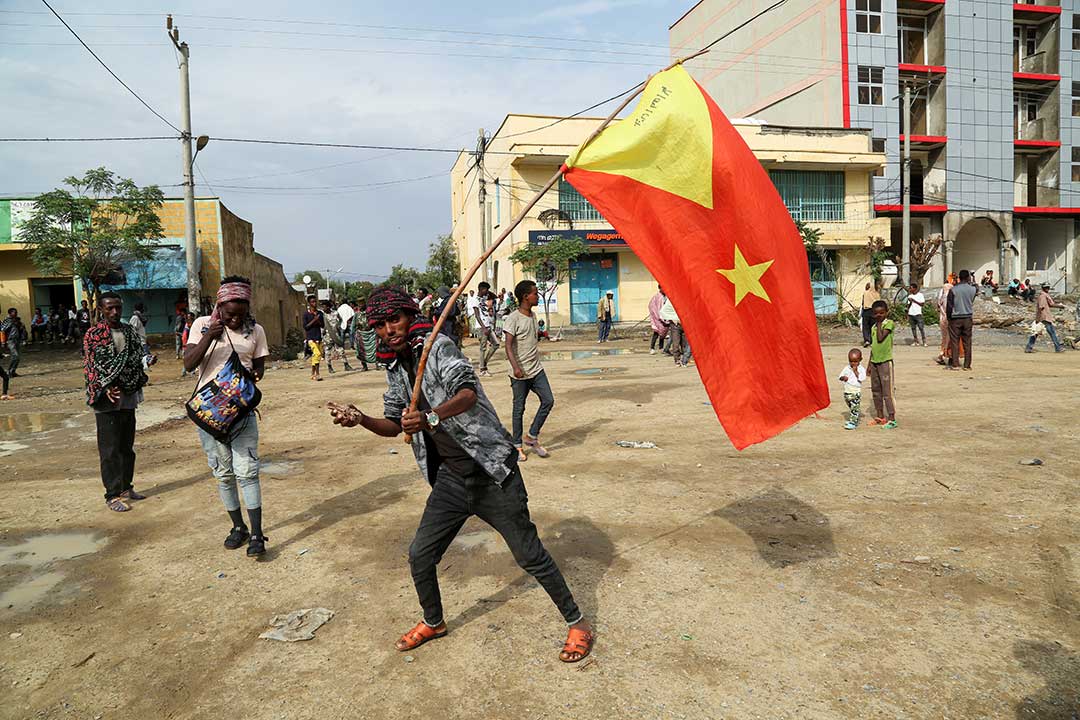
In a provocative move, the Tigray People’s Liberation Front (TPLF) announced it was taking back control of the regional government in northern Ethiopia.
The announcement by the region’s powerful political party and armed group came just weeks before a national election on June 2 in which Prime Minister Abiy Ahmed and his ruling Prosperity Party were expected to maintain control of the federal government. It provoked fears of a return to war, with each side accusing the other of violating the terms of a peace deal.
“The decision by TPLF … is clearly a major escalation,” Kjetil Tronvoll, a professor of peace and conflict studies at Oslo New University College and a scholar of the TPLF, told Reuters. “If mitigating efforts and a process of de-escalation are not introduced quickly, this may trigger the outbreak of new armed conflict.”
The Tigray region was the site of a devastating civil war between 2020 and 2022 that killed an estimated 600,000 people and displaced 2 to 3 million. The two warring sides signed the Pretoria Agreement to end hostilities in November 2022, and Tigray has since been administered by an interim group of officials. The TPLF’s wartime leadership was left out of power.
That changed in late April when the TPLF said it had reinstated the Tigray Government Assembly and, the next month, TPLF leader Debretsion Gebremichael was returned to his role as regional president along with other top officials from the wartime government.
The move was a direct affront to Abiy, who had extended the appointment of the interim leader of Tigray by one year.
“To me this shows that symbolically and actually we are drifting away from the peace agreement,” Desta Gebremedhin, who studies peace and conflict at Mekelle University, told AfricaNews.
Observers say that after consolidating power, the TPLF’s first move might be to try to forcibly take control of western Tigray, a disputed territory that was a flashpoint for violence during the civil war. Jalale Getachew Birru, a senior analyst for the Armed Conflict Location and Event Data project (ACLED), warned that this would be a “red line” for the federal government and would “almost certainly trigger a full-blown battle, dragging the region into another round of war.”
ACLED reported that the TPLF has aligned itself with Eritrea, which is seeking to weaken Ethiopia’s government due to long-standing animosity and a fear that Ethiopia wants to invade and capture Eritrea’s port city of Assab. The TPLF also could receive support from ethnic Amhara militias known as the Fano, which are fighting their own guerrilla war against the central government.
In a display of the regional scope of the conflict, analysts believe the TPLF also could get help from Sudan, which has accused Ethiopia’s government of providing a rear base to the paramilitary Rapid Support Forces (RSF) waging war inside its borders. After accusations that Ethiopia launched drone attacks in support of the RSF in May, the Sudanese Armed Forces moved troops and weapons to Gedaref State, which borders Ethiopia’s western Tigray and Amhara regions.
“The tactical adoption of the ‘enemy of my enemy is my friend’ paradigm has forged an unprecedented alignment,” Jalale wrote of the complex web of alliances forming.
Jalale cautioned that an armed assault by the TPLF on western Tigray could be the start of something larger and draw in a host of foreign and domestic players.
“The localized dispute over western Tigray has transformed into the primary trigger for a much wider, systemic conflict capable of reshaping the geopolitical architecture of the entire Horn of Africa by shifting alliances,” Jalale wrote.