

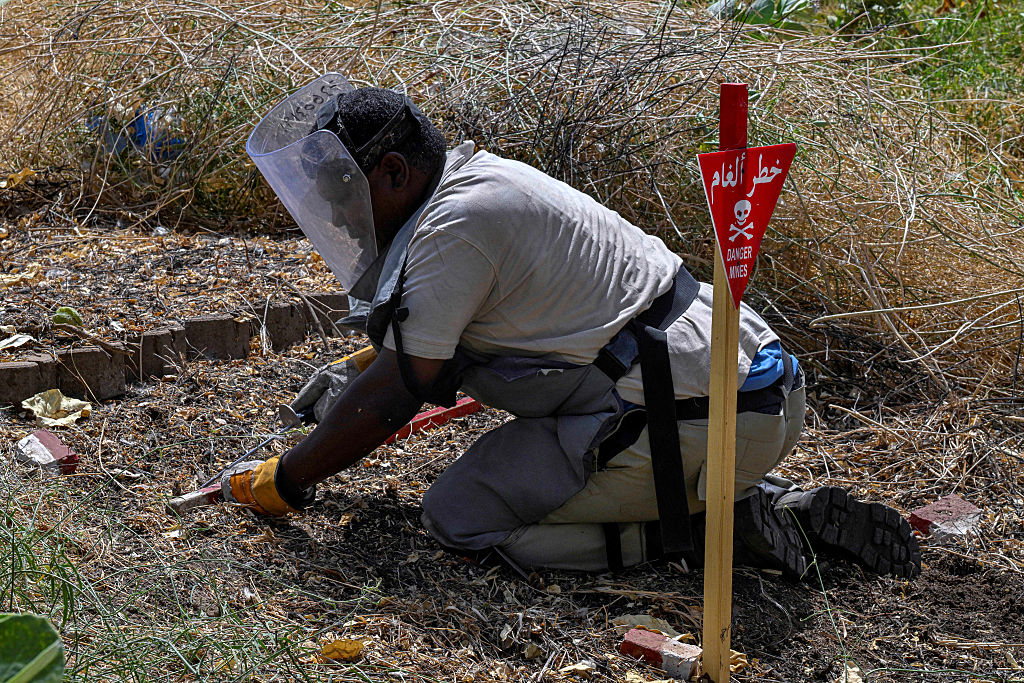
The red triangular signs point downward and warn civilians to stay away with a skull and crossbones above the words DANGER MINES. They are a familiar sight in Khartoum, the shattered capital of war-torn Sudan.
As one of the biggest early battlefields in a civil war that broke out more than three years ago, Khartoum was ravaged and occupied by the Rapid Support Forces (RSF) militia before the Sudanese Armed Forces (SAF) retook the city in March 2025.
Since then, more than 1.8 million of the 9 million residents of the greater Khartoum metropolitan area have returned to face the long and arduous task of rebuilding.
“As families begin to return, they are doing so into a highly dangerous environment, often without awareness of the risks,” said Mohamed Sediq Rashid, chief of the United Nations mine action program in Sudan, during a March 18 news conference.
Khartoum is littered with the deadly remnants of the war: hidden improvised explosive devices and unexploded ordinance (UXO) such as land mines, rockets and artillery shells. At the center of the metropolis, Al-Mugran Park sits on the tip of a small peninsula that juts out where the Blue Nile and White Nile rivers meet. It used to be a haven for families, with cafes, a small stage for music and amusement park rides surrounded by green spaces.
Today, it is the site of a major effort to clear UXO by the Sudanese government’s National Mine Action Center.
In July 2025, two SAF Soldiers accidentally set off a mine, leading authorities to discover an active minefield that stretched across 4.5 square kilometers. Deminers from Sudanese organization JASMAR and the Danish Refugee Council have spent nine months removing more than 12,000 pieces of explosive ordnance from Al-Mugran Park.
Noting the strategic significance of the site, JASMAR field supervisor Jumaa Ibrahim Abu Anja said that the RSF planted mines to prevent incoming troops from fanning out after they crossed the White Nile Bridge from Omdurman.
“We have found more than 300 hazardous items, including mines fitted with smaller charges and highly explosive materials, designed to inflict the highest possible number of casualties upon detonation,” he told Asharq Al-Awsat newspaper for an April 25 article.
Sudanese officials say they have cleared tens of thousands of explosives across the capital, but they have only inspected a fraction of the city, where six other minefields have been found and where vast swaths of the city lie empty and unsafe.
Demining is a meticulous process, so progress comes slowly. One team clears about 10 to 15 square meters a day. It will take years to clear Khartoum, Abu Anja said. About 80% of Al-Mugran Park has been cleared, and his team is on track to finish in May. But delays increase the danger to civilians, dozens of whom have been killed or injured by UXO in greater Khartoum.
Along with fieldwork, the National Mine Action Center runs awareness campaigns, speaking at mosques, in markets, on radio programs and podcasts, and sending text messages urging residents to avoid suspicious items and to report them. They also warn against burning waste due to the widespread risk of hidden UXO.
Back at the Al-Mugran site, deminer Hussein Idris put his metal detector aside and lifted the clear plastic visor that protects his face. At age 60, he has cleared mines for nearly two decades.
“It’s hard work, but thankfully we’re still alive,” he told Agence France-Presse, “and the park can come back even better than before.”