

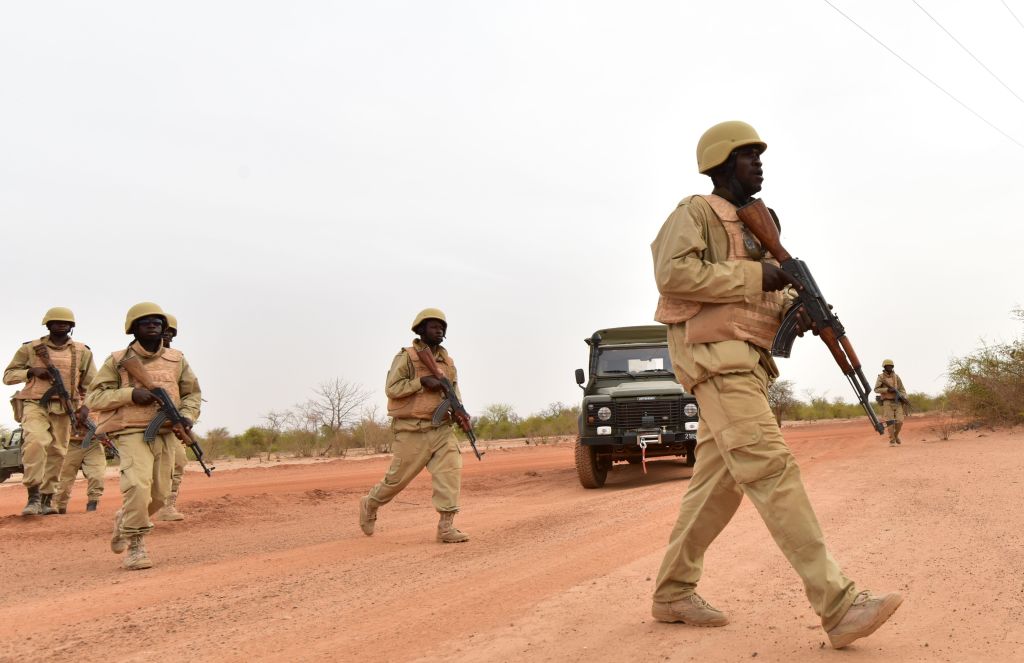
Burkina Faso’s military and pro-government forces are accused of killing hundreds of civilians between January 2023 and August 2025, according to a recent report by Human Rights Watch (HRW).
Of the 1,837 civilians killed in Burkina Faso during that time, more than 1,200 were slain by the Burkinabe military and allied militias known as the Volunteers for the Defense of the Homeland (VDPs). Both Burkina Faso’s military junta, led by Capt. Ibrahim Traoré, and the VDPs are accused of ethnic cleansing in Fulani communities.
One of the deadliest attacks on civilians came on December 14, 2023, when more than 200 Burkinabe soldiers and VDPs entered the town of Bouro on motorbikes, in pickups and armored vehicles around 9 a.m. and massacred at least 211 civilians. Witnesses said the military and VDPs accused them of collaborating with Islamist fighters.
One man lost 19 relatives in the attack.
“I found my family and my neighbor’s family massacred,” Samer, a pseudonym, told HRW. “My wives [and] my children were dead…. The only survivor [from my family] was my 11-year-old son…. I found the bodies lying on the ground, bullets in their heads, chests, stomachs. My little one was wounded in the left leg…. I took him out of a pile of corpses. I found five other injured children from my neighbor’s family.”
Samer tended the children’s wounds with torn clothing before fleeing with them to Mali.
Burkina Faso’s military and the VDPs are using indiscriminate violence in a way that mimics terror groups such as the al-Qaida-affiliated Jama’at Nusrat al-Islam wal-Muslimin (JNIM), Ilaria Allegrozzi, senior Sahel researcher at HRW, told Reuters. Allegrozzi added that the behavior of Burkina Faso’s security forces is part of a regional pattern.
Neighboring Mali and Niger are also under military rule, and the militaries of both countries have been accused of committing atrocities against civilians. Malian government forces and their partners killed up to four times as many civilians as terrorists over the last two years, according to the Armed Conflict Location and Event Date (ACLED) project. Russian mercenaries operating alongside Malian troops are also accused of committing atrocities against civilians. The heavy-handed tactics are having the opposite of the intended effect as they drive civilians into the arms of terror groups.
“As state responses increasingly rely on retaliation and collective punishment, more civilians find themselves trapped in areas under jihadist control, where JNIM is consolidating its influence through coercion and strategic engagement with local populations,” said Heni Nsaibia, ACLED’s senior analyst for West Africa.
Between March 10 and March 11, 2025, the Bukinabe military and pro-government fighters massacred more than 130 ethnic Fulani civilians during an attack in the western town of Solenzo. It was part of a Bukinabe special forces operation called “Green Whirlwind 2,” which resulted in widespread civilian deaths and displacement.
“The viral videos of the atrocities by pro-government militias near Solenzo sent shock waves through Africa’s Sahel region, but they told only part of the story,” Allegrozzi said on HRW’s website. “Further research uncovered that Burkina Faso’s military was responsible for these mass killings of Fulani civilians, which were followed by deadly reprisals by an Islamist armed group. The government needs to impartially investigate these deaths and prosecute all those responsible.”
Traoré vowed to tackle terrorism when he seized power in September 2022, but JNIM offers a particularly violent, unrelenting challenge. In September 2024, for example, the group claimed responsibility for attacking hundreds of civilians ordered by the government to dig a defensive trench around the town of Barsalogho, which was a VDP stronghold. JNIM claimed it killed 300 members of the Burkinabè military and militia members during that attack and did not apologize for slaughtering civilians forced to dig the trench.
“This would not be an excuse to spare them,” JNIM’s Sharia Committee in Burkina Faso said in a statement to HRW. “Anyone who … follows this regime … deserves to be held accountable.”
Amid the violence, Traoré’s government is cracking down on civil society through repressive laws and by dissolving civic groups, HRW, the Kisal Observatory and a consortium of other organizations reported on April 26. Eleven days earlier, the government announced the dissolution of 118 civil society organizations, many engaged in human rights work.
“The mass dissolution of civil society groups is the Burkina Faso junta’s latest effort to silence dissent and avoid scrutiny of its grim human rights record,” Binta Sidibé Gascon, president of the Kisal Observatory, a human rights monitoring organization, said in a story on HRW’s website. “The decision reinforces a climate of fear that is crippling independent civic activity.”
The government has also expelled or banned dozens of media outlets and international organizations, conscripted critics, detained human rights workers, enforced arbitrary arrests and committed forced disappearances.