

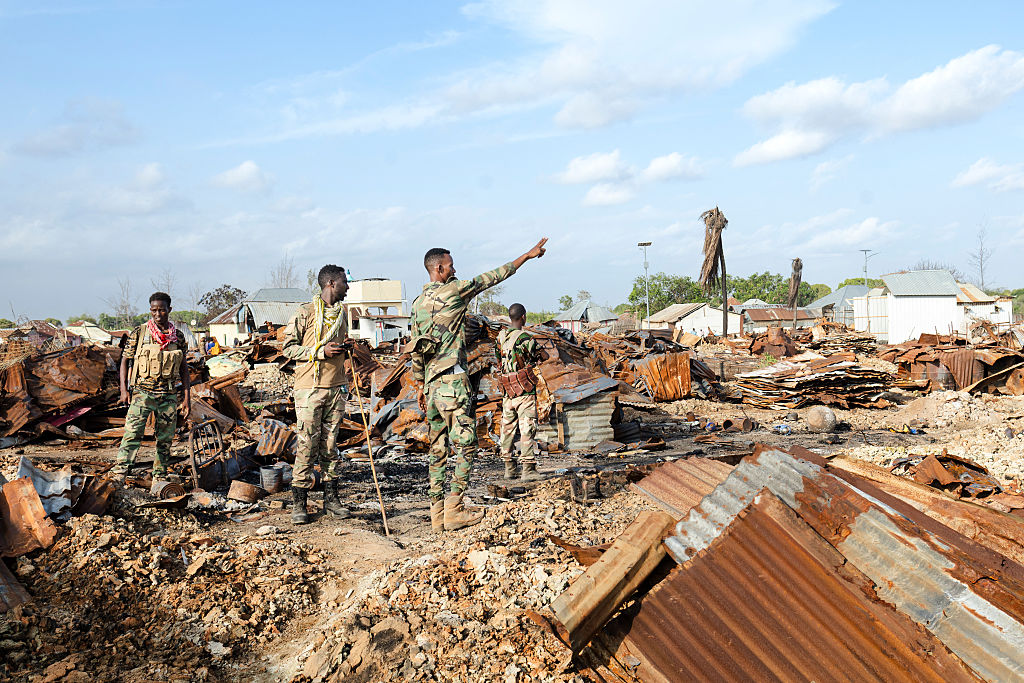
A security specialist says that the terrorist group al-Shabaab and other extremist organizations are learning to move faster as they refine their efforts to target communities and security forces.
Security expert Ibrahim Yanaya told intelligence chiefs from 70 countries at an April 2026 meeting in Kenya that militant groups linked to terrorist movements are changing how they operate, with new pressure points that could affect countries across the region, including Kenya.
Yanaya, a deputy project director with the International Crisis Group, said the shift matters because extremist networks have continued to find ways to move faster than security forces, keeping defenders busy and reactive, The Star newspaper of Kenya reported.
“In many cases, these groups decide when, where, and how to attack,” Yanaya said, adding that opposing security forces have to keep traveling and responding, sometimes after an incident already has begun.
His warning came as al-Shabaab continues to expand its influence beyond Somalia. Al-Shabaab is now al-Qaida’s largest, wealthiest and deadliest affiliate, generating more than $150 million in annual revenue in Somalia alone and governing a quarter of the country’s district capitals through a functioning shadow state.
The special operations forces news site SOF News said that seemingly isolated attacks over the years are evidence of an “expanding geographic reach.” Those incidents include the 2013 Westgate Mall siege in Kenya, the 2014 suicide bombing in Djibouti that targeted Western military personnel, the 2015 Garissa University massacre in Kenya, the 2020 Manda Bay attack against U.S. and Kenyan forces, and a 2022 cross-border incursion that left up to 1,000 fighters embedded in southern Ethiopia.
Yanaya said the current terrorist threat is not just about isolated attacks. He said militant groups are making changes that can alter the conflict picture, including how they pressure countries and communities. Terrorist groups are increasingly focusing on urban and trading areas. Part of that approach, he said, is to impose blockades that strangle communities and interfere with citizens’ everyday lives. He said that the terrorist groups also are becoming more political, trying to establish alliances, The Star reported.
The new tactics are not limited to al-Shabaab. In Mali, the extremist organization Jama’at Nusrat al-Islam wal-Muslimin has been choking off the country’s fuel supplies since late 2025, leaving the government in Bamako vulnerable to being overrun. The blockade is part of the group’s evolving strategy of economic warfare, to “demonstrate to the Malian population that the current government is incapable of providing for its citizens or protecting them,” the Soufan Center has reported. The center focuses on global security, including terrorism.
“There are increasing concerns that if Mali falls, there could be a domino effect with other governments in the region, including in Burkina Faso and/or Niger, and worries that momentum will propel the jihadists throughout coastal West Africa,” the center said.
In Somaliland, al-Shabaab has been quietly infiltrating the population for years, laying the groundwork for a rebellion, according to the news website Pan African Visions. Now, this quiet infiltration “is no longer a matter of speculation,” the website reports.
“In a recently circulated propaganda video, the notorious Al-Shabaab Jihadist commander Abdi Madoobe was shown presiding over the graduation of several hundred militiamen under his command,” Pan African Visions reported in late April 2026. “The imagery of a Jihadist group leader openly drilling forces within striking distance of a major city represents a direct and unprecedented erosion of Somaliland’s long-standing security shield.”
Researchers say that al-Shabaab’s intelligence wing, the Amniyat, has been exploiting clan rivalries for years, weaponizing local grievances. “By embedding themselves as political and economic tools within clan dynamics, jihadist operatives corrode trust from the inside,” the website reported.
There have been regular reports in 2026 of high-level al-Shabaab activity in Somalia and elsewhere. In late April 2026, the African Union Support and Stabilization Mission in Somalia (AUSSOM) and the Somali Armed Forces captured a senior al-Shabaab commander during a joint operation in the southern region of the country. The mission said the suspect, identified as Salaad Cusmaan Macalin, was captured while scouting defensive positions in preparation for an attack.
“Initial interrogation findings indicate that one of his associates, identified as Ismaaciil, a Kenyan national, had volunteered for a suicide mission as part of a planned attack,” AUSSOM said, as reported by Horn of Africa news website Hiiraan Online.
Salaad was accompanied by a group of fighters, including 17 foreign militants deployed from al-Shabaab’s command center in Jilib, AUSSOM said. They urged local leaders and communities to actively support security forces in countering terrorist threats and strengthening stability across Somalia, Hiiraan reported.
“To Al-Shabaab, conflict is not just ideology; it is a business model,” Pan African Visions reported. “The organization operates like a deeply corrupt corporation, enmeshed in political and economic ecosystems to fund itself and enrich its elite.”
Researchers say that the changing nature of terrorists’ tactics makes major urban areas vulnerable. For Kenya and other countries, Yanaya said, the concern is how these new tactics could play out along key corridors and in towns where security forces must balance multiple responsibilities.
He said the most serious scenario would be militants finding ways to target cities as key points of leverage. Regional governments cannot handle the threat alone, he said. According to The Star, he said “cooperation is needed through mechanisms like the African Union, along with continued intelligence sharing and coordination with neighbors and international partners.”