

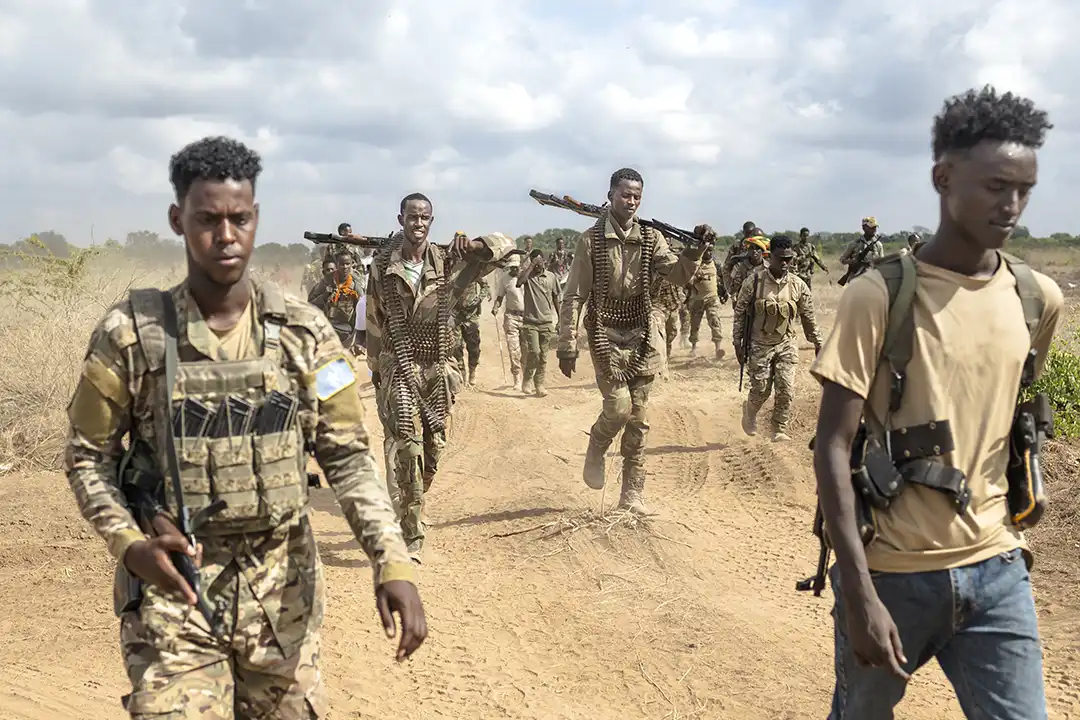
Somalia faces a convergence of crises, including the departure of international forces, persistent terror threats from al-Shabaab, political division and regional tension, that leave it on the precipice of chaos.
On August 8, Ethiopian forces serving under the African Union Support and Stabilization Mission in Somalia (AUSSOM) handed over a military base to the Somali National Army in the southern town of Burhakaba. Ethiopian troops had maintained a presence at the base since 2014. Now Somali troops must address security concerns posed by al-Shabaab and other armed groups on its own.
Analysts question whether Somalia has the capacity to do so, especially amid diminishing international support.
“The issue is not whether Ethiopian forces should remain indefinitely. Nor is it whether Somali sovereignty is negotiable,” analyst Abdi Guled wrote for the Horn Briefs newsletter. “The issue is whether the state taking responsibility for a position possesses the logistics, intelligence, reinforcement capacity and political legitimacy to keep it.”
The handover in Burhakaba occurred amid ongoing political friction between Ethiopia and Somalia over sovereignty issues related to the breakaway region of Somaliland. It also happened as the United Nations Support Office in Somalia (UNSOS) faces severe funding cuts, including at least $500 million in international support that will be cut off by December 31, 2026.
UNSOS supports approximately 12,000 AUSSOM personnel and as many as 20,900 Somali security personnel. It funds food, water, fuel, transportation, medical evacuation, communications, engineering, maintenance and other critical battlefield services. In August, the agency said it moved about 240 tons of food each month to sectors and forward operating bases around the country.
Observers wonder how such deliveries will be made come January.
“A soldier at a remote base does not experience an international funding mechanism as a diplomatic abstraction. He experiences it as fuel arriving, or not arriving,” Guled wrote. “As food supplies being delivered. As a helicopter available for medical evacuation. As a vehicle that still works. As ammunition reaching a position before an attack rather than afterward. For much of the post-2006 period, those functions have been heavily supported by the international system.”
Mohamed Daud Ismail, a senior research assistant at the Armed Conflict Location and Event Data (ACLED) project, believes this shortfall will leave the approximately 12,000-strong AUSSOM force “operationally unsustainable.”
“Without immediate alternative international funding, AUSSOM faces imminent operational collapse heading into 2027,” Ismail wrote. “Because the Somali National Army (SNA) remains overstretched and structurally unequipped to manage complex country-wide logistics independently, an abrupt degradation of African Union positions will trigger an immediate, destabilizing security vacuum across central and southern Somalia.”
Ismail predicted that al-Shabaab will try to exploit security gaps with a major offensive throughout the final months of 2026 and into 2027.
“This push could allow the group to reclaim territorial footholds in the central and southern regions while directly threatening major urban hubs, including Mogadishu and Kismayo,” Ismail wrote.
As Somali troops lose direct battlefield assistance, the country also lost assistance from the United Nations Transitional Assistance Mission in Somalia (UNTMIS) at the end of October. As that date approached, Hassan Moallim Mohamud, Somalia’s minister of justice and constitutional affairs, thanked UNTMIS delegates for supporting justice sector institutions, particularly in capacity-building, legal and policy development, and corrections reform.
As with battlefield concerns, analysts question whether Somalia can maintain any momentum UNTMIS helped establish.
The end of UNTMIS “raises the central question that has accompanied every phase of the UN’s engagement in Somalia: can national institutions sustain and build on the gains achieved with international support?” wrote researchers with FTL Somalia, a policy and research institute.
Mohamud’s justice and constitutional affairs office will now handle UNTMIS-related work on its own.
“The handover to the Ministry of Justice and Constitutional Affairs, with continued backing from UNDP [United Nations Development Program] and UNODC [United Nations Office on Drugs and Crime], suggests a phased approach that recognises national capacity remains a work in progress,” FTL Somalia researchers wrote.
The funding cuts, troop drawdowns and the end of UNTMIS coincide with armed resistance from state governments upset over Mogadishu’s influence over state elections. Some states have rejected constitutional changes they say leave power with the federal government.
“Somalia does not necessarily face an imminent collapse,” Guled wrote. “It faces something more difficult to measure and potentially more consequential: the gradual erosion of the infrastructure that has made the country’s security system viable. And that erosion is occurring at the same time that the country’s political order is becoming less cohesive.”