

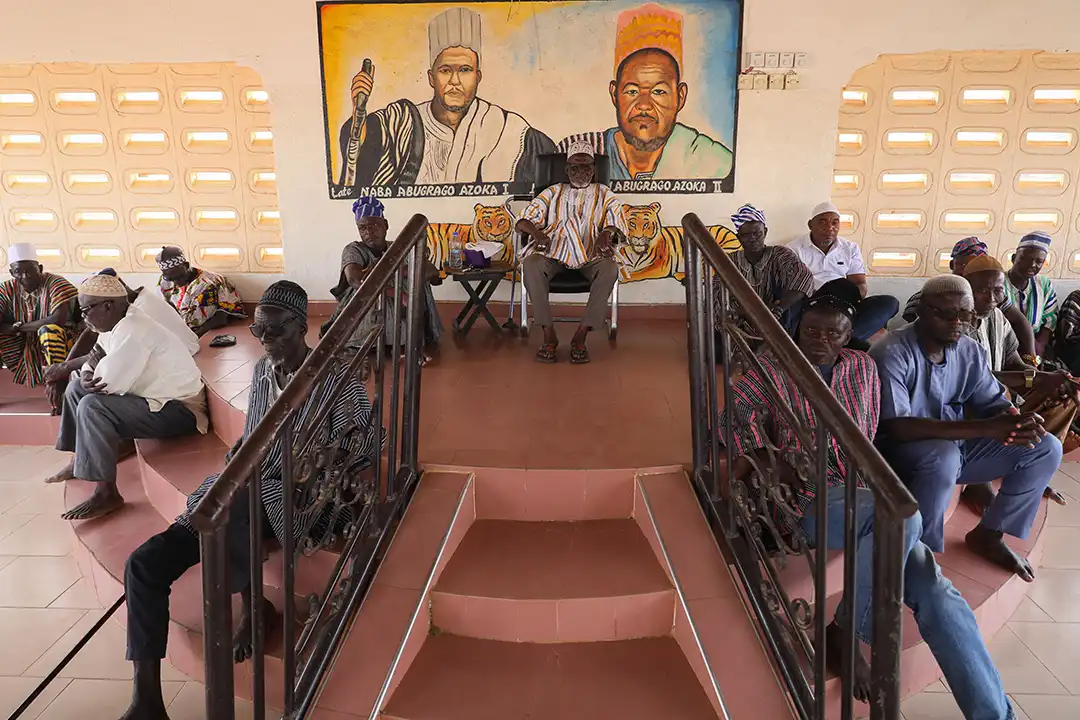
In mid-October, leaders in Ghana’s northern Bawku community celebrated a milestone: 150 days without gun violence in a region beset by a long-running ethnic conflict.
Experts say that Bawku’s five months of calm between the Kusasi and Mamprusi ethnic groups are the result of intensive mediations by the National Peace Council, an increased security presence and the promise of investments by the national government.
Kusasi and Mamprusi groups have been at odds for decades over which group holds the chieftaincy of Bawku. In 2021, their conflict erupted into violence that has continued sporadically. Ghanaian authorities deployed Soldiers to the region in July 2025 after gunmen killed three students near a school.
Bawku sits in northeastern Ghana near the borders with Burkina Faso and Togo. For centuries, the town’s open-air market has been a crossroads for communities across the Sahel and forests of West Africa.
Bawku’s population is mostly Muslim, tying the community’s 80,000 residents more closely to their neighbors in the Sahel and creating a divide with the rest of Ghana, which is more than 70% Christian.
Ghana’s leaders see calm in Bawku as an important hedge against the potential spread of Jama’at Nusrat al-Islam wal-Muslimin (JNIM) and violent groups from Burkina Faso, Mali and Niger.
JNIM has a history of exploiting ethnic conflicts and anti-government sentiment to gain a foothold in communities across the Sahel and, more recently, along the border regions that Burkina Faso and Niger share with Ghana and other coastal nations to the south.
Those border regions tend to fall short when it comes to government investment, leading to resentment among residents. To counter that, Ghana recently announced plans to invest heavily in public infrastructure through the three-year, $85.7 million ($1 billion cedi) Bawku Revitalization Fund.
Between 2026 and 2028, the fund will pay for roads, healthcare, education, dam and irrigation facilities for all-year-round agriculture, security installations and economic and commercial facilities, according to a government statement.
“Insecurity over the years has severely constrained public and private investment and stalled critical infrastructure development,” Felix Kwakye Ofosu, Ghana’s minister of government communications, said in a statement announcing the fund.
The goal, Ofosu added, is “to restore Bawku to its historic position as a significant economic and trading hub in Northern Ghana.”
Ghanaian Ministry of the Interior Mubarak Mohammed Muntaka recently told Ghana’s Joy FM radio that, thanks to improving security conditions in Bawku, the government has loosened a nighttime curfew in the region and lifted a five-year-old ban on traveling by motorcycle.
George Amoh, executive secretary of the National Peace Council, believes the current calm could be a sign that the conflict between the two groups is burning out.
“At a point in conflict, people or actors in the conflict become fed up,” Amoh told The African Report.
However, security analyst Col. Festus Aboagye cautions that the region’s porous borders, illicit weapons markets, cross-border kinship networks and organized crime could give JNIM and other armed groups an opening to stir up trouble should Bawku’s internal conflict remain unresolved.
“The calm is real, but it is not yet the same as peace,” Aboagye told The African Report.