
Ghana has been a beacon of peace and stability along the West African coast for years, but its security landscape has evolved to encompass a diverse range of threats.
Expanding Sahel-based terrorist groups intent on reaching the coast threaten the nation’s north. On the eastern border with Togo, a secessionist movement has stirred anti-government sentiment. At sea, piracy poses an aggressive and unconventional maritime threat that calls for a specialized response.
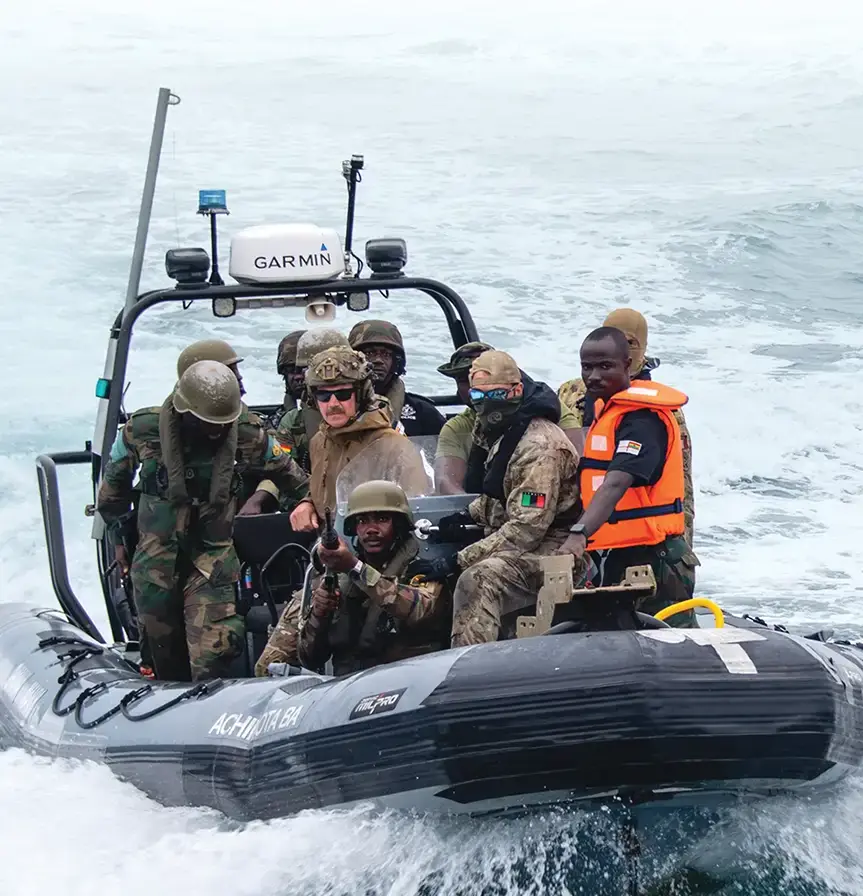
The Ghana Navy’s Special Boat Squadron is addressing all of these threats and more. As the specter of piracy loomed in the Gulf of Guinea from about 2009 to 2015, officials realized that conventional forces would not suffice, said Cmdr. Seth Dzakpasu, squadron leader.
“At the time, the Ghana Navy was very familiar with conventional threats at sea,” Dzakpasu told ADF. “And piracy was not one of those conventional threats.”
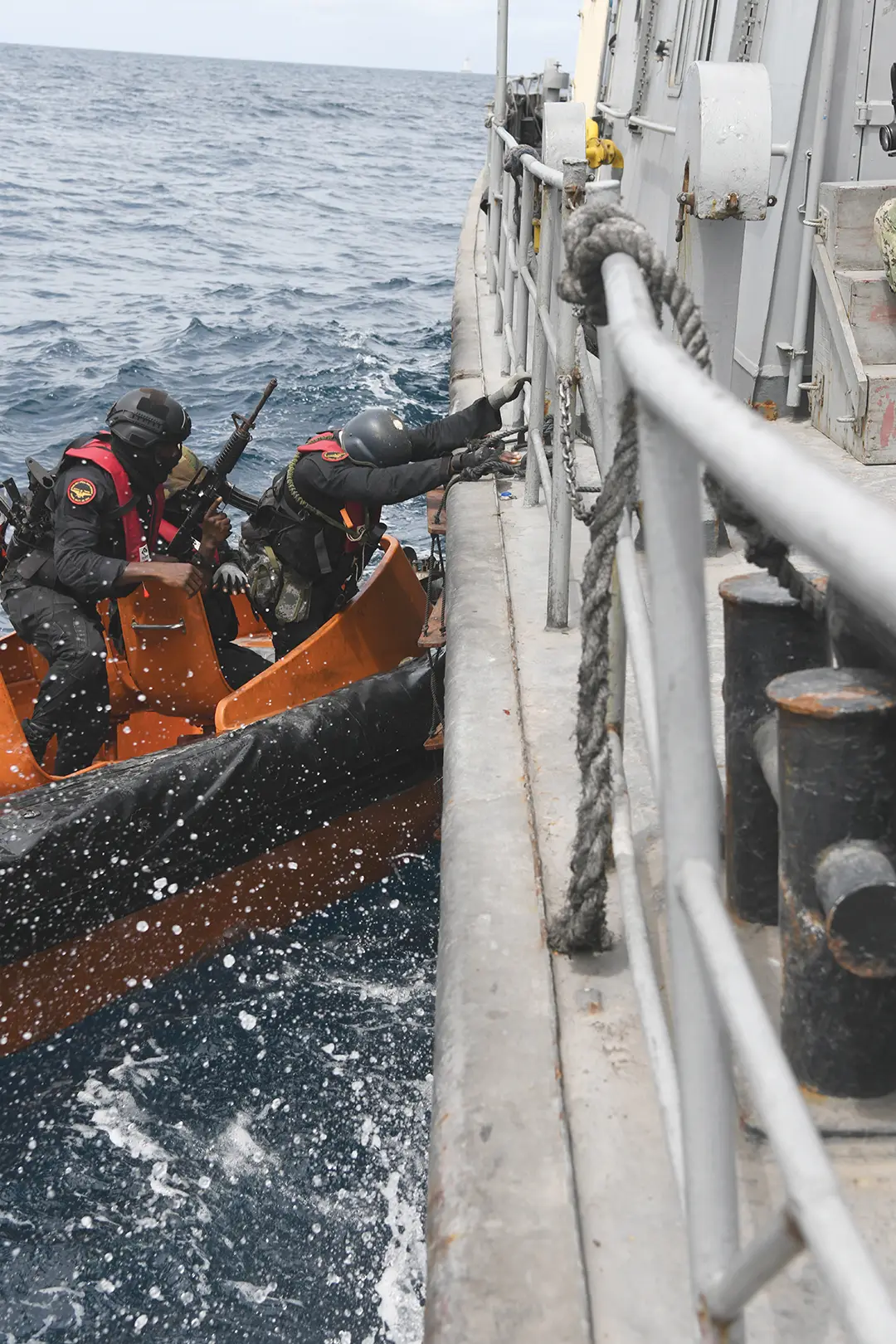
That’s when Ghana joined the ranks of African navies with elite special forces squadrons, such as Kenya and Nigeria. These small, highly trained units conduct opposed boarding and vessel searches, countertrafficking operations at sea and on lakes and rivers, and disaster response, among other things.
NEW THREATS, NEW RESPONSES
Several navies have demonstrated a capacity to address maritime threats in some of the most challenging waters on the planet. Nigeria’s Navy is recognized as one of the continent’s strongest in the 2026 Global Firepower report. It ranks 22nd globally. The ranking is based largely on its 152 total assets, which consist mainly of offshore patrol vessels.
However, its Special Boat Service (SBS) offers a more nimble tool. It addresses an ever-evolving threat matrix that includes traffickers on the high seas and terrorists who navigate Lake Chad and other inland waterways.
Retired Rear Adm. Dolapo Kolawole, former director of operations at Nigeria’s Naval Headquarters and former commander of the SBS, told Arise News in February 2026 that the service helps the Navy address asymmetric threats and complex counterterrorism missions. Formed in 2006, it can perform “surgical strikes” and destroy terrorist camps.
“It is modeled after the United States Navy SEALs,” Kolawole said. “Their personnel and sailors are trained for asymmetric warfare ashore and afloat, land and sea. They can function in both environments.”
For example, Nigeria’s SBS joined Army and civilian forces in a four-day June 2021 clearance and recovery operation in Baga, a strategic town in Borno State on the shores of Lake Chad.
One of the service’s biggest successes came in May 2020. As the Chinese-flagged Hailufeng 11 trawled in Ivoirian waters, 10 pirates stormed the ship, accosted its 18 crewmembers and turned off the automatic identification system. Even so, maritime authorities along the west coast of Africa tracked the vessel until it sailed into Nigerian waters two days later, on May 16, where a Navy patrol boat waited.
The NNS Nguru pulled alongside the hijacked boat about 140 nautical miles south of Lagos. SBS commandos boarded it while underway at 9 knots after pirates refused orders to stop. No Sailors or crewmembers were injured. The pirates were taken ashore and prosecuted.
Across the continent, members of the Kenya Navy’s Special Boat Unit (SBU) serving in the African Union Support and Stabilization Mission in Somalia responded to a distress call when the dhow MSV Fazlerabbi caught fire off the Kismayo coast on October 29, 2025.
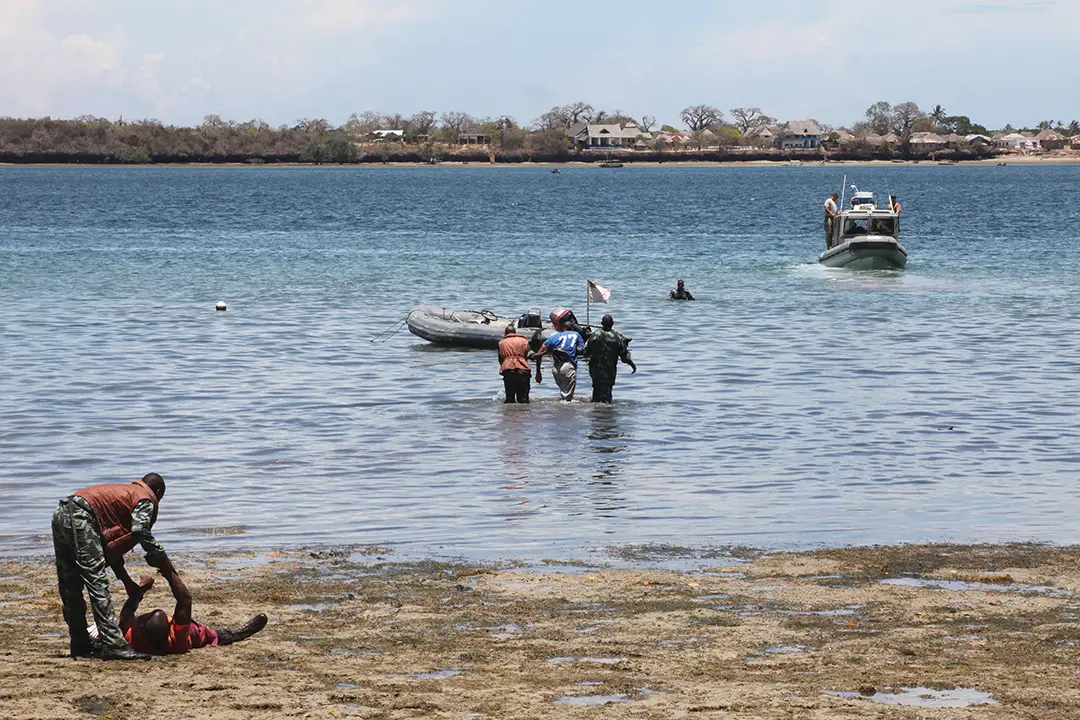
The vessel, on its way to Dubai, United Arab Emirates, was ablaze about 5 nautical miles northeast of the port, according to the Kenya Defence Forces. SBU personnel, working with local boats, rescued all 16 crewmembers.
Less than a month later, 15 Marine SBU commandos were part of a multiagency force that intercepted a ship about 340 nautical miles off the cost of Mombasa, Kenya. The Marines launched in small boats from Navy patrol ship KNS Shupavu and boarded and seized the flagless motor vessel Mashallah.
The outlaw boat, which had been under watch by international drug enforcement agencies, was escorted to port. Once there, authorities unloaded 769 packets of methamphetamine weighing 1,024 kilograms and valued at $63 million. The effort was dubbed Operation Bahari Safi, which means “clean seas” in Swahili. It was the second-largest narcotics seizure in Kenya’s history.
These small, specialized teams allow militaries to deploy forces that can adapt to their nation’s unique threats. Despite being components of naval forces, their purview is not limited to maritime threats. Ghana’s squadron, for example, has been used to address a number of land-related incidents. One is the illegal, small-scale mining known domestically as “galamsey,” which is taken from a slang term that means “gather and sell.” The practice strips revenue and damages the environment.
Formerly known as the Gold Coast, Ghana still produces the most gold of any nation on the continent, according to a November 2024 Wilson Center report. Galamsey costs the country more than $2.3 billion yearly in lost revenue. Legal mining is heavily regulated, but illegal small-scale miners often use cyanide and mercury, which pollute freshwater sources.
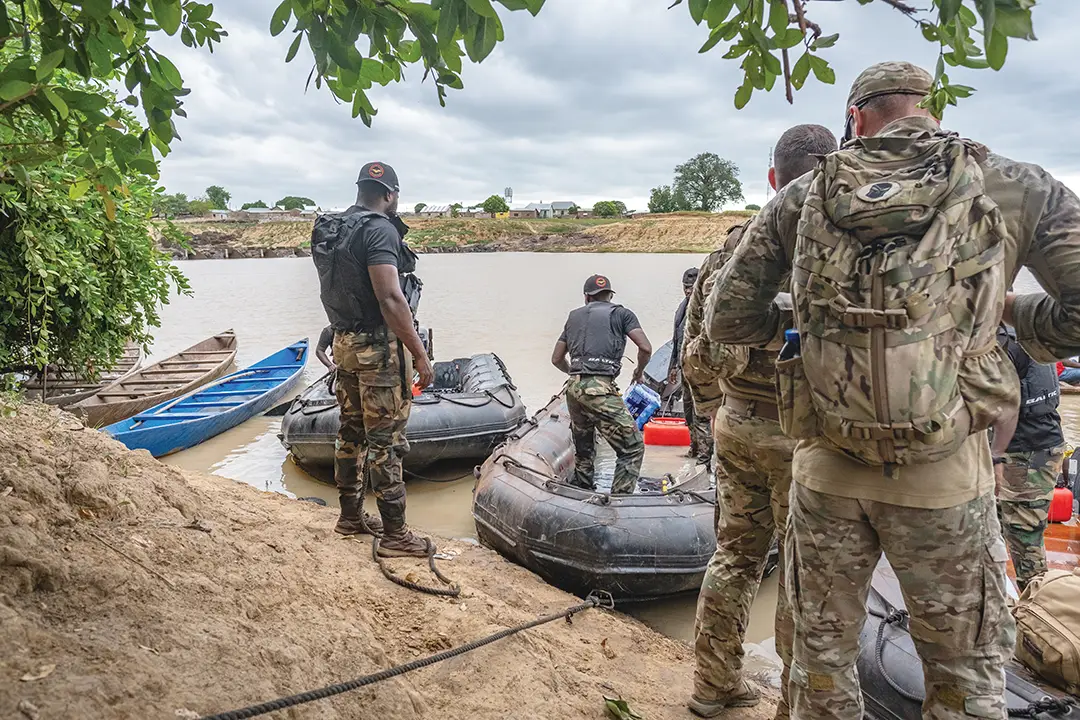
Dzakpasu said the Ghanaian military has worked to combat galamsey. “The Special Boat Squadron has been in the thick of that operation, particularly due to how complex that illegality is. It typically happens on riverways in places which are cut off, where there is no direct road access. So, the squadron employed its skills in rivers or in water and in the air, deployed by air means, and has been effective in countering that from about 2017 to 2021.”
Ghana’s squadron also responded to the Western Togoland secessionist movement in 2020, Dzakpasu said. Separatists want to create a new nation from the boundaries of the old Trust Territory of Togoland, which existed under British administration. An incident near an eastern military base had secessionists “taking up arms, blocking up bridges and the rest,” Dzakpasu said. “The squadron was quick and effective in restoring common order by getting into that confrontation with members of this movement.”
Likewise, squadron members have conducted preventive counterinsurgency and counterterrorism operations in northern Ghana to deter terrorists who operate in Burkina Faso and the larger Sahel region.
SPECIALIZED TRAINING
Ghana’s squadron, established in 2016 with support from Denmark, Nigeria and the United States, in 2022 graduated its first group of domestically trained operators. The eight new members were the only ones out of 25 who completed the rigorous six-month training.
From 2016 to 2020, Ghana sent five groups to Nigeria for training. Once they returned, the Sailors worked in various teams but without a formal unit or command and control structure. In 2021, the chief of naval staff officially formed the squadron, and Dzakpasu was appointed its commander in March 2022.
The ability to train domestically was a key part of a five-year development plan formed in partnership with the U.S. and Denmark’s Special Warfare Group, known as the Frogman Corps. The plan runs through 2026.
One tool that helps train the squadron is a
$1.2 million “ship in a box,” which was commissioned in August 2024 with help from the Danish government and the United Nations Office on Drugs and Crime. The metal simulator, which resembles a ship, lets squadron members and others practice visit, board, search and seizure drills. It is at Naval Training Command at Nutekpor in eastern Ghana.
“Instead of sailing out a ship every time you wanted to conduct boarding operations, we have a ship on land that we can just enter, clear out, set up different scenarios and retrain on,” Dzakpasu said.
Then-Minister of Defence Dominic Nitiwul said the simulated ship symbolized a commitment to excellence, dedication to protecting the Gulf of Guinea and a realistic training environment for different mission types, according to an August 2024 Ghana Peace Journal report.
“The threats we face today, from piracy, drug trafficking, smuggling, illegal fishing and maritime terrorism among others, demand that we equip our personnel with the best possible training, preparing them for every conceivable scenario they might encounter at sea,” Nitiwul said at the commissioning ceremony.
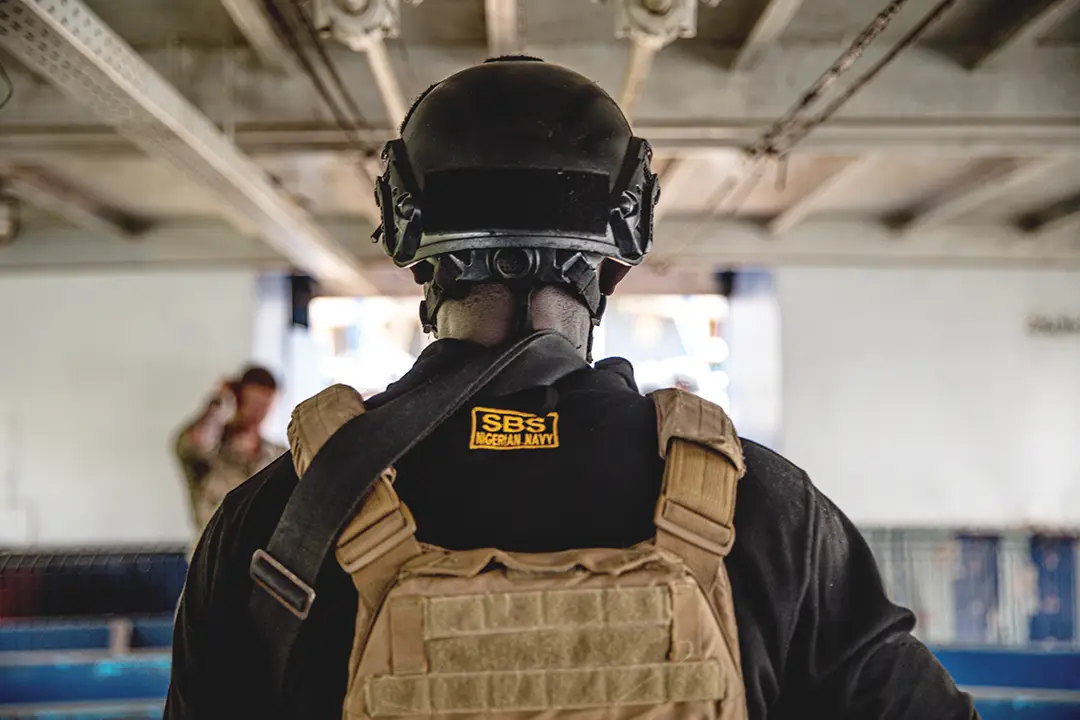
He added that the facility will benefit allies and partner nations by fostering cooperation and helping maritime forces work together seamlessly. Nigeria also has a ship-in-a-box simulator at the Joint Maritime Security Training Centre in Lagos.
Nigeria created its own Special Operations Command on the Benue River in 2025. It incorporates the SBS and the Deep Blue Project’s Maritime Security Unit.
SBS training is notoriously difficult and includes endurance tests, physical deprivation and long-range swimming. Specialized courses focus on underwater demolition, combat diving, parachuting, survival training, close-quarter combat, weapons handling, and intelligence gathering and analysis. The training culminates with “hell week,” in which candidates are pushed to their physical and mental limits.
In August 2025, Nigeria’s SBS inducted 33 graduates, less than half of those who began the program’s 36-week Basic Operator Capability Course. Capt. Andrew Zidon, SBS commander, said the trainees “expended thousands of rounds of ammunition and pyrotechnics, burnt thousands of liters of petroleum, oil and lubricant, swam kilometers at sea, and performed countless hours of high-intensity workouts.”
The training is intended to help the service win before ever setting foot on the battlefield. “They have demonstrated the physical fitness, mental tenacity, psychological readiness and emotional toughness required to carry out duties that will be assigned to them by the Nigerian Navy,” Zidon told the Nigerian newspaper This Day.
Dzakpasu said he foresees Ghana’s squadron sharing its expertise with African neighbors and partner nations more, in much the same way that Denmark, Nigeria and the U.S. helped train them.
“We’ve already started on that pathway,” he said. “With Nigeria, plans are far advanced to do more bilateral exchange training programs with Senegal, with Côte d’Ivoire and other nations. We shared our expertise during a training event under the auspices of the U.S. Special Operations Command Africa, Exercise Flintlock. During Exercise Flintlock, we meet and we train across; we get to know ourselves better.”
Through its partnership with Denmark and the U.S., Ghana has for the past three years invited mid-level leaders from Benin, Côte d’Ivoire, Kenya and Senegal to take part in a special operations orientation and operations planners course, Dzakpasu said. “We’ve started that partnership, and I believe that it will grow with more participation in the coming years.”