

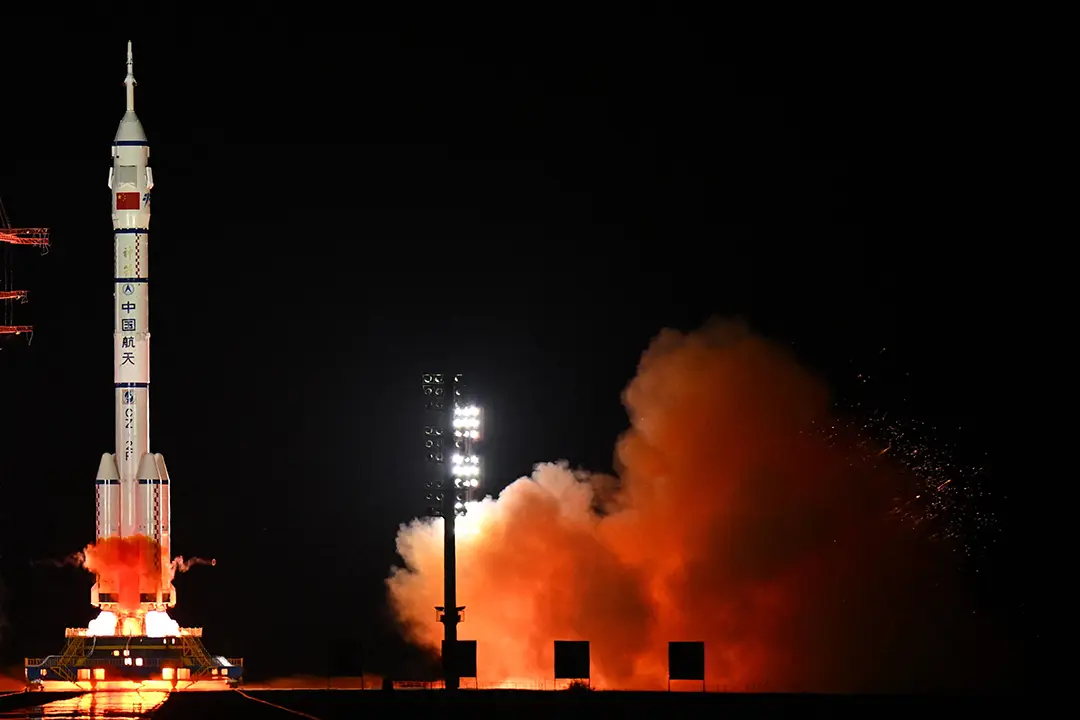
As African countries stake their claim to space by developing satellites, China has folded space missions into its Belt and Road Initiative (BRI). Experts note, however, that space-related cooperation comes with debt, operating costs and other financial risks associated with other BRI projects.
“China’s space collaborations are structured to advance its own industrial and military goals at the cost of asymmetric outcomes to foreign partners,” researchers Cortney Weinbaum, Christopher G. Pernin, Camille Reeves, Libby Weaver and Shanshan Mei wrote in a recent Rand Corp. report.
Countries that work with China on space projects typically find that funding depends on using Chinese vendors and launch services. Tracking and operations also must flow through China’s systems, raising questions about a nation’s ability to access its own data. In some cases, financing comes from the Export-Import Bank of China, the same facility tied to billions of dollars in loans for BRI projects across the continent.
Countries can find themselves the junior partners in the arrangement with China. An example: Argentina’s national space commission hosts a Chinese satellite tracking ground station tied to the Chinese military. The facility has the same legal status as an embassy, meaning Argentinian authorities cannot enter without permission. Argentinian researchers have access during only 10% of its operating time, limiting their work, according to the Rand researchers.
Africa’s Space City, east of Cairo, Egypt, is an example of China’s relationship with African space agencies. The facility is home to the African Union’s Africa Space Agency and the Egyptian Space Agency. It also hosts satellite construction facilities.
Space City was developed with the help of China, which has, so far, been the complex’s primary beneficiary. Chinese workers staff Space City, and its first locally produced satellite, Egypt’s MisrSat-2, was launched and managed from China.
China has established space-related partnerships with nearly half of Africa’s 54 countries. In addition to manufacturing and launching African satellites, China has satellite tracking and receiving facilities in Algeria, Egypt, Ethiopia, Mozambique, Namibia, South Africa, Sudan and Tunisia. Tunisia also hosts a ground station for BeiDou, China’s version of GPS.
In 2023, Djibouti signed a memorandum of understanding with China’s Hong Kong Aerospace Technology to build Africa’s first spaceport, a $1 billion facility on the Obock peninsula near the Bab el-Mandeb Strait.
Under the agreement, Hong Kong Aerospace would operate the facility for 30 years before releasing it to Djibouti.
“Beijing is rapidly stitching together a network of specialized outposts, positioning itself as a gateway to space for developing countries. Yet the deep integration of China’s space sector with the People’s Liberation Army (PLA) means these partnerships carry risks,” researchers Matthew P. Funaiole, Brian Hart and Aidan Powers-Riggs recently wrote for the Center for Strategic and International Studies.
Nigeria is experiencing firsthand the risk of working with China as the government finds itself embroiled in a financial dispute with China Great Wall Industry Corp. over the cost of operating Nigeria’s NigComSat-1R.
The Chinese-built NigComSat-1R supports broadcasting, internet connectivity and security communications across Nigeria. It was launched in 2011 and is expected to reach the end of its operational life later this year.
The satellite is active and sits in a geostationary orbit above South Sudan, according to tracking data.
The Chinese government-owned company, a subsidiary of China Aerospace Science and Technology Corp., recently warned Nigeria that it might stop supporting NigComSat-1R due to an outstanding $11.44 million debt.
The company gave Nigeria 30 days to resolve its debt earlier this year under the threat of deactivating the satellite’s transponders.
Nigeria has denied that it owes the Chinese company money. It has approached France and Israel for help in developing future communications satellites.
“Government, commercial, and academic researchers should approach space cooperation with China with rigorous due diligence,” the Rand researchers wrote.