
The alliance between the Azawad Liberation Front (FLA) Tuareg-led separatist movement and the al-Qaeda-affiliated Jama’at Nusrat al-Islam wal-Muslimin (JNIM) terror group is reshaping the dynamics of Malian conflict.
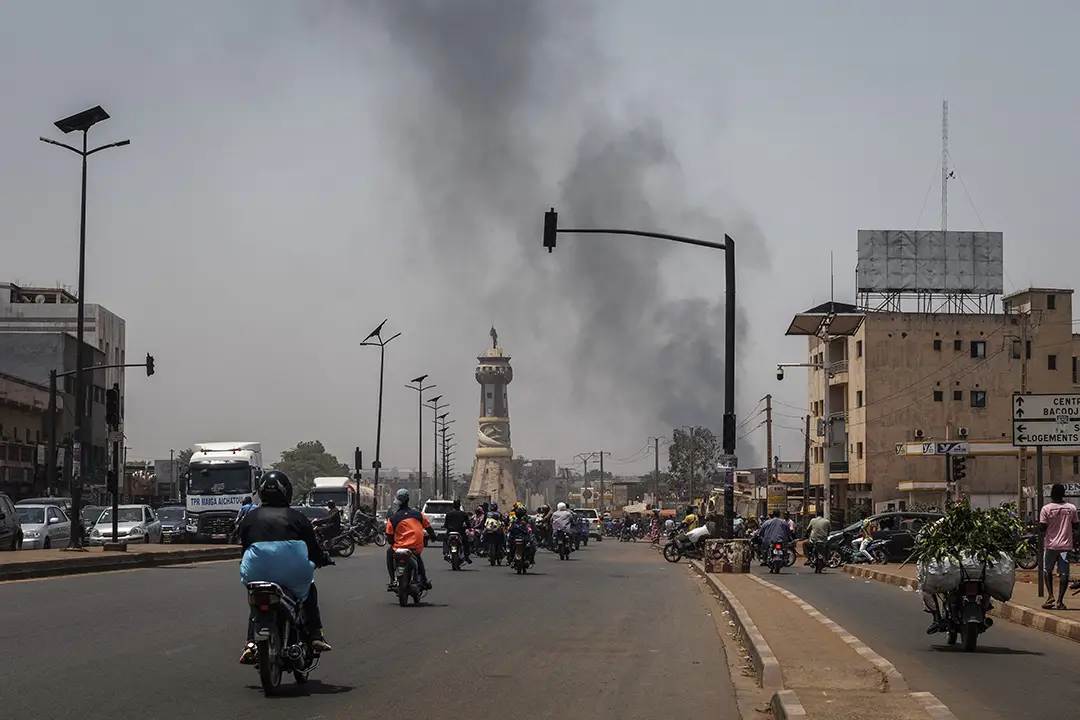
The groups’ coordination was clear on April 25 when they attacked the northeastern desert town of Kidal, forcing Malian soldiers and Russian Africa Corps mercenaries to retreat. That day, they also attacked Bamako, the national capital, and Kati, both in the southwest; Gao, in the northeast; and Mopti and Sévaré in central Mali. The Kati assault killed Gen. Sadio Camara, Mali’s defense minister and veterans affairs minister.
On July 5, the groups attacked the northeastern towns of Aguelhoc and Anefis, a military camp in Gao, a prison in Keniroba near Bamako, and Sévaré. Marie Dubois, an expert in African security and counterterrorism operations, characterized these towns as “pressure points chosen to force the Malian army to look everywhere at once.”
“Gao locks down the eastern Sahel and the routes to Ansongo and Ménaka. Sévaré, near Mopti, remains a crucial air and logistical hub to hold the center of the country,” Dubois wrote for HiWars, a military news website. “Aguelhoc and Anefis belong to the politico-military space of Kidal, where the Tuareg question remains more than just an old file. Finally, Kenioroba is too close to Bamako to be treated as a mere rural periphery.”
In mid-July, the groups claimed responsibility for killing or capturing scores of Malian Army soldiers and Africa Corps fighters in a convoy in the Gao region. The next day, the Malian Army said it carried out “precision strikes against enemy positions” in the area.
“Three terrorist positions were successfully targeted (and) several terrorists were neutralized. … These operations allowed the convoy to break free from the ambushes and continue its route,” The Malian Army said in a report by The Associated Press.
According to the Armed Conflict Location and Event Data (ACLED) project, militant attack fatalities increased by 35% to 3,435 in the first seven months of this year.
“The JNIM and FLA see the benefit of working with each other because they function as force multipliers for each other,” Héni Nsaibia, a senior analyst for West Africa at ACLED, told the AP. Both groups share the aim of “finishing the common enemy,” which they see as being the Malian Armed Forces and Africa Corps, Nsaibia added.
FLA spokesperson Mohamed Elmaouloud Ramadane said the groups had agreed to decide what version of Sharia to apply after securing independence for northern Malian communities. Ramadane told the AP that the groups’ relationship is “a form of tactical coordination” focusing on military operations.
Senior officials from both groups told Al Jazeera they had tabled ideological differences to confront a common enemy. Col. Mohamed Issa, a senior FLA officer, said the group is committed to an independent Azawad, as previous peace agreements repeatedly collapsed due to Bamako’s failures to honor them. Issa said JNIM fighters operating alongside the FLA were exclusively Azawadis rather than members of the group’s wider regional network and were defending their communities.
Suleiman, a senior JNIM field commander, said the group agreed to collaborate with the FLA because fighters on both sides mostly came from “one people” mired in the same conflict, and their goals were “relatively unified,” Al Jazeera reported. Suleiman gave only his first name for security purposes.
However, “one should not confuse operational coordination with political fusion,” Dubois wrote. “The FLA seeks a balance of power with Bamako around Azawad. JNIM wants to impose its religious order and weaken the Malian state over time. These two projects are not identical. They may even become adversaries again tomorrow.”
The groups had previously aligned against the Malian state in 2012, but the forces turned on one due to differing political and religious goals after seizing northern Mali. According to Wassim Nasr, a senior research fellow at The Soufan Center, negotiations to form a renewed alliance began in early 2025. The talks were facilitated, partly, by al-Ghabass Ag Intalla, an influential personality within the FLA, and Iyad Ag Ghali, the Tuareg leader of JNIM.
“These personal and tribal relationships were critical because they allowed former rivals to negotiate and build a strategic partnership,” Nasr wrote for the International Centre for Counter-Terrorism think tank.
Nasr viewed as significant the ideological aspects of the alliance, as the FLA has accepted a moderate form of Sharia law in areas it jointly controls with JNIM.
“This concession was essential for JNIM to join any formal alliance,” Nasr wrote. “However, this pragmatic agreement was made possible by JNIM’s less brutal version of Sharia, compared with other jihadist groups in northern Mali.