

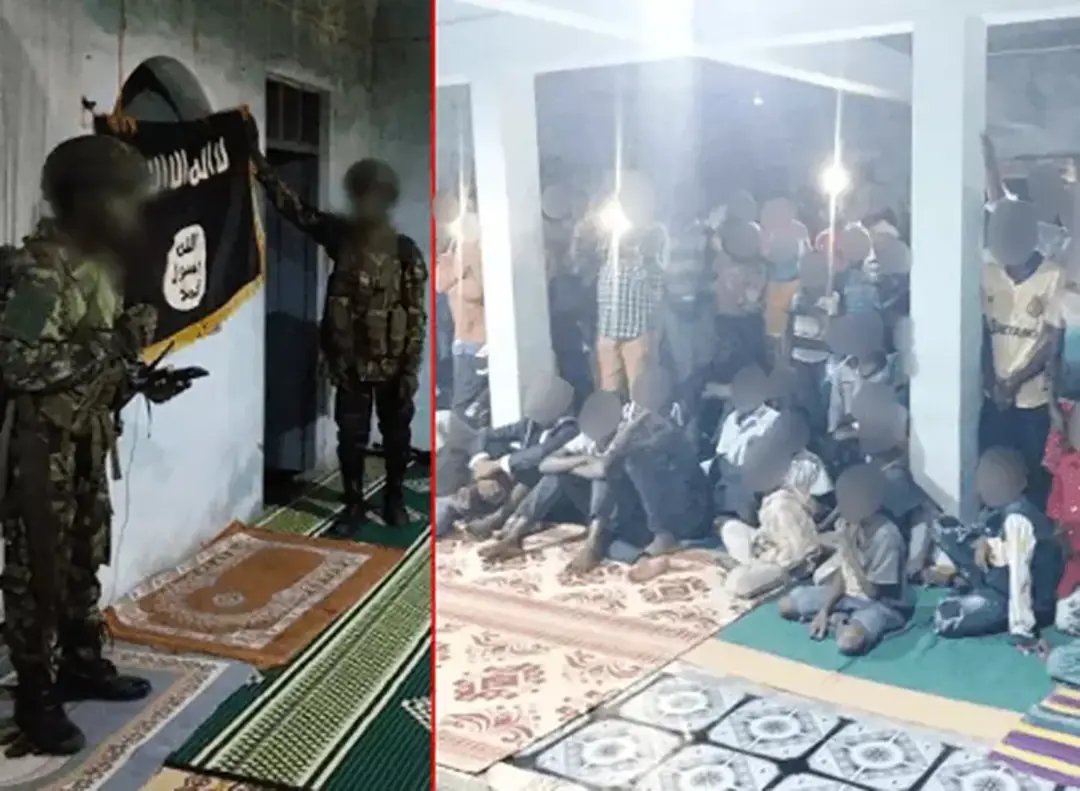
On October 7, 2025, a group of heavily armed men in military fatigues visited a mosque in Mocímboa da Praia, a coastal town in Cabo Delgado province. Addressing a crowd of men, women and children, one of the men presented the group, the Islamic State Mozambique (ISM), as a legitimate authority in opposition to Mozambique’s government.
He told them that they had a duty to support the group’s jihad, and that there were “two governments, one of the non-believers and the other of the Muslims.” He warned them not to collaborate with the authorities or attend their meetings.
In recent years, ISM has shifted its approach in Cabo Delgado to that of a sectarian, religious alternative government to gain legitimacy and build a stronghold among local communities. Peter Bofin, senior analyst for southeast Africa at the Armed Conflict Location and Event Data (ACLED) project, said the group is carving out a distinct area of influence that stretches along more than 100 kilometers of the coast and 50 kilometers inland.
“ISM is engaged in a political project,” he wrote in a June 26 report.
Within this enclave, the militant group seeks a greater connection with the people, maintains a base and has some freedom of movement despite the presence of state security forces and a contingent of the Rwanda Defence Force. Since 2023, Islamic State global has encouraged ISM’s changing approach and has highlighted it through its media channels.
“Within this area of influence, the insurgents have attempted to define a civilian constituency of support for their actions,” Bofin wrote. “They have also set out a broad political position that rejects the secular state and advocates for rule based on their interpretation of Islamic law. … While couched in religious sectarian terms, these patterns are also influenced by long-standing ethnic and political configurations. Consequently, its presence will be hard to undo through military means alone.”
By the end of 2023, the group had established itself as an Islamic State affiliate, had new leadership and had adopted a less violent approach to the communities in its area of influence, which was reflected in ACLED data on civilian targeting. At the same time, ISM’s nonviolent activities rose sharply, including visits to communities to seek support or dissuade cooperation with state forces, occasional preaching, and purchasing supplies in villages, sometimes enforcing prices and values of exchanged goods.
“Civilian targeting has remained negligible near the coast, despite ISM’s main base being located there, while civilian targeting elsewhere, particularly in the south, remains a significant element of the conflict,” Bofin wrote, adding that “ISM’s targeting of civilians had led to citizens fleeing, and without people, territorial control is of little value.”
Although ISM’s tactical shift has revealed its political and territorial ambitions, Bofin said the endeavor is still in a nascent stage of development with no tangible signs of governance or community involvement, such as the establishment of a school. The Mozambican government therefore would be wise to increase its presence officially and militarily while improving public infrastructure.
“The challenge for the state is to ensure that its minimal presence in this area, primarily through Mozambican and Rwandan security forces, is maintained and that ISM cannot develop into any form of quasi-governmental authority,” he wrote. “Such a development would greatly ease recruitment and financing. Beyond that, it must itself regain authority and legitimacy.”
After visiting Mozambique, United Nations human rights expert Ben Saul encouraged the government to continue moving its counterterrorism strategy beyond a highly militarized approach to address terrorism’s underlying conditions.
“After nine years of horrific violence, I recognise the significant efforts made by Mozambique and its partners to prevent and counter terrorism, including the recovery and stabilisation of many areas that have allowed many displaced people to return home,” he said in an August 14 statement.
“A comprehensive approach is essential. The Government and international partners should intensify efforts to counter violent extremist ideology, strengthen State institutions and human development in the north, ensure communities in Cabo Delgado benefit fairly from the province’s rich natural resources, effectively regulate extractive industries, and strengthen inclusive governance.”