

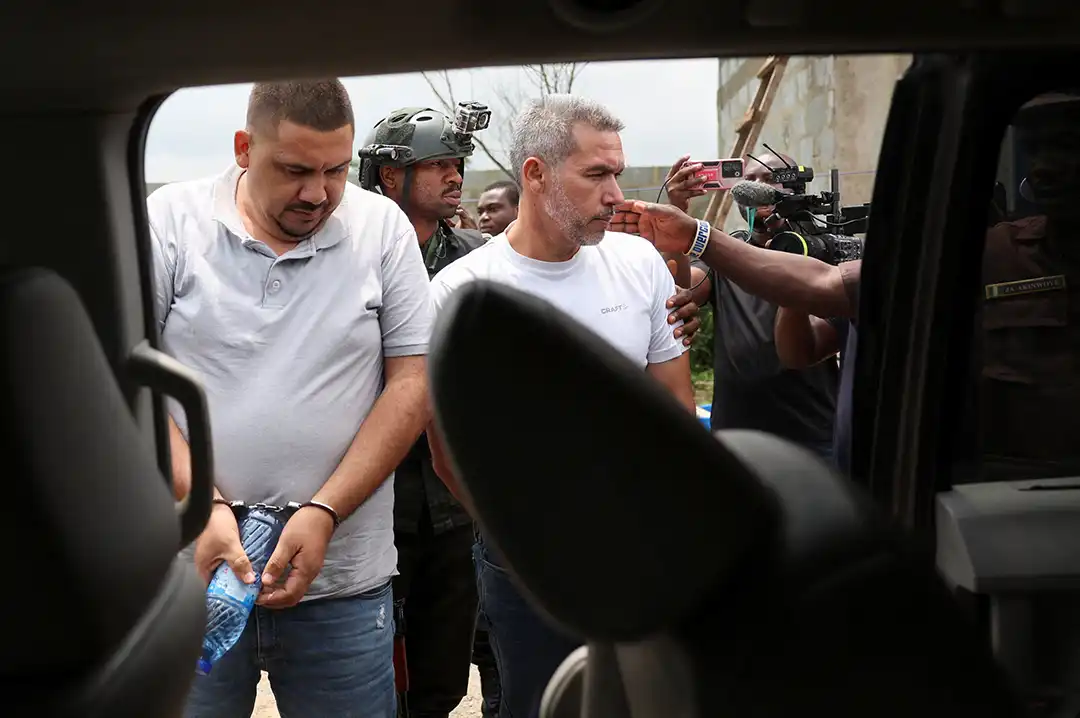
Col. Ze-ev Krein has been commander of the South African Narcotics Enforcement Bureau for nearly four years, but his career in law enforcement dates to 2008. In that time, he has seen his country become a prime target of Mexican cartels seeking to produce and traffic meth.
“Over the last 10 years, we saw an exponential rise in methamphetamine,” he said during an October 7 webinar organized by the Africa Center for Strategic Studies and the Pretoria-based Institute for Security Studies. “In the last five years, we started to find industrial-scale methamphetamine labs.”
Major laboratory busts in South Africa and Nigeria show that Africa is shifting from its historic role as a drug trafficking corridor into a production base, said Ebunoluwa George Ojo-Ami, an intelligence manager at maritime risk consultancy Agwe Global Group.
“The broader significance is that we may be seeing a change from Africa being primarily a transit environment for the international drug trade toward parts of the continent becoming locations where criminal networks can establish and operate parts of the production chain itself,” he told Bloomberg news service for an October 8 article.
Why are Mexican cartels moving into Africa? Nigeria’s National Drug Law Enforcement Agency cites a crackdown by authorities in North, Central and South America on cartels and trafficking routes.
“These cartels are feeling the pressure from other parts of the world, and so [they] are looking at West Africa as a corporate production hub,” spokesperson Femi Babafemi told the BBC for a July 28 article.
While plant-based drugs such as cocaine and heroin only can be grown and processed in certain parts of the world, synthetic drugs like meth can be produced anywhere with the right chemical precursors and expertise, which make it easier for criminal groups to rapidly scale up production.
Some of the methamphetamines that are trafficked to Asia, Europe and Oceania now are being produced in Africa, where cartels seek to exploit weak law enforcement, existing smuggling networks, corruption and cheap labor.
“Criminal networks gravitate toward wherever governance, security or judicial capacity gaps are widest,” Cheikh Ousmane Toure, the United Nations Office on Drugs and Crime (UNODC) representative in Nigeria, told Bloomberg.
Wendy Williams, an adjunct research fellow at the Africa Center, said the profitability of synthetic drugs is driving cartels to invest in production.
Between 2015 and 2019, Mexican cartels made approximately $2.8 billion in the global trade of methamphetamine, according to UNODC estimates. In 2015, one kilogram of Mexican meth from Nigeria, which cost about $1,500 to make, could fetch $150,000 in the East Asian market.
Meth seizures on the continent rose from 180 kilograms in 2012 to 1.3 metric tons in 2017, but Williams said trade remains incredibly profitable despite major busts by law enforcement.
“Currently, methamphetamine produced in Africa and shipped to Australia and New Zealand can command prices many times higher, possibly even 16 times higher, than the North American market, creating an extraordinary incentive for traffickers to expand production on the continent,” she said during the webinar.
As South African authorities have discovered and busted several large meth labs hidden inside farms in remote locations in recent years, Krein began to get a sense of the scale of the problem.
“Our estimate is that it’s producing something like five tons a month per lab,” he said. “In terms of South African rand, that’s worth 500 million. To buy the farm costs 8 million rand. To set up everything else — the precursors, the equipment — we’re looking at 2 million. So, let’s say your entire capital setup is 10 million, and in your first month you’ve already made 500 million rand. That’s one lab.”