

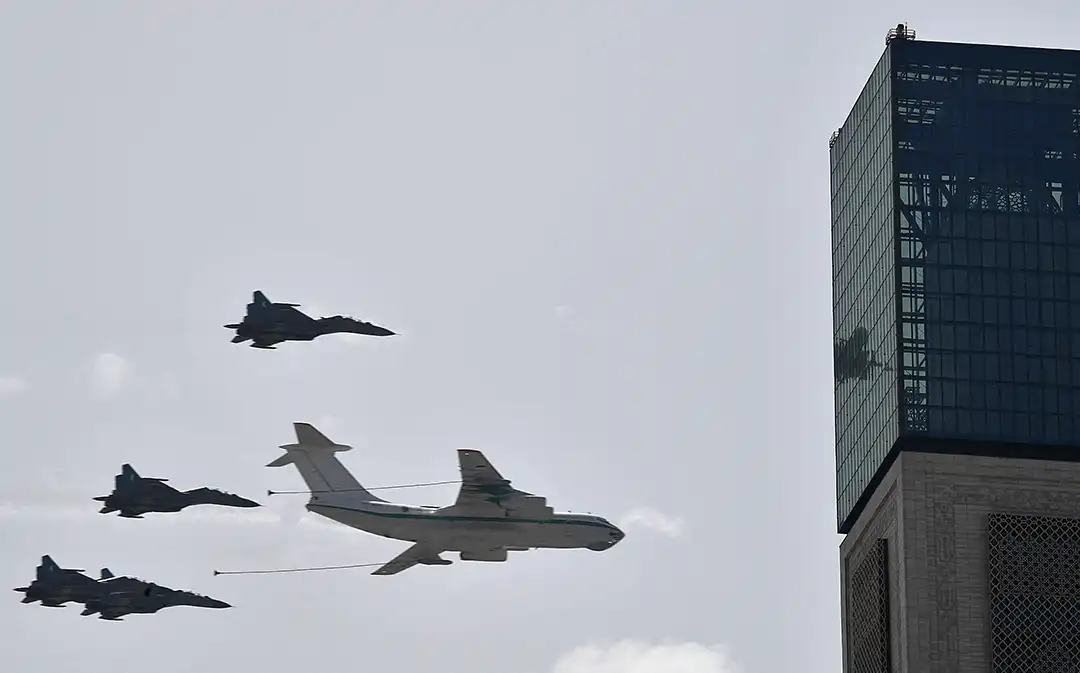
Algeria’s decision in August to deploy elements of its military to support Niger’s ruling junta was more than simply a policy shift: It showed that one of Africa’s strongest militaries is prepared to project its power in the name of maintaining stability in the Sahel, according to analysts.
The day after the Aug. 29 mutiny by a group of Nigerien soldiers, Algeria dispatched four Sukhoi Su-30 fighter jets and an air-to-air refueling plane to Niger’s Air Base 101 in Niamey. The base, located adjacent to Niger’s international airport, is Niger’s main military outpost and the base for fighters from Russia’s Africa Corps.
The aircraft came with pilots and support personnel. They also followed four helicopters that Algeria dispatched to Niger earlier in August. The deployment was Algeria’s first beyond its borders since 1973.
“Behind the aid provided to Niger there may be a broader ambition: to have a strategic depth south of the Sahara that Algeria had so far refused to exercise militarily,” Algerian analyst Akram Kharief wrote recently on MenaDefense, his Substack publication.
“The importance of the gesture lies first and foremost in its speed,” Kharief added. “What happens in Niamey can therefore be considered in Algiers as almost immediately a matter of national security.”
Algeria shares a porous 951-kilometer border with Niger. It also shares a 1,359-kilometer border with Mali, one of Niger’s partners in the Alliance of Sahelian States (AES). In July, Algeria and Mali announced plans to rebuild relations that have deteriorated since Mali’s 2023 coup.
Along with the third AES member, Burkina Faso, Mali and Niger have spent years fighting a rising tide of terrorism by Jama’at Nusrat al-Islam wal-Muslimin (JNIM) and the Islamic State Sahel Province (ISSP). Algerian leaders increasingly see instability in the AES as a potential threat to their own national security, Kharief noted.
Algeria likely has a broader reason for buttressing Niger’s ruling junta: Niger sits at the heart of the future Trans-Saharan Gas Pipeline running more than 4,100 kilometers from the oil fields of Nigeria’s Niger Delta to Algeria’s Mediterranean Sea coast.
About 2,400 kilometers of the pipeline have been built in Algeria and Nigeria. Much of the remaining 1,600 kilometers travel through Niger.
The pipeline is part of a multifaceted trans-Saharan transportation system that could also include a railway, roads and communication technology. But that all depends on security in Niger, Kharief wrote.
“The stability of Niger is no longer just a matter of good neighborliness for Algiers,” Kharief wrote. “In this perspective, the interest of an Algerian military presence in Niger is immediately apparent.”
Algeria can no longer defend its security only by protecting its own borders, but must take a broader approach, according to Riccardo Fabiani, North Africa project director at the International Crisis Group.
Algeria made its interest in supporting stability in Niger clear when Algerian Maj. Gen. Rachid Cheblaoui appeared at a press conference with Nigerien officials after the new aircraft and support crews arrived on Aug. 30.
“This is part of a new, more pragmatic foreign policy in which Algeria is ready to play a security and military role, and no longer exclusively a diplomatic one, in order to pursue its objectives in an environment that is changing very rapidly,” Fabiani told Middle East Eye.
From Air Base 101, Algeria could add drones and intelligence operations to support regional militaries across the Sahel and the Lake Chad Basin against multiple terrorism groups, according to Kharief.
So far, Algeria has shown no interest in taking that approach. However, the decision to deploy military elements to Niger remains significant, he added, since it breaks a longstanding policy
“There is also a fundamental difference between the permanent installation of a foreign force and the deployment of a force from a border State at the request of a neighboring Government,” Kharief wrote. “But a taboo seems to have lost its force.”