

ADF STAFF
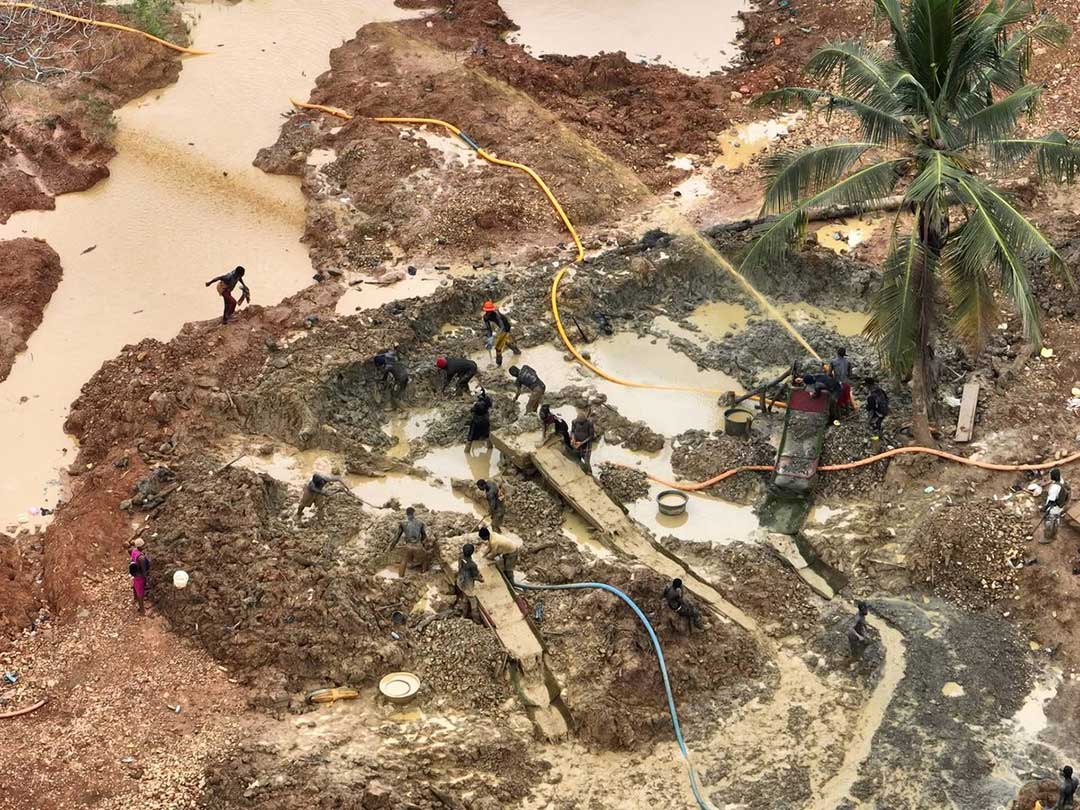
Piloting a drone, award-winning journalist and documentary filmmaker Edem Srem flies high above polluted waterways in his native Ghana to show the scale of environmental devastation from illegal gold mining, known locally as galamsey. The land is pock-marked with large and small mining pits filled with water that looks like coffee with heavy cream.
Srem is sounding an alarm that galamsey is not just an environmental disaster. It also has become a dangerous criminal enterprise that threatens national and regional security.
“[Galamsey] supports a sprawling illicit economy involving hundreds of thousands of miners, transnational financiers, foreign operators, gold smugglers, equipment suppliers, and criminal intermediaries,” he wrote in a July 21 report for the Africa Center for Strategic Studies.
As the continent’s leading gold producer, Ghana has experienced a large expansion of artisanal and small-scale gold mining. With $11 billion in foreign exchange earnings in 2025, small-scale mining eclipsed for the first time the country’s industrial gold mining output of $9 billion.
Most small-scale mining, however, is illegal. Some 70% to 80% of artisanal miners are unlicensed, according to data from Ghana’s Minerals Commission, the mining sector regulator. The government has tried to curb galamsey by creating police task forces and deploying the military.
“Yet, these recurring operations have failed to establish durable control over many affected areas,” Srem wrote.
Illegal mining networks in Ghana have become intertwined with cross-border gold smuggling routes, illicit financial flows and foreign actors.
“This includes the large-scale influx of Chinese operators, capital, and equipment that accelerated the sector’s mechanization over the past two decades,” he wrote. “These dynamics have transformed galamsey from a largely informal livelihood activity into a parallel political economy that increasingly operates beyond effective government oversight.”
An estimated 50,000 illegal Chinese miners operate with relative impunity in Ghana, according to Srem. They are supported by networks of financiers, equipment suppliers, informal refiners and intermediaries.
Chris Aston, who leads a British-backed program that seeks to regulate galamsey, said artisanal miners are vulnerable to organized crime gangs, which provide up-front funding for equipment, unlike other lenders.
“Miner pre-financing is one way that organised crime groups can penetrate the gold supply chain,” he told Reuters in 2024. Gangs then “require miners to sell the gold they mine back to them at a subsidised rate.”
Emmanuel Kwesi Aning of the Kofi Annan International Peacekeeping Training Centre in Accra told Reuters that galamsey also has fueled an increase in gun trafficking, as those overseeing illegal mines require protection against thieves and rivals.
Srem outlined several ways in which Ghana can bolster its efforts to counter galamsey: “Enforcing restrictions on foreign participation in Ghana’s small-scale mining sector, strengthening scrutiny of heavy equipment imports and illicit gold exports, and working with customs, financial intelligence units, and international partners to disrupt cross-border smuggling and money laundering are vital to making it more difficult for organized criminal networks to sustain illegal mining operations.”
Experts have shown that in addition to its links to transnational organized crime, galamsey is a profound threat to Ghana’s health and economic development.
More than 60% of Ghana’s bodies of water are polluted with toxic heavy metals such as mercury and chemicals such as cyanide and lead, according to Franklin Obiri-Nyarko, a research scientist at the Groundwater Division of the Council for Scientific and Industrial Research-Water Research Institute.
“If you look at the state of our water resource now, it is clear that we are not doing enough to protect this valuable resource and going forward, there is the need for urgent steps to be taken to sustainably restore the polluted rivers to save lives,” he said during an August 11 presentation, according to Ghanaian website Graphic Online.
Alhassan Tahiru, a researcher focused on security, governance and conflict dynamics in Africa, said galamsey is a moral imperative that demands intervention.
“Illegal mining is no longer only an environmental issue,” he wrote in an article for the website New Security Beat. “Galamsey has become a human security problem that poisons and destroys the lives of children in mining areas. In their formative years, Ghanaian children in these regions face immediate health and long-term developmental issues that blight their present and imperil their future.”
This year, the Pediatric Society of Ghana warned that children’s continuous exposure to galamsey-related toxins leads to behavioral disorders, poor speech development, reduced academic performance and increased risk of chronic disease later in life.
“Illegal mining (galamsey) poses a severe threat to children’s health and brain development, with irreversible consequences for Ghana’s future,” it said in a February statement. “The organisation calls on government leaders to treat this as a national emergency requiring immediate action.”