

ADF STAFF
Methamphetamine cooks supplied by Mexican drug cartels have been discovered working at several drug laboratories in Africa over the past two years.
Several arrests, including Nigeria’s largest-ever meth bust in May, have occurred as Mexico’s Sinaloa and Jalisco New Generation cartels expand their operations under a franchise-style business model. The cartels are accused of funding continental terrorists, armed groups and criminal groups that help them produce and move the drugs.
“The relationship between cartels and drug use and terrorism is very, very simple,” Nigerian organized crime expert Faisal Sanusi Ibrahim told news service Deutsche Welle (DW). “The terrorists give the cartels protection, while the cartels give the terrorists financing. We have porous borders. We have a large part of forests ungoverned. We also have a situation where you have cheap labor … and also the trans-Atlantic route for the shipping.”
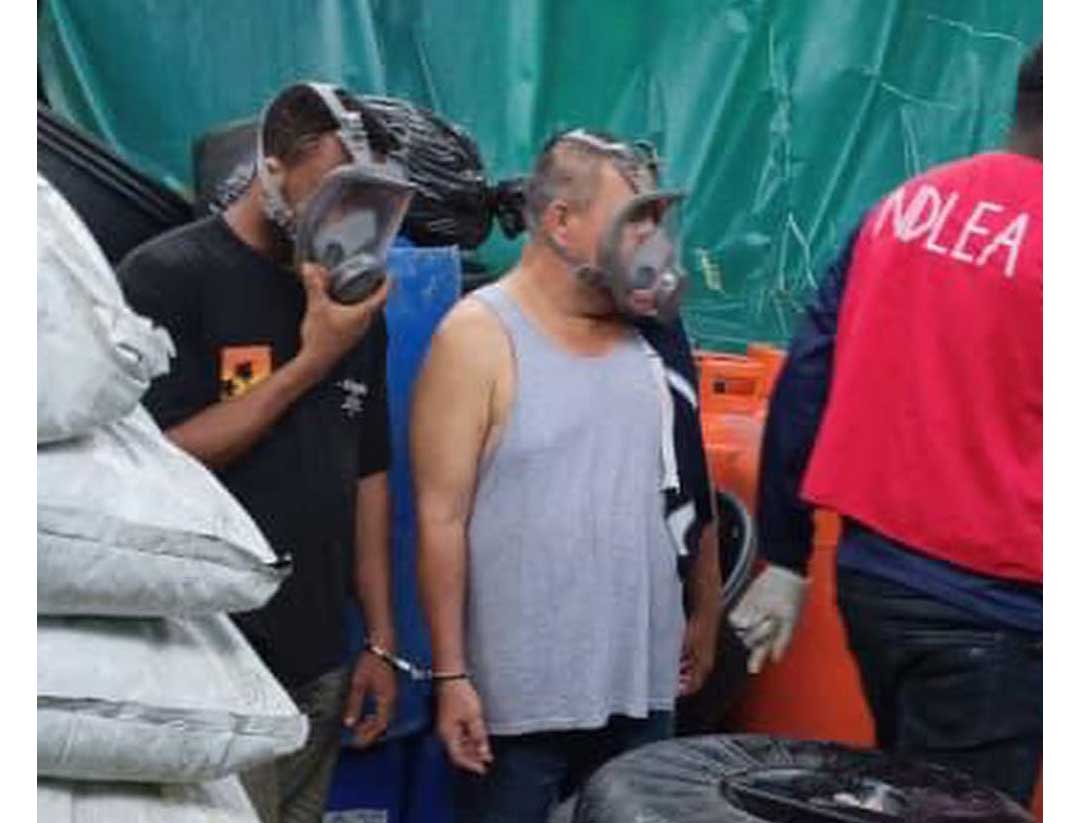
Nigerian authorities seized precursor chemicals and drugs worth $363 million when they raided a clandestine, industrial-scale lab in a heavily forested area in Ogun State in mid-May.
“The volume of what was recovered here, that’s enough to cause a lot of issues — public health issues, security challenges, not only in … Nigeria, but in the sub-region,” Femi Babafemi, director of media and advocacy for Nigeria’s National Drug Law Enforcement Agency (NDLEA), told DW.
In June, the NDLEA uncovered another meth lab in a forested area of Oyo State and arrested five suspects, including one Mexican national. NDLEA Chairman Mohamed Buba Marwa described the facility as “a sophisticated, factory-scale methamphetamine production center run by a highly organized transnational criminal syndicate.”
Mexican meth cooks have operated in Nigeria since 2016, but the recent local arrests and significant meth busts in Kenya and South Africa — areas that historically have been used as transit hubs for drugs — show that the cartels are increasingly sending their own chemists to produce meth.
According to the InSight Crime think tank, Mexico’s meth industry has grown more sophisticated over the past two decades, and the country produces some of the purest meth globally. This makes Mexican meth producers attractive partners for criminal networks, according to Jason Eligh, a senior expert at the Global Initiative Against Transnational Organized Crime (GI-TOC).
“It is likely that there has been an initial contact [between Mexican and Africa-based criminal actors] where production has significantly changed because the Mexican model of production is superior to the model that has existed in the past in Africa,” Eligh told InSight Crime.
In recent years, Mexican cartels have expanded their meth operations into South Africa, which is considered one of the world’s largest consumer markets for crystal meth. This was underscored in July 2024 when two Mexican nationals were arrested at an industrial-scale meth lab on a farm in Groblersdal, a small town in Limpopo Province. Authorities discovered large quantities of precursor chemicals with an estimated street value of 2 billion rand ($122 million).
This was one of South Africa’s largest-ever drug busts, and it preceded three more major meth busts involving Mexican nationals over the next 18 months.
“All of those labs are located in quite remote areas; not many people get in there, not a lot of prying eyes,” Willem Els, a counterterrorism expert at the Institute for Security Studies, told ADF. “In these areas they compromise the [property] owners. We saw they arrested some of these Mexicans at the Botswana border and got information that a Nigerian national in Botswana is arranging to bring the Mexican cooks from the Sinaloa and other cartels that are diversifying, then they deploy them at these clandestine labs. They are typically there for one month to four months, then they keep on rotating them.”
The Sinaloa cartel has tried to expand its South African operations to neighboring countries. In Mozambique, authorities arrested three people, including two Mexican nationals, in April 2026 at Maputo International Airport. Authorities said the cartel wanted to establish itself in Maputo province.
Kenya’s growing role in Mexican meth production was highlighted in September 2024 when authorities arrested six people, including a CGNJ member, in the countryside near Namanga, a community on the border with Tanzania. Although remote, the Namanga lab sat along traditional trafficking routes and had easy access to seaports and airports in Kenya, Tanzania and Uganda, Eligh told ADF last year.