

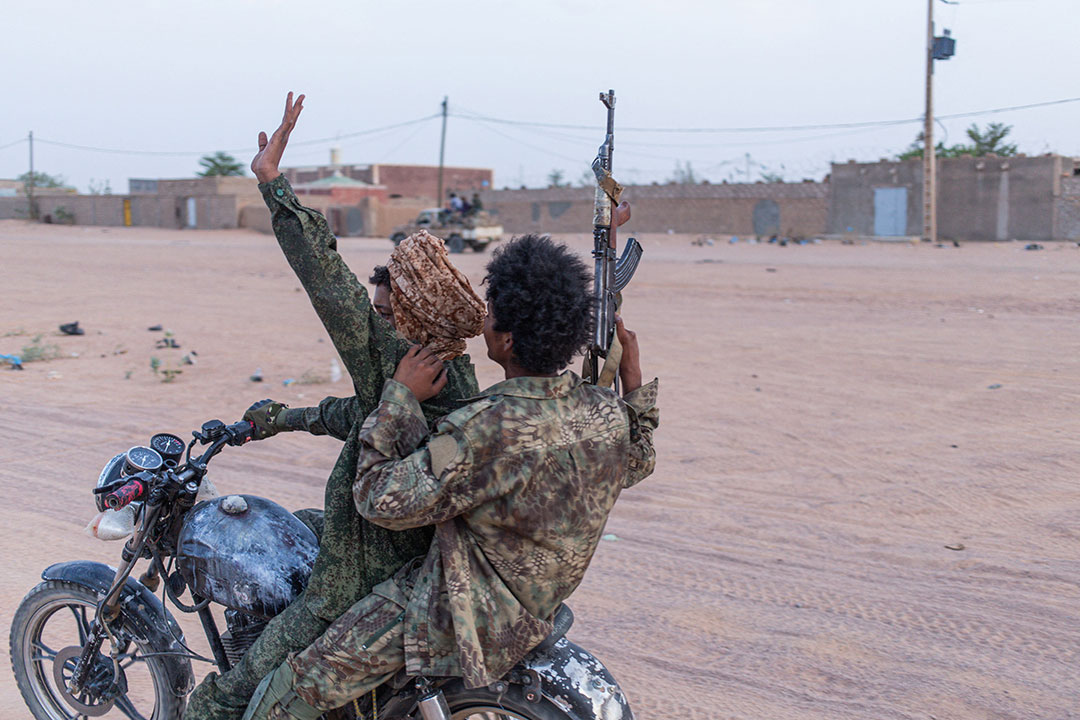
Synchronized April terror attacks in Mali targeted military bases, an airport and a public official’s home. Strikes by the terror group Jama’at Nusrat al-Islam wal-Muslimin (JNIM) and the separatist Azawad Liberation Front included swarms of motorcycles, indirect fire and vehicle-borne improvised explosive devices (VBIEDs).
After the siege, several rural military outposts had been overrun, the country’s defense minister was dead, and the rebels controlled the strategic northern town of Kidal.
Alioune Tine, a former United Nations expert in Mali, called it a “veritable catastrophe,” adding that the “jihadists struck at the very heart of political power and military security.”
Although the scope of these attacks was unique — they spanned 1,500 kilometers — their strategy was not new. Daniele Garofalo, an expert on Sahel terrorism and counterinsurgency, said the attacks represent a continuation of an operational doctrine used by JNIM for more than a year. He said security forces must quickly understand and respond to this strategy or risk further losses.
“[It] shows a group that fights through mobility, repetition, and selective escalation,” Garofalo wrote for the Jamestown Foundation. “For state forces, this dynamic exposes a structural mismatch.”
Garofalo said the April attacks show that JNIM understands how to maximize its asymmetric advantage over state forces. Some hallmarks of the group’s doctrine are:
Moving in groups on motorcycles: The vehicles are ideal for speedy attacks and getaways.
Conducting nighttime raids: Terrorists attack when visibility is lowest and confusion is highest. The threat of these attacks saps resources and forces Soldiers to maintain a permanent high-alert posture.
Targeting isolated bases: JNIM has repeatedly hit outposts far from central authority. Terrorists conduct rapid assaults and flee before ground or air forces can arrive.
Using indirect fire and VBIEDs: By hitting a target with mortars, improvised rockets and rocket-propelled grenades, JNIM disrupts the military’s ability to mount a coordinated defense. VBIEDs are used to blast open barricades, inflict large numbers of casualties or target officials.
Roadside ambushes: By targeting trucks and convoys, JNIM isolates communities and reinforces the perception that the state cannot protect major roads and vital supply chains.
JNIM uses these tactics to spread chaos. The goal is to shake confidence in state institutions, discourage civilian cooperation with security forces and reinforce the public perception that JNIM is the dominant security actor in contested areas, Garofalo said.
“JNIM seeks to impose continuous operational pressure while forcing security forces into a reactive posture,” Garofalo told ADF in an email. “The immediate military objective is only part of the equation. Every successful attack is intended to generate broader strategic effects.”
Garofalo said there is no simple way to counter these asymmetric attacks, but he recommends a multipronged, adaptive approach.
- Increase operational resilience: Remote bases must be integrated into a wider defensive network supported by reliable logistics, secure communications and rapid reaction forces.
- Operate unpredictably: JNIM plans attacks based on predictable military routines, convoy schedules and reinforcement patterns. Security forces must vary patterns to confuse the enemy.
- Improve trust: Building civil-military relations, respecting human rights and protecting local communities will win allies for security forces and help the military gather intelligence.
- Do not view security only through a military lens: JNIM thrives in areas where the state does not provide public services, rule of law, healthcare, education and economic opportunities. Improving governance makes it harder for terrorists to win support.
Since JNIM is constantly changing its tactics and probing for weaknesses, security forces must be equally ready to adapt.
“Ultimately, the challenge posed by JNIM is adaptive rather than purely tactical,” Garofalo told ADF. “Counterinsurgency efforts must therefore become equally adaptive, combining military effectiveness with intelligence-led operations, resilient governance, civilian protection, and institutional credibility. Without this integrated approach, tactical victories are unlikely to produce lasting strategic effects.”