

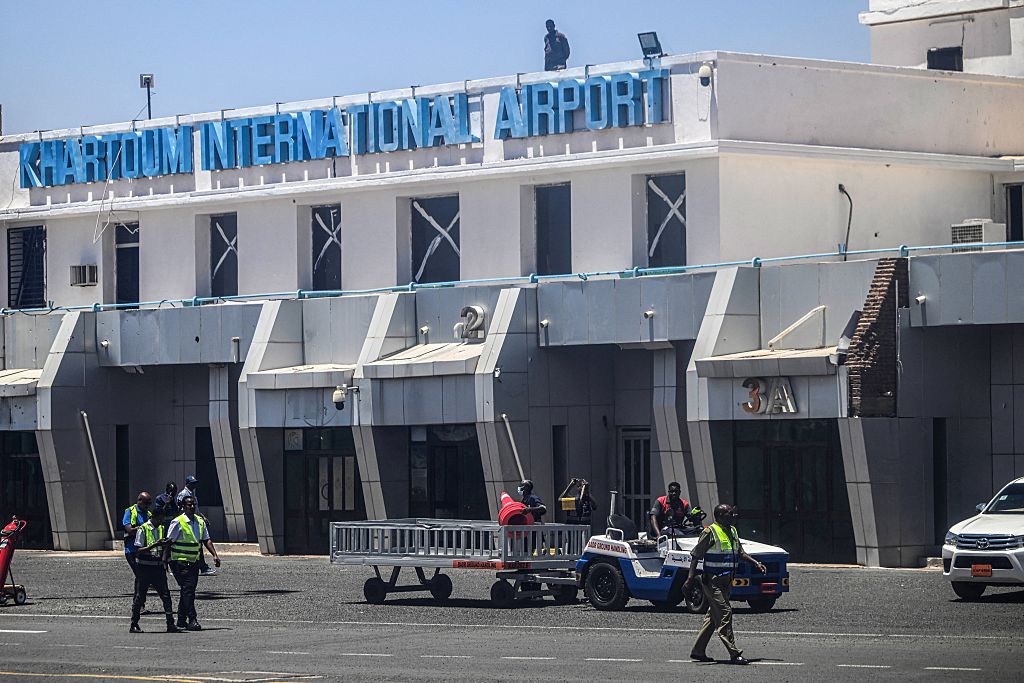
Since Sudan’s civil war began in 2023, there has been widespread fear that prolonged fighting could spill across its borders and spark broader conflict in the Horn of Africa.
In early May, a barrage of drone strikes hit Khartoum’s airport and upended what had been a burgeoning sense of normalcy in the Sudanese capital. The drones targeted civilian terminals and struck a radar and an air defense system just one week after 300 citizens returned on the first international flight since the war began.
“The episode marks a dangerous escalation in what has become one of the world’s most tangled regional proxy conflicts,” Sudan expert Elfadil Ibrahim wrote in a May 5 analysis for The Arab Weekly newspaper. “Sudan’s three-year civil war between the SAF (Sudanese Armed Forces) and the paramilitary Rapid Support Forces (RSF) has steadily drawn in outside powers, each pursuing its own agenda.”
In a May 5 news conference, the SAF accused Ethiopia of committing a “direct act of aggression against Sudan.”
“Technical teams analyzed the aircraft’s data and communicated with the manufacturer, which confirmed that the drone, bearing serial number S88, is owned by the United Arab Emirates,” Sudan’s Foreign Affairs ministry wrote in a statement. “It also confirmed that the drone was operated from within Ethiopian territory, specifically from Bahir Dar Airport.”
In issuing a denial on the same day, Ethiopia accused the SAF of giving weapons and money to Tigrayan mercenaries and “thereby facilitating their incursions along Ethiopia’s western frontier.”
“There is ample and credible evidence showing that Sudan is serving as a hub for various anti-Ethiopian forces,” the statement read. “It is evident that these hostile actions, as well as the recent and earlier series of allegations by officials of Sudanese Armed Forces, are undertaken at the behest of external patrons seeking to advance their own nefarious agenda.”
Experts believe the mention of “external patrons” was a thinly veiled reference to Egypt, which is the SAF’s biggest supporter. The intensifying war of words points to the intertwined complexities of Sudan’s war and Ethiopia’s internal and regional conflicts.
As prime minister of landlocked Ethiopia, Abiy Ahmed has rattled neighbors Eritrea and Somalia with threats of gaining access to the Red Sea by force. In western Ethiopia, his Grand Ethiopian Renaissance Dam project triggered a war of words with Egypt over control of the Nile River.
Four years after the Tigray War, which killed an estimated 600,000 people, the Ethiopian government has accused Eritrea of supporting and coordinating with the Tigray People’s Liberation Front, a paramilitary group. Ethiopian federal forces also are fighting militias in two other semiautonomous regions, Amhara and Oromia.
While the governments of Egypt, Eritrea and Sudan continue to forge closer ties, some analysts caution against describing their growing partnership as an anti-Ethiopia bloc.
“The term ‘bloc’ may be too rigid for the realities of the Horn of Africa,” Yonas Yizezew, a researcher at Horn Review, told the Africa Report for a June 9 article. “What appears to be emerging is not a formal alliance but a convergence system in which different actors increasingly find themselves aligned around overlapping strategic concerns regarding Ethiopia’s growing regional influence.”
Crisis Group Horn of Africa director Alan Boswell warned that Sudan’s accusation against Ethiopia marks a dangerous turn in an already destabilized region.
“Both countries … are facing massive internal challenges, and essentially, both sides now see the other as supporting their armed opponents,” he told Al Jazeera, adding that the heightened tension “creates a very dangerous dynamic … and risks making their own internal challenges much worse.”
On May 7, the SAF responded to the drone attacks by announcing that it had bolstered its positions in the East Gallabat, Basunda and Al-Fashaga regions of Gedaref State bordering Ethiopia.
“The main trigger really is just that this war in Sudan just continues to escalate with no clear off-ramp,” Boswell said, “and it is really starting to tear apart the Horn of Africa region.”