

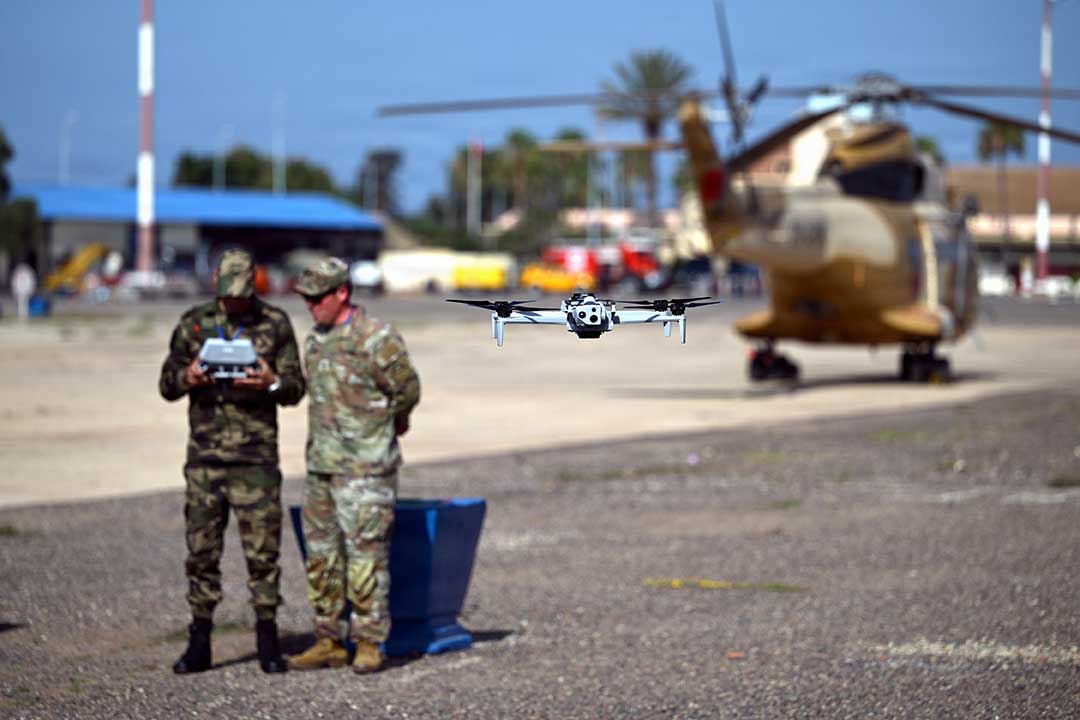
More than 5,600 people from about 40 nations studied new military technology during Exercise African Lion in Ghana, Morocco, Senegal and Tunisia from April 20 to May 8.
“This iteration focused heavily on innovation and advanced technology alongside humanitarian aid, reflecting the constructive dynamics that makes African Lion exercise a truly valuable opportunity for all participants,” Moroccan Armed Forces Brig. Gen. Reda Shuaib said after the final field exercise in Tan-Tan, Morocco.
The largest multinational military exercise on the continent, African Lion is also United States Africa Command’s (AFRICOM) largest annual joint exercise. Organized by U.S. Army Southern European Task Force, Africa, the exercise emphasized innovation, interoperability and partner-led regional security.
“More than 40,000 military personnel have participated in the last five editions of this exercise, thus testifying to the commitment of our partners and the importance of this annual event,” one of the Moroccan military planners said.
During the opening ceremony at the headquarters of the Southern Zone Command in Agadir on April 27, Moroccan Lt. Gen. Mohammed Benlouali, chief of staff of the Southern Zone, said the exercise represents an important step in strengthening military cooperation between Morocco and all participating countries.
“This exercise seeks to strengthen partnership and integration in areas of planning, to upgrade operational readiness, thereby contributing to the gradual improvement of operational performance, the expansion of areas of cooperation, and the enhancement of expertise and skills at various levels and in various specialties,” he said.
The 22nd iteration of African Lion marked a shift from traditional firepower-based tactics toward advanced command and control systems integrating modern technologies, such as drones, autonomous vehicles, remotely controlled firing systems and artificial intelligence.
Along with advanced surveillance and reconnaissance systems, exercise planners integrated the new technology into the planning and execution of training exercises. African Lion 26 also expanded into new arenas, such as cybersecurity, electromagnetic warfare and space operations.
An academic phase from April 20-30 supported the command and field exercises. It included 20 special units using emerging technologies, including drones, cybersecurity tools and space-related operations.
More than 40 military technology vendors were also on hand, allowing participants to use the exercise as a live testing ground for products that addressed specific needs, such as mission command systems, deep-attack capabilities, defense-in-depth enablers and counterattack integrators.
In Kap Draa, near the city of Tan-Tan and the mouth of the Draa River, modern military technology featured prominently in a large-scale attack simulation that marked the conclusion of African Lion in Morocco. Moroccan Lt. Col. Yassine El Semlali, deputy commander of field operations at Ras Draa, said the capstone event had tremendous practical value.
“All of these technologies have confirmed the strategic nature of these exercises as they’ve provided significant capabilities, such as reducing decision-making time and increasing targeting accuracy and saving lives,” he said in an interview with Moroccan television network Medi 1. “The tactical exercise in Kap Draa allowed for an assessment of the readiness and effectiveness of these systems and the possibility of integrating them into real battlefields.”
The demonstration tested the abilities of forces to repel an assault and convert it into a sweeping counteroffensive. Fighters used early warning systems and drones to locate enemy positions before transitioning from defensive to offensive operations.
Using tanks, artillery, other armored vehicles and infantry, Moroccan ground units neutralized enemy assets and breached their lines before destroying advancing columns. They were supported by seven new Apache attack helicopters that the Royal Air Force recently received, emphasizing its increasing integration of modern technology and AI-enhanced command and control systems.
Moroccan Royal Air Force Capt. Adnan Ma al-Aynayn said it was exciting to lead his Apache squadron alongside the U.S. Air Force for the first time.
“We exchanged expertise and modern tactics in the field,” he told Medi 1 TV. “This exercise gave us the opportunity to work in a multinational environment while always prioritizing safety and the precise and effective execution of missions.”
In a symbolic gesture, several Moroccan F-16 fighter jets escorted two U.S. Air Force B-52 bombers as they flew over Kap Draa on April 23.
“Their visible presence over Morocco, operating alongside Royal Moroccan Air Force fighters, signals credible deterrence and reinforces the U.S. commitment to regional security,” AFRICOM Commander Gen. Dagvin Anderson said.
“No longer confined to land, sea and air, the character of war is evolving rapidly,” he said. “African Lion serves as a laboratory for innovation, where we test, learn, and adapt in real time so we are prepared for the challenges of tomorrow.”
In Tunisia, AFRICOM Deputy Commander Lt. Gen. John Brennan said more than 500 military personnel from African and allied nations took part in weeks of high-intensity training that focused on large-scale combat operations, crisis response and humanitarian assistance.
“As a collective from over 40 nations, this year’s African Lion demonstrates the continued growth and relevance of this premier exercise,” he said during the closing ceremony on April 29. “The sheer scale of this combined, joint and interagency exercise demonstrates the depth of unity and diversity of capabilities that the coalition of the willing we’re a part of can be brought to bear against common threats.”