
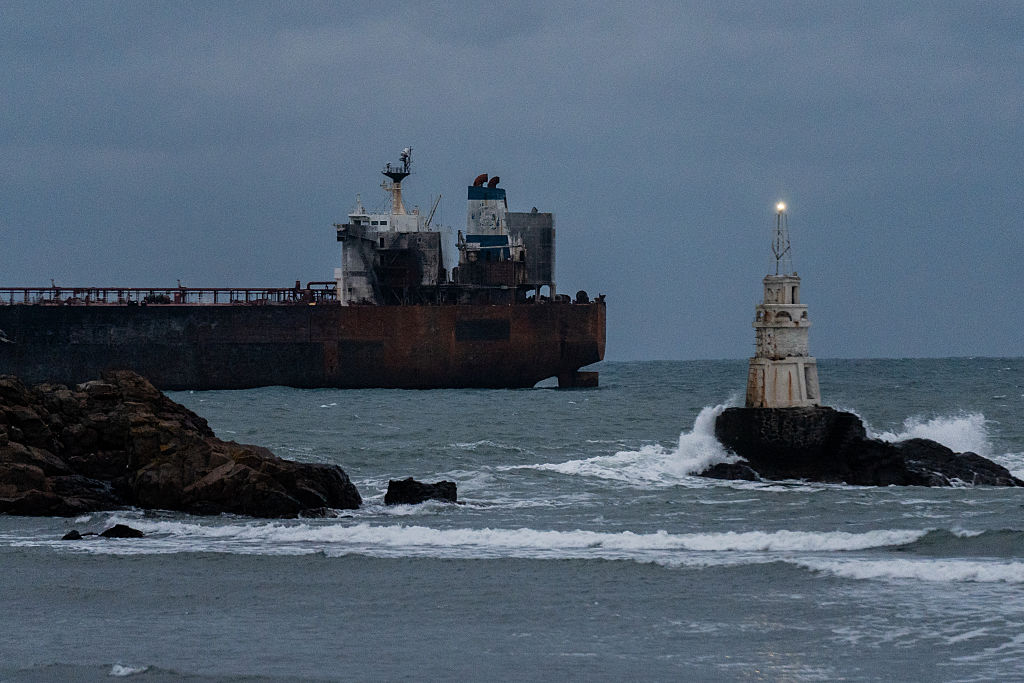
From the ports of Cameroon to the islands of Comoros, Russian vessels are increasingly registering tankers under African flags to keep its widely sanctioned, oil-exporting “shadow fleet” operating. Russia needs to continue transporting oil to fund its costly invasion of Ukraine.
Researchers at the Robert Lansing Institute say that Moscow targets African shipping registries because it lets the shadow fleet obscure the true ownership of its oil-carrying tankers. African shipping registries often are plagued by weak mechanisms to verify a vessel’s registration, operators and ownership origins.
“In practice, this means that ships can continue operating within international shipping networks while remaining shielded from direct enforcement actions,” even if they are already sanctioned, institute researchers wrote in a March report.
According to the Centre for Research on Energy and Clean Air, Moscow’s shadow fleet transported almost half of Russia’s seaborne oil in March. The fleet consists of up to 591 ships that carry up to 4.1 million barrels of oil a day, although some now carry natural gas. The fleet, which operates globally, generates up to $100 billion in revenue annually.
Complicating Enforcement
In Africa, Russia commonly registers its vessels under “false flags,” while its fleet also flies “flags of convenience” and engages in “flag hopping” to evade sanctions.
False flagging is when a tanker claims registration with registries that do not exist or have been shut down. According to the Lansing Institute, more than half of the global cases of false flag registration are linked to African jurisdictions. Last year, false flag registries were discovered in Angola, Benin, Eswatini, Guinea, Malawi, Mali and Mozambique, windwardai.com reported.
“The growing concentration of Russian-linked vessels within African registries indicates that the shadow fleet is evolving into a stable and institutionalized logistics network rather than a temporary workaround,” the Lansing Institute reported. “The fact that more than half of documented false-flag cases occur within African jurisdictions suggests the emergence of a consistent concealment channel used systematically by shadow fleet operators.”
Flying a flag of convenience is when a vessel flies the flag of a country other than the one that owns it. Flag hopping refers to routinely registering with new flag states to avoid detection.
“For Moscow, African flags have become a practical means of concealing shadow fleet operations behind foreign jurisdiction,” the report said. “Once vessels sail under the legal protection of another country’s registry, enforcement becomes far more complex.”
‘Enabling Sanctions Evasion’
Due to the high-risk tankers linked to Russia’s shadow fleet, Benin, Comoros, The Gambia, Guinea and Sierra Leone have experienced large increases in registered tonnage.
The European Union, United Kingdom and United States blacklisted 110 Comorian-flagged ships in 2025 for participating in oil shipments that fund Russia’s war economy, maritimecrimes.com reported. The ship registry in Cameroon alone has increased by 126% over the past year, the Institute for Security Studies (ISS) reported in March.
“These figures suggest that African registries are no longer marginal players in the global maritime system but have become central nodes in the infrastructure enabling sanctions evasion,” the Lansing Institute reported.
In early 2026, Germany identified the tanker Range Vale, which claimed registration in Zimbabwe, as part of Russia’s shadow fleet. Zimbabwean authorities notified the International Maritime Organization (IMO) about the incident, but the Range Vale still operates, now under a Sierra Leonean flag, according to the Marine Vessel Traffic monitoring platform.
Last year, Malawi called for action against the fraudulent use of its registry after eight incidents of improper use of its flag were recorded. Like many African countries, Malawi does not operate an international ship registry.
“It is hoped that Interpol is going to investigate these illegal activities,” David Mzandu, Malawi’s secretary for transport and public works, wrote in a letter to the IMO. “In addition, it will be noted that these fraudsters provided signatures, a fake Government seal, contact details, and an entity that is not related to the Malawi Government.”
In 2024, the IMO found that all Eswatini flags were false after several ships claimed registration with the country, the ISS reported. Landlocked Eswatini does not have a flag registry, nor is it an IMO member.