
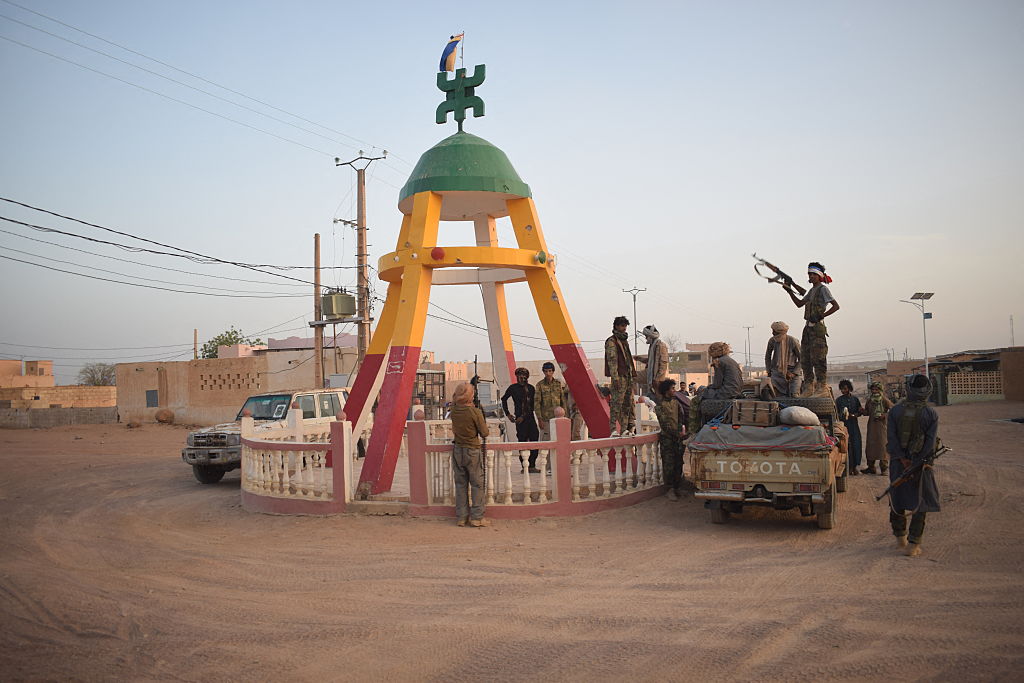
The retreat of Malian and Russian forces from Kidal after their defeat by combined insurgent forces at the end of April called into question the value of the Malian junta’s counterterrorism strategy, which relies heavily on Russia’s Africa Corps private military contractor.
The cost of Africa Corps’ services —estimated to be around $10 million a month for a contingent of around 2,000 mercenaries — has many experts thinking the government should demand a stronger commitment to justify a return on investment.
According to Habib Al Badawi, a professor of international relations at Lebanese University, the image of Russian forces abandoning the community they helped Malian forces capture in 2023 proved a powerful propaganda victory for Jama’at Nusrat al-Islam wal-Muslimin (JNIM) and the Tuareg-based Azawad Liberation Front (ALF).
The West Africa program lead for the Konrad-Adenauer Stiftung think tank Ulf Laessing told Al Jazeera that “Africa Corps has really lost credibility” with their retreat from Northern and Central Malian bases.
Al Jazeera’s Nicolas Haque reported that several dozen Malian army, police and paramilitary forces were left behind to be taken captive at Kidal, in addition to valuable Russian mercenary equipment such as a drone operating station.
The loss of Kidal was the latest defeat for Africa Corps, the 2,500-member Russian government-controlled successor to the Wagner Group that first arrived in Mali in 2021.
In July 2024, Tuareg rebels ambushed fighters with the then-Wagner Group and Malian troops in Tinzouatin near the Algerian border. The battle killed 80 or more Russian fighters and up to 54 Malian soldiers. It remains one of the deadliest days for Russian forces since Wagner arrived in Africa in 2017.
Wagner’s business model in Africa is simple: regime security in exchange for natural resources. Wagner tested its model in the Central African Republic in 2019, where its fighters became security for President Archange-Faustin Touadéra while affiliated companies took over gold and diamond mining operations in the countryside.
Wagner used brutal tactics against people who it accused of seeking to overthrow Touadéra, often targeting civilians for executions and other human rights violations.
Wagner brought similar tactics to Mali in 2021 and Burkina Faso and Niger later. In those cases, Russian companies mined gold, uranium, lithium and other valuable minerals to help Russian President Vladimir Putin avoid international sanctions and finance his invasion of Ukraine.
As an example, Russia is banned from selling gold, however Mali is not. A Russian-built gold refinery in Mali will help Russia avoid international sanctions by laundering Russian gold through Mali, according to a report by the Robert Lansing Institute for Global Threats and Democratic Studies.
The trading of natural resources in exchange for the promise of security has failed to prevent the expansion of the jihadist insurgency into the once-safe central and western regions of Mali and now threatens state collapse.
Africa Corps’ has shifted to a model that focuses on regime protection while offering training and equipment. Experts say ceding the countryside to JNIM insurgents will only allow them to grow stronger.
“It may temporarily shield ruling authorities from collapse, but it expands ungoverned spaces, intensifies insurgencies, and undermines prospects for political reconciliation,” Lansing Institute analysts wrote recently.
As in the CAR, Wagner mercenaries in Mali routinely accompanied soldiers into the field and brutally attacked civilians suspected of working with terrorist groups. International watchdogs estimate that civilian deaths in Mali tripled after Russian mercenaries entered the picture.
“The Russian approach has alienated local populations,” according to Lansing Institute analysts wrote. “Reports of abuses — mass killings, forced disappearances, and sexual violence — have undermined any legitimacy the Malian government hoped to build through its alliance with Moscow.”
That, in turn, has pushed more people into the arms of terrorist groups and worsened ethnic tensions, the analysts added.
The defeats at Kidal and Tinzouatin expose the weakness of Russia’s African mercenaries and the cost for leaders relying on Russia to guarantee their security, according to analysts John J. Chin, Haleigh Bartos and Aleksaundra Handrinos at Small Wars Journal.
“Not only have Russian forces proved unable to quell domestic instability in most places they operate, but they have also left a trail of human rights abuses and exacerbated local grievances in the process,” Chin, Bartos and Handrinos wrote.
“The real question,” they added, “is not whether but how quickly Russia’s weaknesses as a primary security partner will be exposed.”