

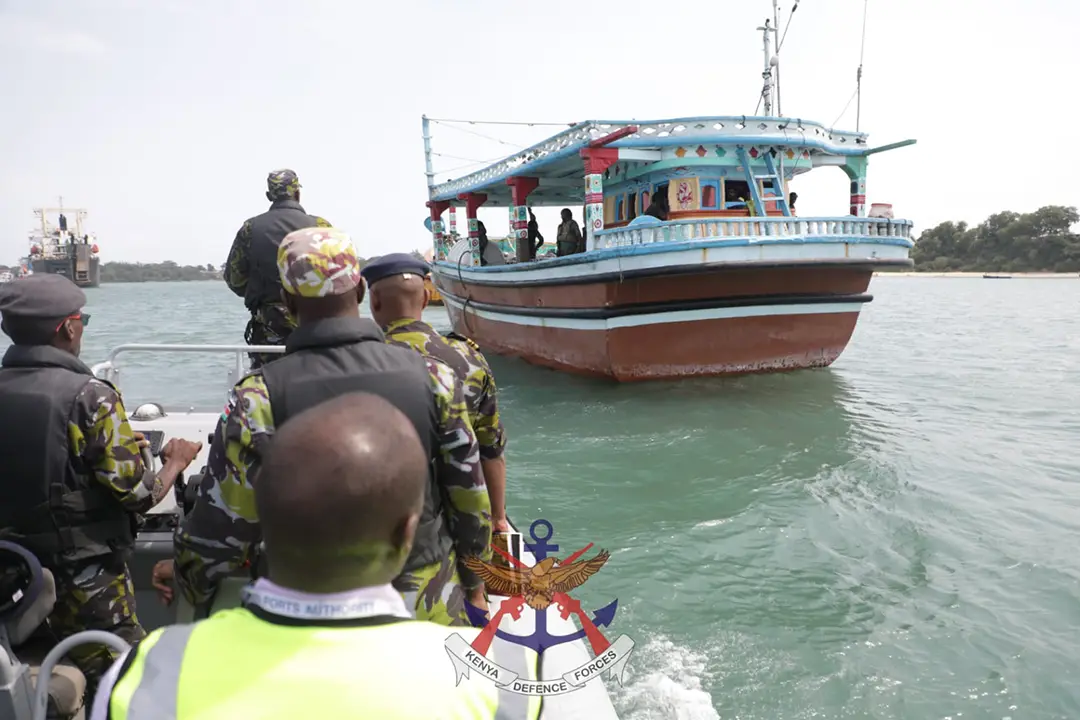
The Kenya Navy discovered more than a metric ton of methamphetamine when it intercepted the MV Mashallah, a small, unregistered fishing boat, about 340 nautical miles east of the coastal Kenyan town of Lamu in October 2025. Authorities arrested six Iranians on charges of trafficking the drug, which was valued at $63.4 million and found to be 98% pure. The seizure was the result of a coordinated multinational operation targeting drug trafficking along Indian Ocean shipping lanes. Authorities said the boat was bound for Kenya.
Once known as a transit hub for illegal drugs, the East African coast is becoming a destination for methamphetamine, while regional shores also are targeted by smaller vessels involved in illegal, unreported and unregulated (IUU) fishing; piracy; and drug, weapons and wildlife trafficking. According to Willis Okumu, a senior researcher at the Institute for Security Studies, criminals typically operate small vessels without visible national markings to obscure their ownership and easily move illegal goods.
“While drug trafficking is the most visible manifestation, these vessels support a vast criminal economy,” Okumu wrote. “Off Somalia’s coast, unregistered dhows have been used as ‘motherships’ to launch piracy attacks on commercial vessels and smuggle weapons.”
Commercial vessels have been forced to take longer routes around the southern tip of Africa due to disrupted maritime traffic around the Red Sea, Gulf of Aden and other regional waters. Authorities recorded three Somali piracy-related incidents between January and March, but the number rose sharply in April, when seven attacks were recorded. By August 24, the Indian Navy, the United Kingdom Maritime Trade Operations Centre and the Maritime Security Centre-Horn of Africa had tallied 29 Somali piracy incidents.
Yemen’s Iranian-backed Houthi rebels support the al-Shabaab terror group in Somalia, and there have been instances of unregistered vessels smuggling weapons into the country. In one 2023 case, security officials intercepted a vessel carrying more than 2,000 AK-47 rifles bound for al-Shabaab in international waters between Iran and Yemen, a route historically used to traffic weapons to the Houthis.
Unregistered vessels are linked to IUU fishing around the continent. Somalia alone loses $300 million annually to illegal fishing.
Unregistered vessels often lack legitimate fishing licenses and participate in many prohibited practices, including bottom trawling, which involves dragging a net along the seafloor, indiscriminately scooping up all manner of marine life. This kills juvenile fish, leading to declining fish stocks and destroyed ecosystems, all of which threatens the livelihoods of tens of thousands of artisanal fishermen in coastal East African communities.
Limited patrol capacity exacerbates the issue, and Okumu pushed for a “sustained regional strategy” that “combines regional and state intelligence with community-led vigilance” to enhance regional maritime security operations.
Okumu highlighted the potential of The Jahazi Project. Launched in September 2025 by Ascending Africa, a pan-African organization committed to fostering sustainable development, the project aims to strengthen protections against illegal fishing. Participating nations include Comoros, Kenya, Madagascar, Mauritius, Mozambique, Seychelles, Tanzania and the Tanzanian archipelago of Zanzibar, which loses an estimated $415 million annually to the scourge.
The project’s first phase will focus on coastal areas near Kenya, Mozambique and Tanzania. Tasks will include establishing community-driven marine conservation zones and supporting joint surveillance patrols.
“The Blue Economy holds enormous potential for East Africa, but this promise is at risk,” Michael Mallya, the project’s spokesperson, told the International Collective in Support of Fishworkers. “With The Jahazi Project, we are committed to joining forces, amplifying efforts, and ensuring our oceans remain abundant for generations to come.”
Smaller, unregistered vessels also are used to illegally move wildlife from East Africa to Asian markets. According to Okumu, these vessels are used to smuggle tortoises from Madagascar and rhino horns from Northern Mozambique to larger ships in the Indian Ocean.