

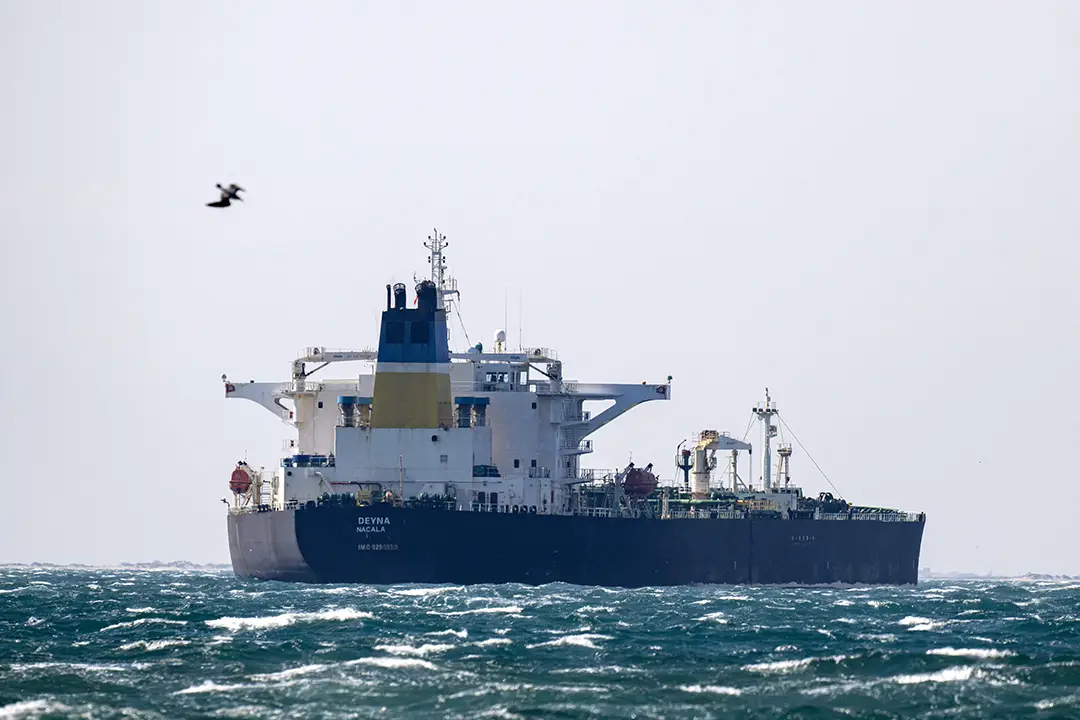
Vessels connected to Russia’s widely sanctioned “shadow fleet” are abusing continental shipping registries to continue exporting oil and fund Moscow’s war with Ukraine.
Russia uses African shipping registries to obscure the true ownership of the shadow fleet’s 591 aging, oil tankers that carry up to 4.1 million barrels of oil a day. The fleet, which also has begun carrying natural gas, generates about $100 billion annually.
According to researchers at the Robert Lansing Institute, shipping registries in Africa often have weak mechanisms to verify a vessel’s registration, operators and ownership. Russia commonly registers its vessels under “false flags,” while its fleet also flies “flags of convenience” and engages in “flag hopping” to evade sanctions.
False flagging is when a tanker claims registration with registries that do not exist or have been shut down. Flying a flag of convenience is when a vessel flies the flag of a country other than the one that owns it. Flag hopping refers to routinely registering with new flag states to avoid detection.
“For Moscow, this is particularly valuable,” institute researchers wrote in March. “The issue is not simply finding a convenient jurisdiction, but exploiting significant gaps in global maritime oversight. The weaker the mechanisms for verifying vessel registration, operators, and ownership origins, the easier it becomes to integrate such ships into the formal infrastructure of international maritime trade.”
More than half of the global cases of false flag registration are linked to African jurisdictions, according to the institute. Last year, false flag registries were discovered in Angola, Benin, Eswatini, Guinea, Malawi, Mali and Mozambique, according to Windward, an artificial intelligence company specializing in maritime intelligence. Russia’s fleet also disables tracking systems and conducts ship-to-ship transfers to conceal the origin of its cargo. Shadow fleet tankers usually are affiliated with complex business schemes.
According to the Loyd’s List digital maritime news platform, shadow fleets commonly use websites affiliated with marinegov.net that appear as fake government ship registers or national maritime authorities. These include a site in Namibia that claims to operate under the nonexistent “Directorate General of Shipping,” while an illegitimate “Cameroon Maritime Administration” runs a fictitious ship registration and seafarer licensing department.
Other pages pose as national maritime administrations and ship registries in Benin, Chad, Equatorial Guinea, Malawi and Zambia.
Fraudulent flag registries associated with marinegov.net were identified in Benin, Cameroon, Malawi, Mauritania and Namibia. Last year, Lloyd’s List revealed as fraudulent the “Malawi Maritime Administration,” prompting the Malawian government to issue a warning to the International Maritime Organization.
Last year, 110 Comorian-flagged vessels were blacklisted by the European Union, United Kingdom and United States over their involvement in Russian oil transport, according to MariTimes Crimes, a website that covers maritime security news. The Comoros is one of the most frequently misused registries globally, according to Africa Business Insider.
The ship registry in Cameroon alone has increased by 126% over the past year, the Institute for Security Studies (ISS) reported in March. Shadow fleets have used pirated digital platforms to forge the signatures of Cameroon’s maritime district heads to get phony registration certificates, bills of payment and other documents, according to ISS Today.
In June, a Cameroon-flagged tanker carrying about 800,000 barrels of Russian crude oil ran aground off the coast of Oman, threatening protected marine areas and local ecosystems. According to the Business Insider Africa digital news website, the Caroline Bezengi switched flags several times before being listed under Cameroon in November 2025.
Cameroon has begun working to deregister and sanction foreign vessels that illegally register with the country. The reforms include suspending new registrations of vessels operating outside Cameroonian waters and auditing the country’s shipping register. Authorities also are pushing to strengthen the country’s digital vessel registration process to reduce fraud and improve traceability.
“The broader challenge extends beyond sanctions enforcement,” Lansing Institute researchers wrote in July. “The same weaknesses that facilitate Russian oil exports also enable narcotics trafficking, illegal fishing, money laundering, arms smuggling, and other illicit maritime activities, making Cameroon’s registry a growing concern for international maritime security.”
In June, the European Union expanded the mandate of its Mediterranean naval mission, Operation Irini, so that it can now detain and inspect vessels suspected of belonging to Russia’s shadow fleet, a move that Moscow protested. Within weeks, the operation boarded and inspected three vessels using fake Cameroonian registration, Reuters reported. Since January, five other boats seized by Belgian, British, French and Swedish navies flew Cameroonian flags.
Cameroon is “cooperating with international authorities and organizations to enforce maritime rules, protect the credibility of its naval registry, and fight against irregular registrations,” its transport ministry said in a statement to Reuters.