

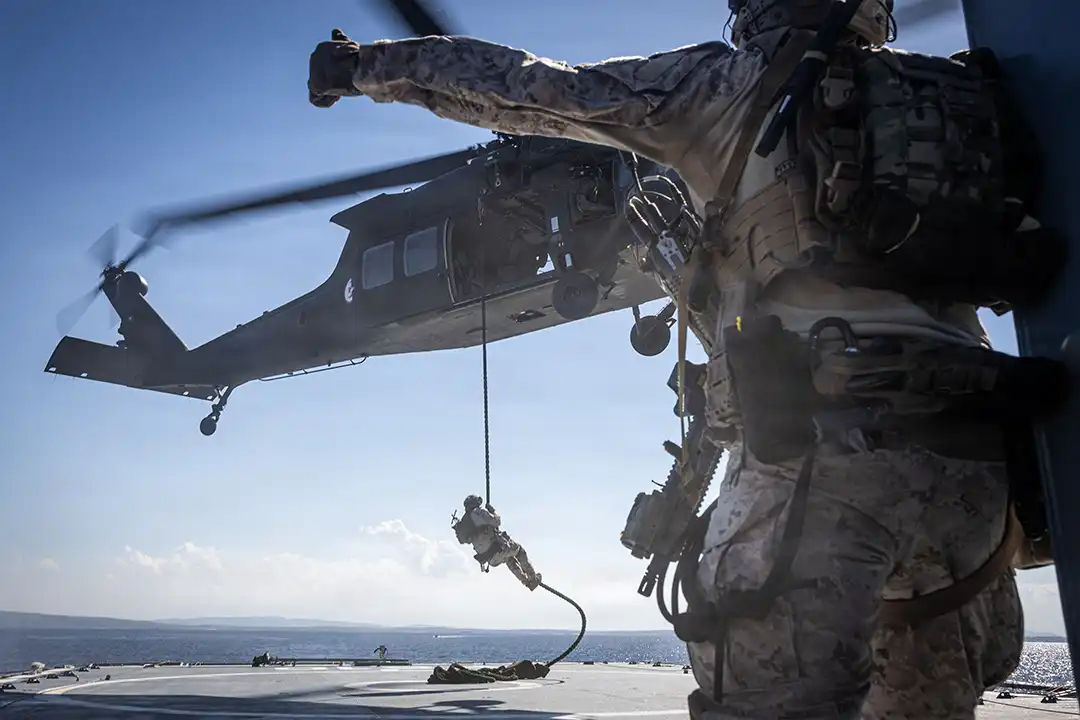
Members of the Tunisian Special Operations Maritime Task Group rappelled from a Tunisian UH-60M Black Hawk helicopter and onto a large vessel in the Mediterranean Sea. Joined by United States Marine Corps members, they then descended a staircase onto the deck, where they searched for contraband, opened a hatch and pointed their guns inside.
The forces were participating in a visit, board, search and seizure operation during Phoenix Express 2026, a 12-day event. It encouraged international collaboration to address human trafficking, illegal fishing, piracy and fuel smuggling in the region. Tunisia hosted the training, sponsored by United States Africa Command and led by U.S. Naval Forces Africa. It ended September 18.
“Tunisia has been proud to host Phoenix Express and welcome our partners from across the region and beyond,” Tunisia National Navy Commodore Rejeb Gara Ali said in a statement. “Bringing our forces together here creates an opportunity to exchange expertise, conduct advanced training and strengthen the cooperation that contributes to a safer, more secure maritime environment.”
Fourteen nations with maritime interests in the Mediterranean Sea participated in the exercise. Activities during the 21st iteration included joint search-and-rescue drills, simulated ship boardings and live demonstrations aimed at improving tactical coordination. Other participating countries included Algeria, Belgium, Egypt, France, Georgia, Italy, Libya, Mauritania, Morocco, Türkiye, Saudi Arabia and Spain.
The exercise included land-based and at-sea phases in which regional maritime operations centers exchanged real-time data to guide operational efforts. The U.S. 6th Fleet also worked with participating countries to integrate advanced systems and tracking tools designed to detect and deter criminal operations in African exclusive economic zones. In-port and land-based exercises incorporated the use of Tunisia’s Multinational Communication Center to improve communications among the forces. This phase also included intelligence exchanges and academic and legal workshops.
“True partnership is not defined by the size of our respective fleets or our contributions, but by our willingness to align our efforts, share our responsibilities and work as a unified team,” said Vice Adm. J.T. Anderson, commander of U.S. 6th Fleet and Naval Striking and Support Forces NATO. “Over the past two weeks, our crews have proven that we are bound by shared interests and shared responsibilities, maintaining a safe, secure, stable and open Mediterranean.”
The area is targeted by vessels fishing illegally or using banned methods. In Tunisia, some of those ships use bottom trawling, which involves dragging huge nets across the ocean floor, indiscriminately scooping up marine life. This kills juvenile fish, decimates fish stocks and destroys ecosystems. Tunisia loses up to $65 million annually to the destruction of seagrass meadows that help sustain marine life.
Although piracy in the waters between Tunisia and Italy is not as common as it is off the Somali coast, the area does occasionally experience attacks.
In August 2024, Tunisian authorities arrested four Tunisians, including one fisherman, on suspicion of piracy. The suspects intercepted a vessel bound for Italy, stole its engine and robbed its passengers of money. This was one of several such incidents recorded that year, but none have been recorded since. International collaboration against the scourge is believed to be an effective deterrent, analysts say.