

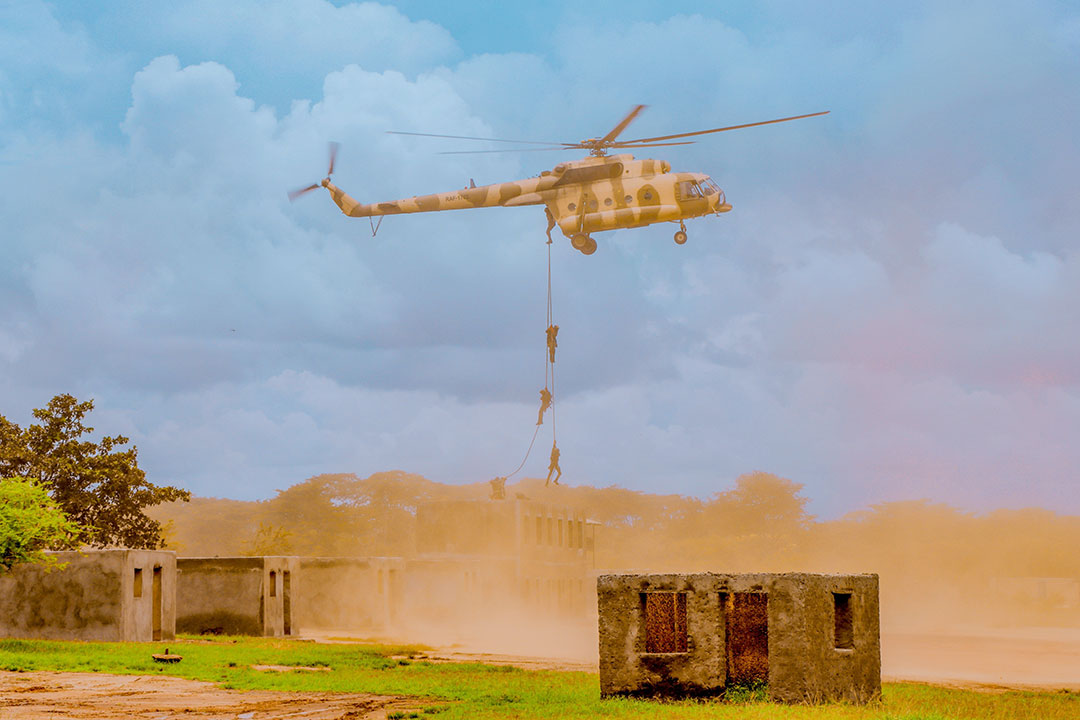
The African Union, the United Nations and other international partners have helped create increasingly sophisticated regional coordination mechanisms, but those efforts can be hindered when participating countries work from different doctrinal philosophies.
“Multilateralism matters because individually we are quite weak, and collectively this is what provides us much stronger avenues for rules that better benefit us and leads us to a more stable and sustainable development pathway,” Gustavo de Carvalho, head researcher at the South African Institute of International Affairs, said during a February 24 webinar about shaping multilateral peace and security reforms. The European Centre for Development Policy Management and the South African Institute of International Affairs conducted the webinar.
Effective interoperability remains a significant hurdle for multilateral African-led peace operations. Terrorism has necessitated a regional response in several of Africa’s most complex conflict environments, such as the Democratic Republic of the Congo, northern Mozambique and Somalia.
In multinational security missions, troops increasingly are exposed to various tactical approaches delivered through multiple foreign training programs. This has fragmented individual countries’ military doctrine, hindered integration into multilateral missions, undermined operational planning and reduced the effectiveness of joint offensives, according to Maj. Beautah Suba, a peace and security consultant with the Kenya Defence Forces, and Mugah Sitawa, a research consultant with the South Africa-based Institute for Security Studies.
“On the surface, these partnerships strengthen capacity by introducing advanced equipment, modern planning procedures and specialized combat training,” they wrote in a March 20 article for defenceWeb, a South African security news website. “Yet beneath these benefits lies a structural risk that is gradually shaping battlefield outcomes in the erosion of a unified infantry doctrine within national armies.”
A country’s military doctrine is a set of principles that governs how its forces organize, train, deploy, fight and coordinate within security operations. It standardizes tactics, techniques and procedures across branches, focusing on how to think rather than what to think. It can include anything from available technology and capability to geography and the nature of a nation’s adversaries. It can be offensive or defensive.
In multilateral counterterrorism operations, a unified doctrine would enable infantry and special forces units to work within the same operational framework as air and naval capabilities.
“When doctrine becomes fragmented or diluted by competing tactical systems, even highly trained units can struggle to achieve operational coherence,” the researchers wrote. “This dynamic is increasingly visible across several African conflict theaters where regional and international security assistance has expanded rapidly over the past decade.”
In Somalia’s protracted fight against al-Qaida affiliate al-Shabaab, Egypt, Ethiopia, Eritrea and Kenya have provided training or training support, as have international partners in the European Union, Türkiye, the United Arab Emirates, the United Kingdom and the United States. Within AU missions, Uganda has maintained a long-term role with its forces training Somali infantry battalions and officers in counterinsurgency and peace support operations.
“While these programs have undoubtedly strengthened Somalia’s tactical capabilities, they also introduce diverse doctrinal influences,” Suba and Sitawa wrote. “When combined with training from other partners, the result can be a force where operational methodologies vary significantly across brigades.”
They saw similar patterns emerge in the Central African Republic and the DRC.
“On a case-by-case basis, each of these partnerships contributes valuable expertise and enhances the capabilities of the units involved,” they wrote. “The challenge arises when multiple doctrinal influences converge within a single national army without a unifying doctrine that integrates them. In such environments, formations may operate according to different mission planning cycles, communication protocols or engagement procedures. Commanders coordinating joint operations are forced to reconcile varying tactical approaches, complicating battlefield coordination thus slowing operational decision-making in line with their threat evaluation.”
Suba and Sitawa outlined a structured process that allows militaries operating within bilateral and multilateral security mechanisms to form a unified doctrine. It begins with assessing the strategic operating environment and analyzing threats, terrain and geopolitical dynamics that influence conflict patterns. Intelligence assessments identify insurgent tactics, cross-border networks and emerging security risks.
“When doctrine leads training, international partners reinforce a country’s operational framework rather than introducing competing systems,” they wrote. “In such a model, Special Forces training enhances elite capabilities while remaining aligned with national infantry doctrine, ensuring that tactical specialization strengthens rather than fragments the broader military structure.”