

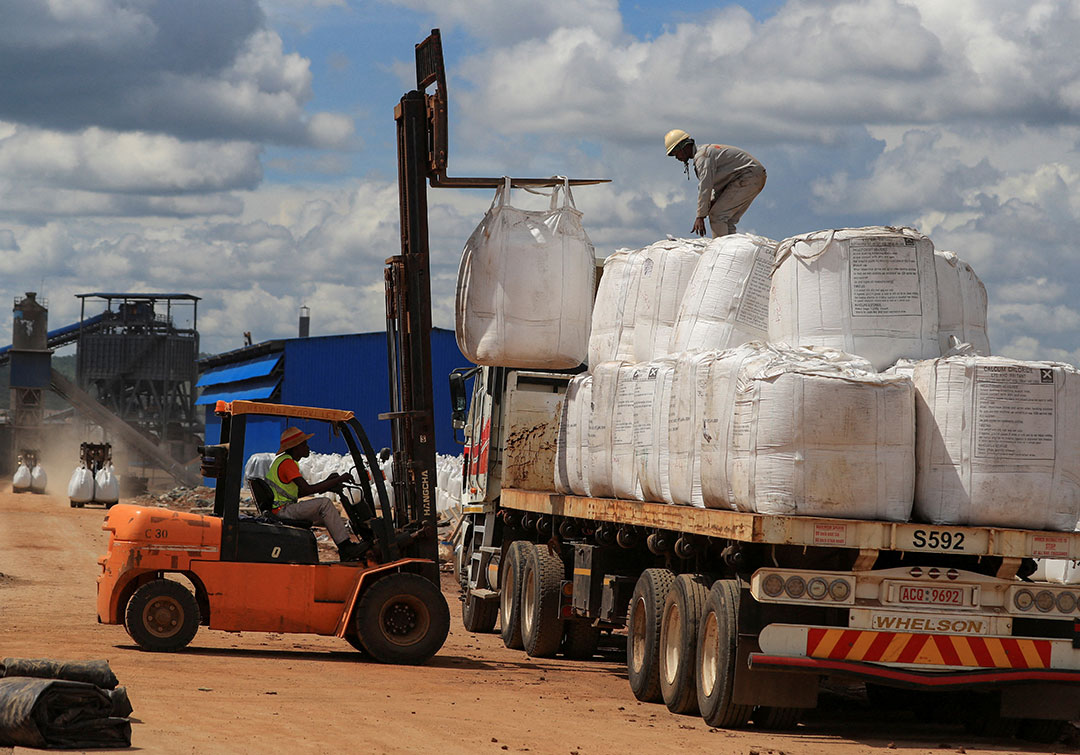
When Zimbabwe announced an immediate ban on the exports of all raw minerals and lithium concentrates in February, international analysts called the move audacious. At home, however, Zimbabweans saw it as a practical matter of protecting the country’s national security.
With the largest lithium reserves on the continent, Zimbabwe has taken control not just of its mineral wealth but also of its relationship with China. Experts say it likely signals a trend throughout Africa.
“Zimbabwe’s lithium export ban in late February changed how resource-rich countries are approaching the global supply chains,” risk intelligence analyst Esther Sit wrote in a March 25 analysis for the website Modern Diplomacy. “By tightening its control over its resources, Zimbabwe has put pressure on China the most, which takes in over 90% of its mineral exports.”
Sit continued: “Zimbabwe’s export ban did not come out of nowhere. Since 2022, Zimbabwe has been tightening its grip on raw lithium ore exports and later expanded to all unprocessed base mineral ores. This move is a core pillar of the country’s Vision 2030 framework, which intends to increase domestic processing and value addition of raw materials.”
Lithium is a critical ingredient in lithium-ion batteries used in the electric vehicle industry and in some batteries for consumer electronics such as laptop computers and smartphones.
Zimbabwe’s ban originally was scheduled to take effect in January 2027, a deadline the government had hoped would push Chinese mining companies to begin processing and refining lithium locally.
Zimbabwe “will be engaging the industry in the near future on new expectations and way forward,” Minister of Mines and Mining Development Polite Kambamura said in a February 25 statement announcing the ban.
The ministry also sent a letter to Zimbabwe’s Chamber of Mines, which represents major mining companies, warning that it would realign export processes due to concern about “continued malpractices during the exportation of minerals.”
“This review is part of a broader effort to curb leakages and enhance efficiency within our systems,” the February 17 letter stated, according to Reuters news service.
Zimbabwe exported 1.128 million metric tons of lithium-bearing spodumene concentrate in 2025, up 11% from 2024. Mining is Zimbabwe’s second-largest contributor to the country’s gross domestic product, accounting for 14.3% of output behind manufacturing, according to World Bank data.
With lithium in high demand worldwide, Zimbabwe took the measures to better control its natural resources. Citizens and activists similarly are calling for the government to hold Chinese mining companies to years of promises to benefit local communities. Nongovernmental organizations in Zimbabwe frequently accuse Chinese businesses of failing to uphold environmental and labor standards.
Up in arms over an open-pit mine operated by Chinese company Chengxi Pvt Ltd., residents of the town of Shurugwi on March 30 filed a petition asking Parliament to intervene over claims of environmental destruction, public health risks and human rights violations.
Harare-based environmental organization Centre for Natural Resource Governance said unsafe mining practices, including the use of cyanide and toxic chemicals, have resulted in severe environmental degradation, loss of biodiversity, hazardous dust pollution causing respiratory illnesses, and contamination of the Mutevekwi River with heavy metals.
“These violations are not just environmental, they are a direct assault on community dignity, health, and livelihoods,” the organization said in a March 30 statement. “The Constitution is clear: natural resources must benefit the people, not harm them.”
Analysts like Sit expect to see more resource-rich countries on the continent follow Zimbabwe’s lead and not only restrict access to minerals without local refinement but extract environmental and labor concessions from Chinese companies as well.
“This development is likely to redefine economic relationships between China and African countries,” Sit wrote. “An extraction-led relationship is giving way to a more transactional, investment-linked partnership. The supply security of those companies will depend on whether they are willing to be involved in downstream investment and technology transfer.”