

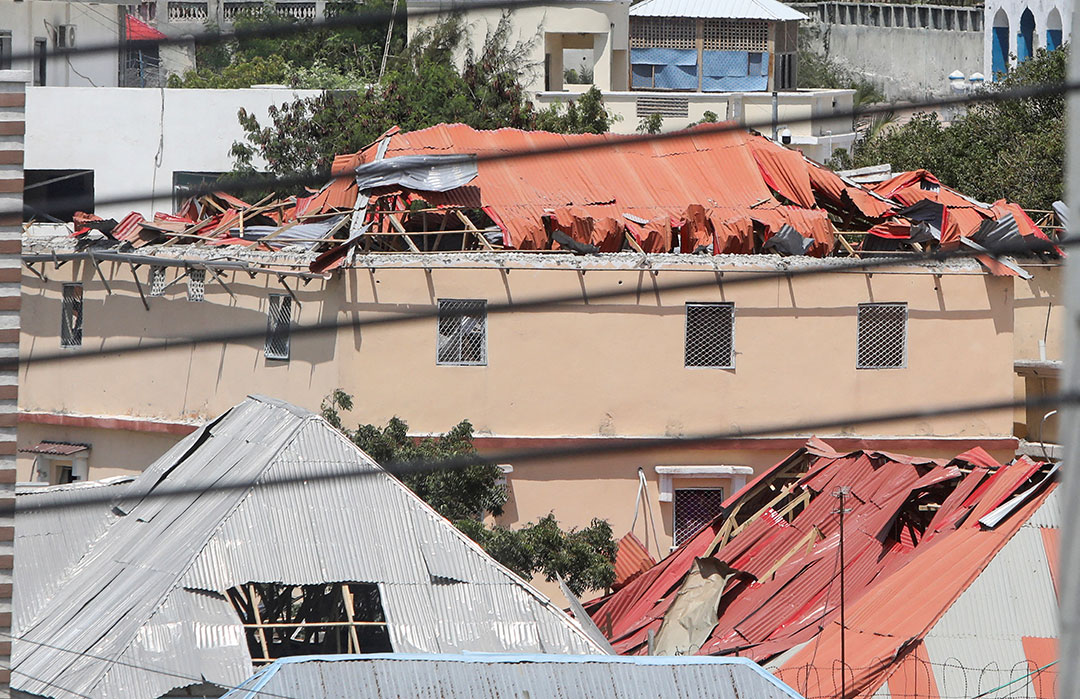
Al-Shabaab’s attack last October on the Godka Jilacow prison in Mogadishu took place with the help of foreign fighters from across East Africa, the terrorist group reported in a recently released video.
The attack on one of the country’s most secure prisons sent shockwaves through the region. Al-Shabaab claimed to have killed more than 40 Somali security personnel. In contrast, the government described the attack as a failure in which the attackers died.
It appears that some of those attackers came from Ethiopia, Kenya and Tanzania, according to the al-Shabaab video. Al-Shabaab has a history of recruiting fighters from neighboring countries as suicide bombers, but the video marks the first time the group has publicly promoted the presence of foreign fighters in a major operation, according to analyst Ayaan Abdullahi.
“The new video suggests that, even when an attack fails to achieve its stated battlefield goals, the group still sees strategic value in the afterlife of the operation — through image-making, narrative control, and the projection of a movement that remains regionally connected and ideologically unyielding,” Abdullahi wrote in Somalia Today.
Foreign fighters also have become a major part of Islamic State Somalia’s strategy in the northern Puntland region. Fighters use smuggling routes across the Red Sea to arrive in Puntland’s Cal Miskaad mountains where IS-Somalia is based.
An IS-Somalia attack on security forces based in Dharjaale in late 2024 involved 12 fighters, none of whom were Somalis.
Some analysts see the presence of foreign fighters among al-Shabaab and IS-Somalia as attempts to establish credibility as international terror groups, not just regional threats.
However, the addition of foreign fighters also might indicate something else: that nearly 20 years into its insurgency, al-Shabaab is having trouble recruiting from Somali communities.
Al-Shabaab has lost thousands of fighters in battles with the Somali National Army (SNA) and regional militias in recent years as the SNA, aided by multinational forces, has increased pressure on the group’s fighters and hideouts.
In early April, for example, national and regional security forces killed 27 al-Shabaab fighters in the Jubba Valley region. Airstrikes in mid-April killed more than 80 al-Shabaab fighters across the Hiiraan, Lower Shabelle, Bay and Lower Jubba regions. In 2025, Somali security forces killed nearly 300 al-Shabaab fighters across various campaigns, according to reports.
As a result, al-Shabaab has made demands that communities under its control provide fighters for its battles against Somali security forces. The group targets boys and men ages 15 to 30.
However, it also recruits orphaned children younger than 15 from displacement camps and communities. It recruits children from the religious schools it operates within its territory.
“Parents who send their children to these schools may not realize that the school is used for military training. By the time they discover the truth, it is too late,” analysts with the website Human Rights Experts wrote in a recent posting.
“This system puts enormous pressure on families,” the group added. “Parents must choose between sending their sons to fight or facing punishment for the entire family. Many families try to send their children away before al-Shabaab comes.”