

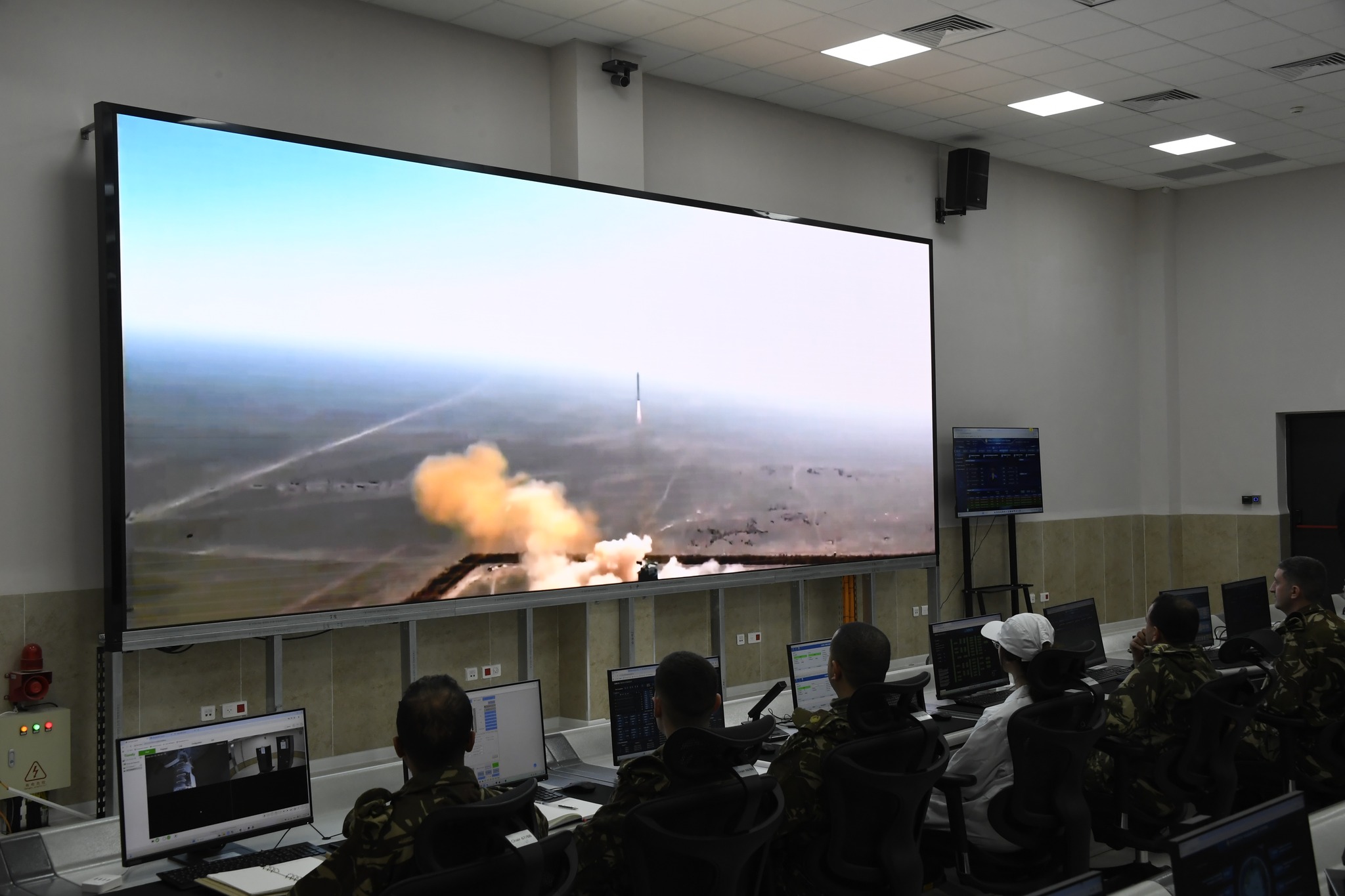
Algeria expanded African nations’ presence in space this year with the launch of two satellites in two weeks in January.
ALSAT-3A and ALSAT-3B brought to 69 the number of satellites African countries have launched into orbit since Egypt’s NileSat-101 in 1998.
Space has become an important frontier for African countries eager to flex their technological muscles and gather data about weather, food security, population movements and other information to help them plan for the future.
Algeria developed ALSAT-3A and 3B to deliver high-resolution images of Earth that will boost its capacity for land-use planning and disaster prevention. They came after ALSAT-2A and ALSAT-2B, both launched in 2010. Algeria’s first satellite, ALSAT-1, went into orbit in 2002.
The second NewSpace Africa Conference addressed the future of the continent’s presence in space in April at a gathering co-hosted by the African Space Agency and Gabon’s space agency, Agence Gabonaise d’Etudes et d’Observations Spatiales (AGEOS).
The three-day conference brought together experts from government, national space agencies, academia, and the commercial space sector to develop strategies for advancing Africa’s future in space.
Conference organizers emphasized the need for that future to drive development across the continent in a fair and equitable way. The goal, according to organizers, is to reframe Africa’s space industry “as not just a frontier of science and innovation, but as a strategic enabler of sustainable development and shared prosperity for every African.”
Tidiane Ouatarra, president of the African Space Agency Council, described the conference as more than a chance to highlight Africa’s progress in space technology, but also “a platform to align our collective vision for space as a driver of sustainable development, economic growth, and global partnership.”
Across nearly three decades, 18 African countries have placed satellites in orbit with Egypt (15) and South Africa (12) leading the way. The satellites are used for observation, communication and other purposes.
Without local launch facilities, African satellites blasted off aboard rockets from Japan, Russia, China, the United States and the European Space Agency’s facilities.
Satellite development has increased as their underlying technology has become cheaper and more readily available. Several African countries made their first steps into space using low-cost CubeSats, which measure about 10 centimeters on each side that can carry a variety of technologies.
Senegal developed the country’s first satellite, Gaindesat-1A, in collaboration with France’s University Space Centre of Montpellier. The CubeSat launched in 2024, a year after Senegal’s Agency for Space Studies (ASES) opened.
Senegal plans to create its own “Space Valley” as a hub for technological innovation and development on the way to launching up to seven more satellites starting in 2028.
“By creating ASES, the State of Senegal has a clear ambition: to make the space sector a cross-cutting lever to impact all areas, and security as a priority,” said Maram Kaïré, ASES director-general. “This partnership will stimulate innovation, strengthen our sovereignty and build the skills of tomorrow.”
In 2025, ASES signed a five-year agreement with the Armed Forces of Senegal to collaborate on gathering data using satellites. The agreement reflects a growing trend on the continent as countries recognize the value space-based technology offers in terms of surveillance, secure communications and national security.
The drive to create an equitable approach to space inspired the African Union to launch the African Space Agency, which opened in Cairo in late 2025. The agency operates on four pillars: improve Earth observation; support satellite communication, navigation and positioning; promote astronomy; and promote space sciences.
The goal is to bring the continent’s fragmented space programs together to collaborate on projects that benefit all Africans, according to Meshack Kinyua Ndiritu, the AU’s space applications training officer.
“The African space program is in the embryonic stage right now,” Kinyua said in an AU video last year. “We are working directly to make sure the member states have the capacity in terms of infrastructure and in terms of human capital development.”