

Russia is sending weapons to its Africa Corps mercenaries on civilian ships, possibly with intelligence officers or defense-industry employees onboard.
Those are among the findings uncovered in a joint investigation by the Dossier Center, Follow the Money, Süddeutsche Zeitung, Danwatch and Delfi, a consortium of European investigative media outlets. The investigation found that 28 people on seven ships used falsified Russian passports without biometric chips, which verify a traveler’s identity, prevent forgery and expedite processing at borders.
These are known as “cover passports,” which are a tool sometimes used in intelligence- or specialized defense-related work, Russian foreign and security policy analyst Nadina Ronc said in the October 19 report.
“These documents may be part of an intelligence operation,” Stiig Wæver, a former Danish Security and Intelligence Service officer, said in the report. “Either they are connected with organized crime or with units that have an indirect connection with the special services or act on their direct orders.”
Analysts at C4ADS, a security research organization, also said the passengers’ personal information looked fabricated.
“Usually, such people for whom there are no other matches [in databases, registries and leaks] are our colleagues [from Russia],” a European source who works in the intelligence field said in the report. “It would be extremely unusual if someone else used fake identity cards.”
En route to Africa, ships with military equipment sail under the protection of Russian warships. Michelle Bockmann, a senior analyst at maritime intelligence company Windward, suggested that the suspected intelligence operatives may be tasked with overseeing crews and preventing vessels from complying with orders from European authorities.
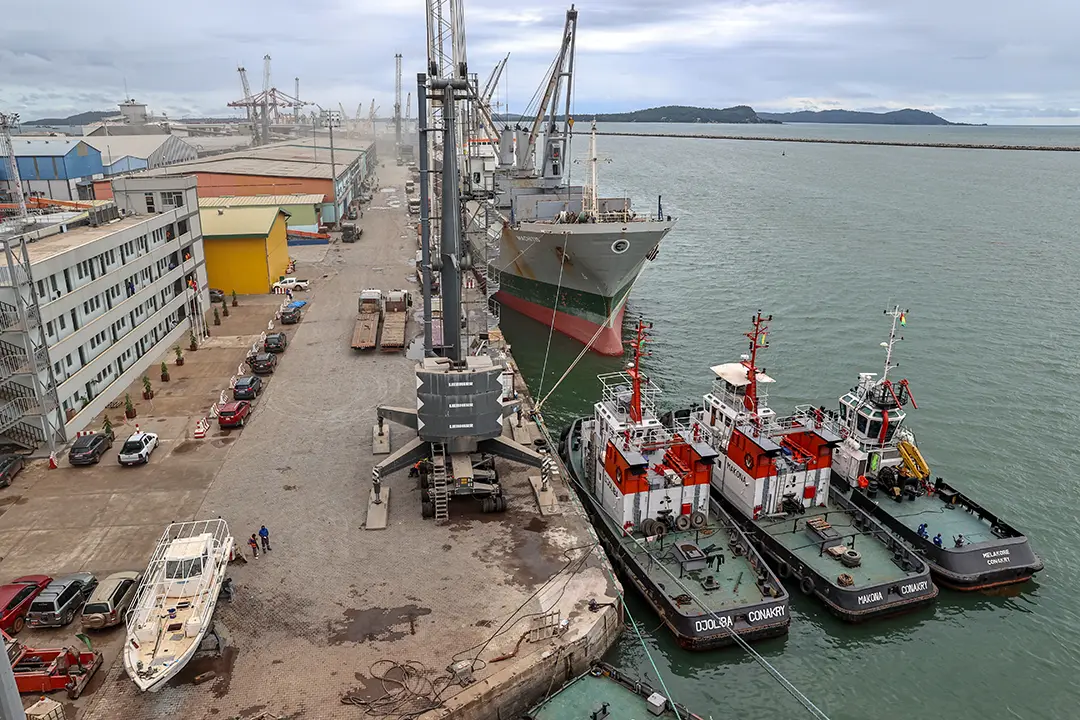
One Russian vessel, the Sabetta, reportedly delivered about 50 military and support vehicles, including armored vehicles and fuel tankers, to the port of Conakry, Guinea, on March 19. The vessel is owned by Severny Proekt, a Russian company involved in state defense contracts and special projects for the state-owned nuclear corporation Rosatom.
The equipment then was delivered by land to Mali, where Africa Corps helps junta leader Assimi Goïta maintain power.
The Conakry port terminal is operated by two Russian-Guinean companies, ACG-Fria and Compagnie des Bauxites de Kindia, which are subsidiaries of the Russian aluminum giant UC Rusal, Ukraine’s United24 Media reported. Ports in Equatorial Guinea, Libya and Togo also have received deliveries of Russian military equipment.
The investigation uncovered six other vessels involved in weapons delivery, including three “ro-ro” (roll-on/roll-off) ships, which are designed to transport cargo such as cars and armored vehicles, and three bulk carriers.
“Although formally these are civilian vessels, many of them have been delivering military cargo for several years,” the report said. “The owners and operators of the ships are not afraid of sanctions, since they have been under various restrictions for a long time.”
The ro-ro ships include the Adler, Ascalon and Baltic Leader, each owned by MG-Flot, a Russia-based company that also has delivered Iranian ammunition and components for Russian drones through the Caspian Sea, the report said.
The Ascalon was part of the Syrian Express, vessels that supported Russian mercenaries in Syria. The Ascalon and the Adler moved missiles to China in 2018, while the Baltic Leader evacuated Russian equipment from Syria after the fall of Bashar al-Assad’s regime in December 2024.
The dry cargo ships Mikhail Britnev and Cape Zhelaniya are owned by Arkhangelsk organizations Eco Shipping and Arctic-Trans, while the dry cargo ship Siyanie Severa is owned by the Northern Shipping Co. As of 2022, Northern Shipping was controlled by the family of Dmitry Purim, head of Sovfracht, a company sanctioned for supplying aviation fuel to Russian mercenaries in Syria.
Like many ships involved in shadowy activities, these vessels often switched off their automatic identification systems to avoid detection.
Bockmann said she was not surprised by the use of civilian vessels for military purposes.
“This is just part of the new norm in the field of military cargo logistics in Russia,” Bockmann said in the report. “The civil status of ships makes it possible to rely on the provisions of the law of the sea on innocent passage through the Danish Straits and the Baltic.”