

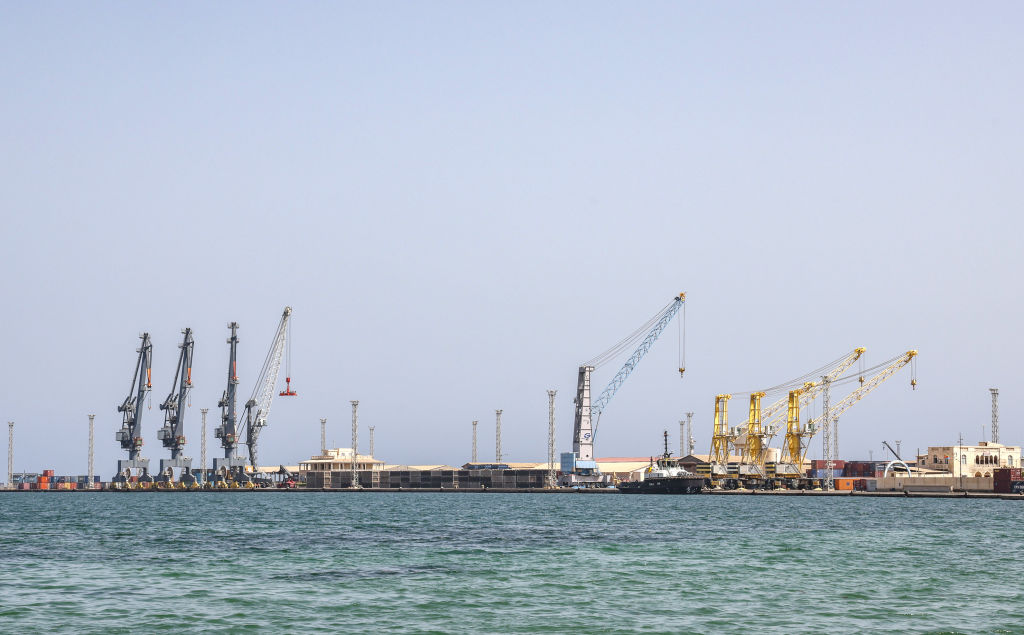
Eritrea is seeing its strategic value to regional security and the global economy rise as conflict affects traffic on the Red Sea. Houthi rebel attacks on commercial vessels have disrupted commercial shipping in the Strait of Hormuz, shifting attention to Eritrea’s 2,234-kilometer coastline.
The Red Sea is one of the world’s most important routes for global shipping. Each year, up to 15% of global maritime trade worth more than $1 trillion transits the waterway, which extends from the Suez Canal in the north to the Bab el-Mandeb Strait in the south.
Analysts say sustained disruptions in the Red Sea would fuel serious supply-chain delays, ratchet up energy prices and further destabilize global trade. Eritrea and Yemen are separated by about 37 kilometers at the Bab el-Mandeb Strait chokepoint.
This makes Eritrea’s location “particularly interesting, as Yemen is in a state of crisis and maritime security in the region is at risk,” Abdurahman Sayed, director of the Horn of Africa Centre for Regional Integration in London, told German broadcaster Deutsche Welle (DW). “The only safe route in this area runs through Eritrea, where there are currently no security concerns.”
In July, diplomatic discussions in Cairo involving Egypt, Eritrea, Somalia and the U.S. underscored Eritrea’s growing role in coordinating approaches to facilitate trade and address security challenges in the Horn of Africa and the Red Sea.
After meeting with Eritrean Foreign Minister Osman Saleh, U.S. Senior Adviser for Africa Massad Boulos said they explored ways to enhance cooperation on regional economic development, trade and security, particularly the need to “work together constructively to address regional conflicts and advance lasting peace, stability, and prosperity in the Red Sea and the Horn of Africa,” Boulos said in an Al Jazeera report.
Amid the Red Sea concerns, Eritrea remains embroiled in tensions with Ethiopia, which has for years demanded access to the Red Sea through Eritrea’s port of Assab. Ethiopia lost access to the sea in 1993 when Eritrea gained independence. According to Michael Woldemariam, a researcher at the School of Public Policy at the University of Maryland and the Atlantic Council, escalating tensions with Ethiopia are key to understanding Eritrea’s strategic moves in the Horn of Africa and the Red Sea.
“Asmara is seeking to forge partnerships that can serve as a counterweight to Addis Ababa,” Woldemariam told DW. “Its recent diplomatic outreach to Egypt, Somalia, the United Arab Emirates’ armed forces, Saudi Arabia, Ethiopian opposition groups, and even the U.S. should be viewed against this backdrop.”
Matters are complicated by ongoing violence in Ethiopia’s Tigray region, situated along Eritrea’s southern border. Eritrean troops in the first week of October reportedly crossed into the Ethiopia town of Zalambessa, residents said. The town was once controlled by Tigrayan rebels who seek overthrow the Ethiopian government. Addis Ababa has accused Asmara of supporting the rebels.
About one week later, Ethiopian troops entered the town, but it was unclear if Eritrean troops remained. Asmara has argued that Addis Ababa’s accusations of an invasion by Eritrean forces was a “declaration of war.”
“With Addis Ababa and Asmara now on opposing sides again, conflicts raging elsewhere in the region and tensions high across the Red Sea, there are fears of broader contagion of violence this time around,” Martin Plaut, a journalist specializing in the Horn of Africa and Southern Africa, wrote on his website.
Fighting between the countries on their shared border in Tigray would mark a drastic turn of events. Hundreds of thousands of people died in the Tigray War that ended with a peace deal in 2022. Eritrea then supported Ethiopia against the TPLF.
“When Ethiopian forces reach the border of Eritrea, this will bring the two forces head-to-head,” Mehari Taddele Maru, an expert on the Horn of Africa and a former senior official inthe African Union, told The New York Times. “There is a high probability of a war between the two countries that may end in Ethiopian control of Assab and potentially regime change” in Eritrea, he added.
Eritrean President Isaias Afwerki has ruled the country as a strict one-party authoritarian regime since 1993.
“The country is ruled by a single man, and there are no constitutional institutions,” Sayed told DW. “That makes the state very vulnerable should this strongman be removed from power.”