

Ghana is spearheading an effort to stop Russia’s illegal recruitment of young people to fight in its war with Ukraine. Independent tracking agencies estimate 37 African countries have been affected by widespread and coordinated schemes to deceive desperate youth in search of employment.
At least 272 Ghanaians have fought for Russia. That is the third-highest number of recruits among African nations. Egypt recorded the highest number, 361, while 335 Cameroonians were recruited, according to the INPACT research group. Fighters are also heavily recruited from Algeria, The Gambia, Kenya, Mali, Nigeria and South Africa.
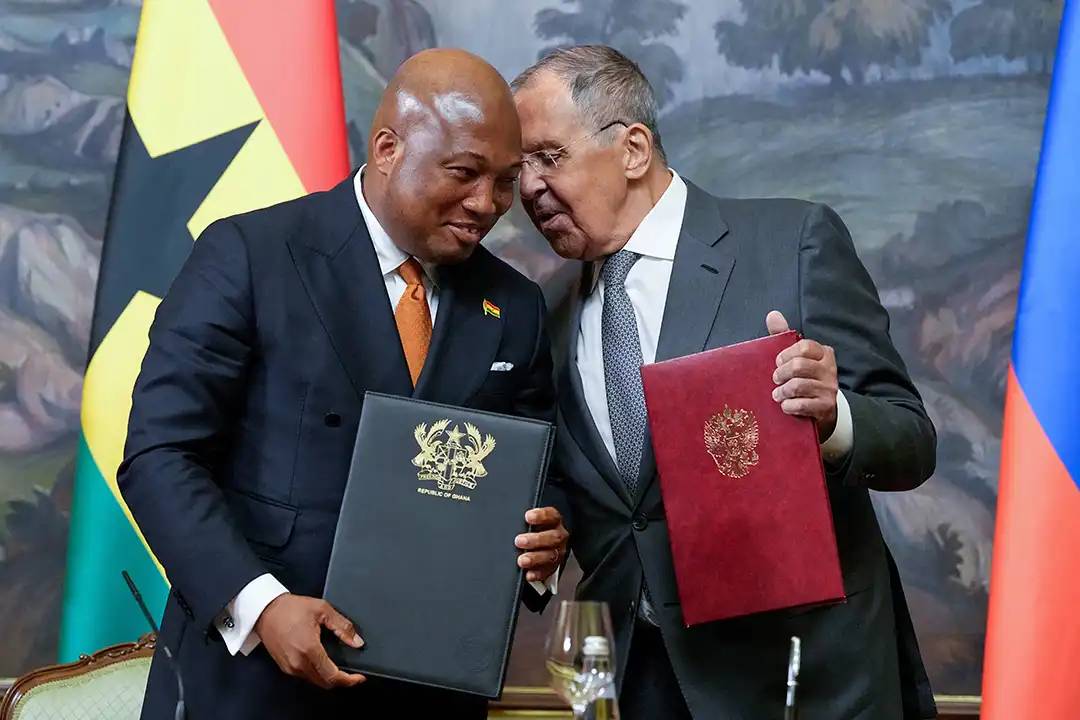
As the number of Ghanaians who have died while fighting for Russia reached 62 in mid-August, Ghanaian Foreign Affairs Minister Samuel Okudzeto Ablakwa met with Russian Foreign Minister Sergei Lavrov in Moscow and urged Russia to “stop the illegal recruitment of these Ghanaians.”
“As a responsible government, we cannot turn a blind eye to these shocking statistics,” Ablakwa said in an INPACT report. “This is not our war, and we cannot allow our young people to become human shields for others.”
While Russia vowed to stop recruiting Ghanaians, the practice has continued.
This raises “questions about how effectively agreements reached between governments are being enforced on the ground,” Kenyan newspaper The Star wrote in an editorial.
Richmond Acheampong, editor-in-chief of Ghanaian digital news platform The International Lens, questioned whether or not Russia did enough to prevent, investigate or punish deceptive recruitment practices.
“That distinction is crucial,” Acheampong wrote for the Modern Ghana news website. “A credible partner does not merely deny an allegation; it helps establish the facts. It identifies recruitment networks, cooperates with investigations, accounts for foreign nationals serving in its military and provides transparent information to the governments whose citizens are involved.”
Recent research by iLAB, the technical investigations team of Code for Africa, found that the Kremlin is using digital tools — including websites, fake domains and social media profiles — to trick Africans into fighting for Russia. These recruitment campaigns originated in Russia and Belarus and used false advertising, forged endorsements and offered promises of generous benefits.
The iLAB investigation found that many African nationals were tricked into joining the Russian military after responding to ads for construction work, visa assistance or even film roles. Many of the sites shared common IP addresses and are based on websites that are “disposable,” a strategy investigators characterized as “burn and replace.”
Analysts say it is time for Ghana and other countries to reassess their relationship with Russia, which seeks to expand its influence on the continent through military partnerships, resource extraction and infrastructure projects. European Union Ambassador to Ghana Rune Skinnebach said in a September report by Ghanaian newspaper The Diplomatic Times that Russia was “neither a credible nor reliable partner” for Ghana.
Skinnebach cited several commitments that have not been delivered, including a nuclear power project, a $1 billion Russia Export Centre facility and a $12.5 billion railway project linking Accra to Paga..
Acheampong agreed with Skinnebach.
“A diplomatic partnership is not measured by handshakes, communiqués or the number of agreements signed,” Acheampong wrote for the Modern Ghana news website. “It is measured by trust, delivery and responsibility. On that test, Moscow has yet to demonstrate that it is a credible and reliable strategic partner for Ghana.”
Acheampong acknowledged that Russia portraying itself as an alternative partner to African nations can seem attractive but argued that its commitments must be carefully analyzed.
“If Western governments announce projects and fail to deliver, Ghana should scrutinize them. If China signs infrastructure agreements that stall, Ghana should ask why,” Acheampong wrote. “Russia should receive precisely the same treatment. … That is not hostility toward Russia. It is normal statecraft.”