

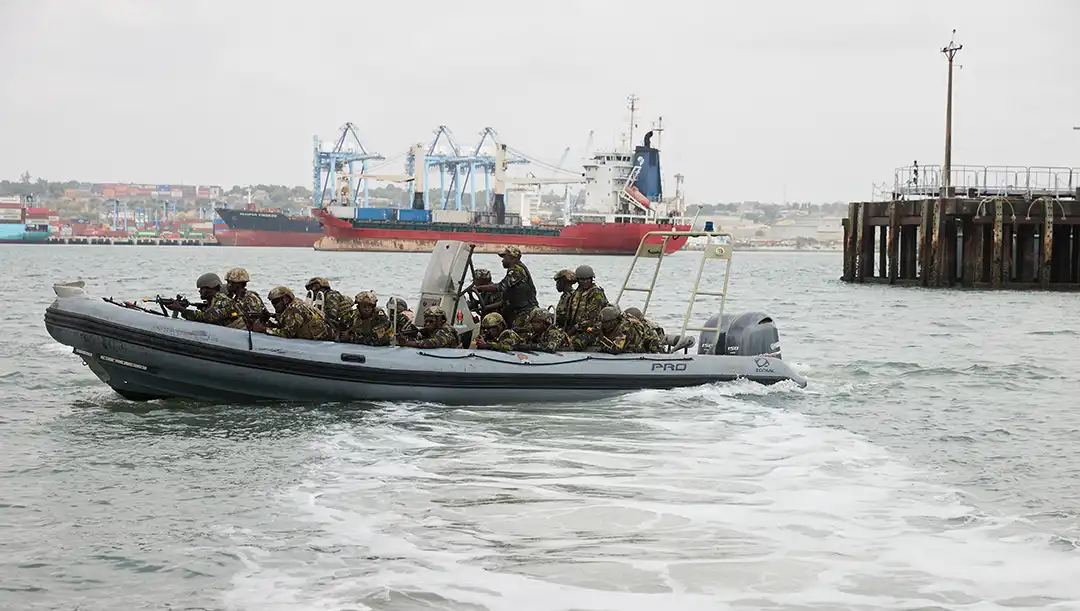
East African nations are joining forces against piracy and other sea crimes that threaten maritime resources and shipping routes.
Countries adhering to the Djibouti Code of Conduct (DCoC) have signed onto a proposal calling for a regional task force to tackle piracy and other crimes in the Gulf of Aden and Western Indian Ocean. The DCoC was adopted in 2009 to support regional and national capacity to counter attacks on ships transiting the region.
The plan was revealed on August 17, the same day that eight armed Somali pirates boarded the Cameroon-flagged MV Lutuf, which had armed guards, about 4 nautical miles off the Somalia coast. Pirates launched their attack from the MV Sward, which they had seized in April, Puntland security officials told Agence France-Presse. They also used the Sward to hijack two Iranian fishing vessels in July. The Iranian boats were released after ransoms were paid.
Somali piracy peaked between 2005 and 2012, when pirate groups collected between $339 million and $413 million, according to World Bank estimates. European Naval Force (EUNAVFOR) Somalia Operation Atalanta recorded 26 pirate attacks between 2013 and 2019 and then no attacks from 2020 to 2022. Piracy off the Somali coast resumed with six attacks in 2023 and surged to 22 in 2024. Only five such incidents were reported last year.
Between April and July 2026, however, the United Nations’ International Maritime Bureau recorded 24 attempted and actual incidents of piracy and armed robbery against ships in the Red Sea and Gulf of Aden.
“The resurgence of piracy has demonstrated that, while considerable progress has been achieved over the past decade, the underlying conditions that enable piracy have not been fully eliminated,” Metse Ralephenya, chair of the Djibouti Code of Conduct/Jeddah Amendment, said in a statement. “The Signatory States therefore recognize that maintaining maritime security requires sustained vigilance, stronger regional ownership, and practical operational cooperation among coastal States.”
Comoros, Djibouti, Ethiopia, Kenya, Madagascar, Mauritius, Mozambique, Seychelles, Somalia, South Africa and Tanzania each signed the agreement, as did Bahrain, France, Jordan, Maldives, Oman, Saudi Arabia, the United Arab Emirates and Yemen.
Ralephenya, who also is director of maritime safety, security and environment protection at South Africa’s Department of Transport, said the proposed task force is similar to the recently established Combined Maritime Task Force (CMTF) in West Africa. The task force supports the Yaoundé Code of Conduct, a framework that helps West African navies maintain situational awareness and fight maritime crime in the Gulf of Guinea.
The CMTF will work closely with the West Africa Regional Maritime Security Center and the Central African Regional Maritime Safety Center. Ralephenya said the DCoC Task Force will enhance existing international maritime security efforts, including the Combined Maritime Forces, Combined Task Force 151 and EU NAVFOR.
The DCoC force will include naval officers known as “sea riders” aboard participating vessels.
“This will enhance interoperability, facilitate coordinated operations across jurisdictions, improve maritime domain awareness, and provide a practical mechanism for participating States to exercise enforcement authority in accordance with international law,” Ralephenya said.
As noted by maritime security consultant Andrew Mwangura, the DCoC force is expected to prioritize the “legal finish” of arrests at sea, including the timely transfer, investigation and prosecution of suspects. According to Mwangura, this is important as earlier efforts to stem Somali piracy, though successful, did not address the root causes of the challenge: weak governance, porous coastal control, financial hardship and the appeal of ransom payments.
“Information sharing, joint operations, and legal cooperation among neighbors are more likely to endure than perpetual reliance on distant navies whose mandates and budgets can shift with the next crisis elsewhere,” Mwangura wrote for Maritime Business Review, a maritime business research and theory journal.
Work to establish a concept of operations, asset contributions, information-sharing protocols and legal arrangements was conducted at a maritime workshop in Mombasa, Kenya, in early September.
“The precise composition of assets, geographic scope, rules of engagement, funding model, and command arrangements remain undefined. Political will across a diverse group of states — some with limited naval capacity, others distracted by land-based security challenges — will be tested. Coordination with existing international mechanisms must be seamless to avoid duplication or gaps.”