

Nigeria’s northern states are experiencing a surge in terrorism spreading from the Sahel as strained diplomatic relations with Niger’s ruling junta complicates cross-border security.
Tensions between the two countries began after the 2023 coup that overthrew Niger’s democratically elected president, Mohamed Bazoum. The situation worsened when Niger joined Burkina Faso and Mali in the Alliance of Sahelian States (AES) and withdrew from the Economic Community of West African States (ECOWAS) in 2025. It later exited the Multinational Joint Task Force (MNJTF), which confronts terrorism in the Lake Chad Basin.
After withdrawing from ECOWAS, Niger and its AES allies have repeatedly denounced their southern neighbors — with a special focus on Nigeria — for allegedly meddling in their internal affairs and attempting to destabilize their governments.
In December 2025, after a Nigerian C-130 made an emergency landing in Burkina Faso, Burkinabe leaders threatened to “neutralize” any Nigerian aircraft that flew over its territory without permission.
“The AES’ increasingly rigid posture challenges Nigeria’s ability to project influence northward,” according to an African Security Analysis report after the C-130 incident.
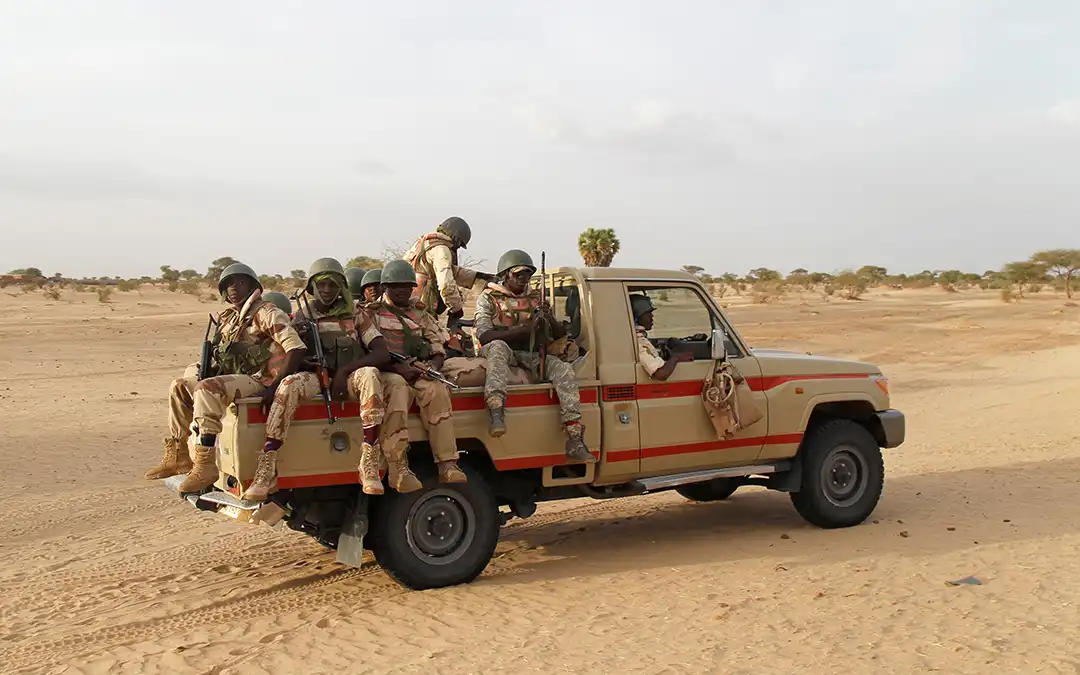
Nigerian Chief of Defense Gen. Olufemi Oluyede told ADF at this year’s African Chiefs of Defense conference in May that Nigeria and Niger continue to work together on security issues along their 1,608-kilometer border.
“On the ground, we’re engaging,” Oluyede said, “In terms of operations, we still do cooperate even though it is not as elaborate as we want it to be.”
Niger’s decision to withdraw from ECOWAS and the MNJTF has created significant gaps in regional security, according to Nigerian analyst Abiola Sadiq.
Sadiq told Al Jazeera that deteriorating relations between Nigeria and its Sahelian neighbors could give terror groups more freedom to operate across the region’s porous borders.
That already appears to be happening as Nigerian communities along the northern border report incursions by Sahel-based Jama’at Nusrat al-Islam wal-Muslim (JNIM) and Islamic State Sahel Province (ISSP) into Katsina and Sokoto states. Meanwhile, Boko Haram and Islamic State West Africa Province (ISWAP) continue attacks in Borno and Yobe states.
Further complicating matters, evidence is emerging that the two Islamic State factions may be using northern Nigeria as a bridge to share personnel.
In addition to insurgents crossing into Nigeria from Niger, Nigerian authorities also must confront their own internal security issues across the north, such as rampant banditry, cattle rustling and ethnic conflicts. JNIM and other terror groups exploit those domestic security problems to recruit new members.
Nigerian President Bola Tinubu stated in July that the lack of security in AES nations was worsening Nigeria’s security. That statement provoked a strong response from all three AES countries, whose representatives met with Nigeria’s charge d’affaires in Burkina Faso to denounce Tinubu’s statement as unfair and inaccurate.
“We are not responsible for what is happening to us. The real enemies are elsewhere,” Burkina Faso’s Foreign Minister Karamoko Jean-Marie Traoré said, speaking for AES members.
The growing diplomatic conflict between Nigeria and the AES highlights a key challenge for the region, according to analyst Amanze Chinonye: The threat from Sahelian terror groups is becoming transnational while the political mechanisms needed to address that threat are breaking down.
“The question for West Africa,” Chinonye wrote for Prime Business Africa, “is whether those competing structures can find enough common ground to cooperate on security before political divisions further weaken the collective response to a crisis that recognizes neither borders nor alliances.”