
Annual cocaine seizures in West Africa have surged from two metric tons in 2018 to more than 30 metric tons in 2025, according to a report by the Global Initiative Against Transnational Organized Crime (GI-TOC).
Cocaine trafficking was the fastest-growing criminal market in West Africa between 2019 and 2025. According to The Economist, the volume of cocaine seized in the region each year increased by 50%. At least one-third of the cocaine exported to Europe transits the region. Some analysts believe that about 30% of all cocaine bound for Europe last year passed through West Africa.
“Critically, West Africa is no longer a transit corridor,” Brig. Gen. Maxwell Abuba Mantey, director-general of Ghana’s Narcotics Control Commission, said during a webinar hosted by the GI-TOC. “We are increasingly becoming a consumer market and, in some instances, a production hub.”
Amado Philip de Andres, regional representative for West and Central Africa at the United Nations Office on Drugs and Crime, told Deutsche Welle (DW) that Guinea-Bissau is no longer “the main gateway” for cocaine into West Africa. De Andres cited seizures in Cape Verde, Côte d’Ivoire, The Gambia, Liberia and Senegal, and said increased cocaine trafficking has been observed in Benin and Togo.
Senegal Emerges as Strategic Hub
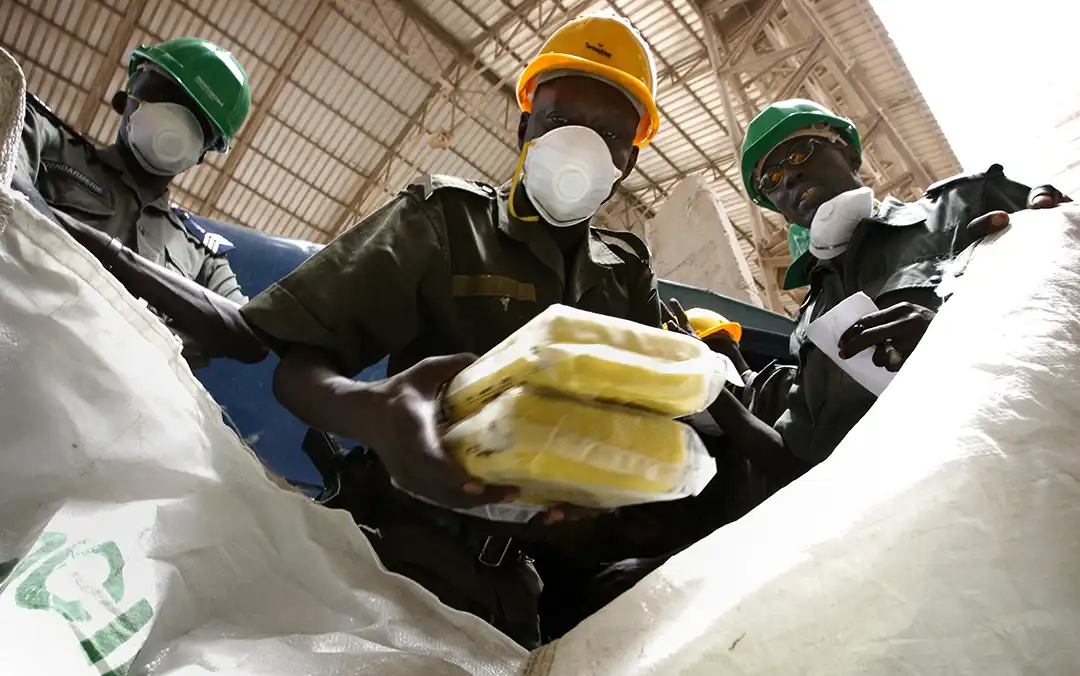
Amid this trend, Senegal has emerged as a strategic international cocaine trafficking hub. Last year, customs authorities in southern Senegal seized more than 850 pounds of cocaine worth about $52 million. In mid-June, Senegalese authorities seized nearly a ton of cocaine worth about $103 million hidden in a truck hauling tropical fruit near the central town of Ida Mouride.
In the port city of Dakar, the national capital, customs agents routinely inspect shipping containers from Latin America, where much of the cocaine bound for Europe originates. Mouhamadou Kane, an analyst at GI-TOC’s West Africa Observatory, said Dakar’s port is the nerve center of regional cocaine trafficking. The port offers land routes through neighboring Guinea, Guinea-Bissau, Mali and Sierra Leone, and direct connections to European ports.
“It is an attractive hub for criminal networks,” Kane told Le Monde.
Criminal networks often use shipping containers with legitimate paperwork. After cocaine is hidden inside, containers are closed with fake seals. The drug commonly arrives in Senegal on fishing boats, sailboats and semisubmersible vessels.
“Criminal organizations use the African ‘rebound’ as a smokescreen,” Florian Manet, an international expert for the consulting firm Pelagos Stratégie, told Le Monde. “A container coming from Senegal attracts less attention from European customs offices than a shipment coming directly from Latin America.”
Not all cocaine arriving in Senegal leaves the country, and local consumption is a public health and security challenge.
“Traffic is extremely dense, and Dakar still remains a transit zone, even if some of it is likely to be consumed on the spot,” Mor Gassama, an economist from Senegal, told DW. “This is not good news, first of all, for the health of the population, but it will also promote the circulation of illicit money.”
Criminal Innovation
West Africa’s evolving role in the global cocaine trade is due to its location between Latin America and Europe; governance gaps; the maritime, aerial and other infrastructure needed to move drugs; poorly regulated financial systems; and law enforcement’s focus on other trafficking routes, a GI-TOC report found.
“The networks are constantly innovating: When a route is monitored, they adapt,” Commissioner Adama Wélé, of the Dakar Regional Narcotics Brigade, told Le Monde. “The methods are also evolving very rapidly. To bypass inspections, the traffickers dissolve cocaine in fuel. Through chemical processes, they can then filter and dry it to recover the cocaine powder.”
Kingsley Madueke, Nigeria research coordinator at the GI-TOC, said cocaine shipments most commonly arrive in West Africa via fishing boats, tugboats and sailboats. Most of the cocaine comes from Brazil, although there has been an uptick in cocaine arriving from Guyana and Suriname since 2023.
“Multi-ton consignments are shipped from Latin America to waters off Senegal, Sierra Leone and the Gulf of Guinea, then transshipped to smaller daughter vessels,” Madueke said during the GI-TOC webinar. “Some go [directly] to Europe, but a lot [of cocaine] is disembarked [into the] West African coast.”
Traffickers are increasingly moving cocaine to the region via semisubmersible vessels and submarines. Air trafficking is not as prevalent but accounts for a “steady and cumulatively significant flow” of the drug, Madueke said.
“Commercial flights move consignments via mules, baggage and freight,” he said. “While individual loads are small, annual volumes can reach several tons. Improved airport infrastructure has expanded connectivity, creating vulnerabilities for both international and intraregional trafficking.”