

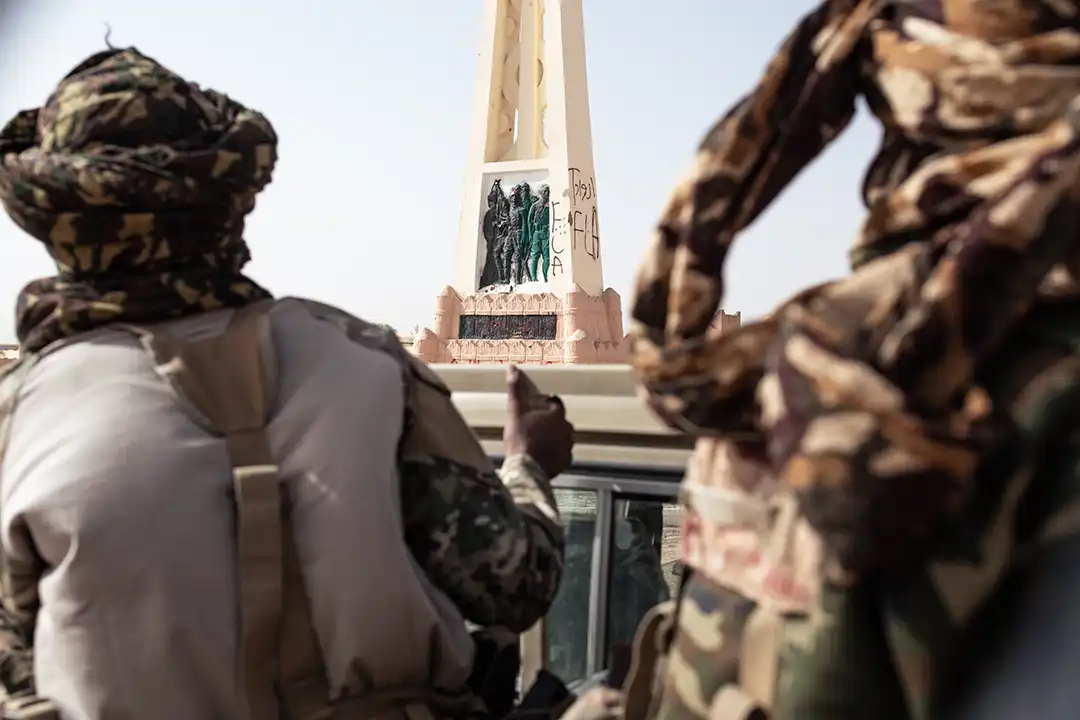
Two years after canceling a peace agreement with Tuareg separatists, Mali’s ruling junta is no closer to restoring security to the country, according to analysts. Instead, the junta appears to have undermined its own counterterrorism efforts by prompting the Azawad Liberation Front (FLA) to align with terrorists.
“They [the Malian government] decided the factions in the north were terrorists equal to JNIM [Jama’at Nusrat al-Islam wal-Muslimin] and would be fought the same way,” Wassim Nasr, senior researcher at The Soufan Center, told ADF. “At the end of the day, this policy led to a real coalition between the [FLA] rebels and JNIM to fight.”
FLA and al-Qaida-affiliated JNIM joined forces in April to drive Malian troops and their Russian Africa Corps backers out of Kidal, a majority Tuareg city in the north that the government had held for two years. The Kidal attack was part of coordinated assaults that killed Malian Defense Minister Sadio Camara and several family members at his home near Bamako.
In July, the same coalition killed at least 50 soldiers in northern Mali when they ambushed an Army convoy as it left the strategically important community of Anefis, heading for Gao.
JNIM killed another 50 or more Malian soldiers and five Africa Corps fighters in September during an attack on the Douri military camp near Mopti in central Mali. The FLA has not claimed any part in that attack.
Terrorist checkpoints, ambushes and land mines laid around Bamako have reduced the military’s ability to control territory outside major cities. As a result, the ruling junta relies on armed escorts for convoys supplying food and fuel to the capital.
Africa Corps fighters have become part of the government’s effort to protect those supply lines. In 2025, JNIM began blockading truck traffic entering the landlocked country from Côte d’Ivoire, Guinea and Senegal.
Africa Corp’s 2,000 fighters in Mali recently received an arms shipment from Russia through Togo, a sign of how supply routes are shifting in response to JNIM’s blockade, according to a recent report by Soufan Center researchers. Africa Corps also increasingly uses aircraft to receive men and materiel to avoid the blockades.
The junta’s ongoing alliance with Africa Corps has complicated counterterrorism efforts further by building resentment among civilians subjected to violence by Malian and Russian forces.
Russian mercenaries played a key role in the 2023 Moura massacre, during which Malian troops and their Russian counterparts killed more than 300 Fulani civilians over three days based on the suspicion that they might have been part of JNIM.
Such attacks against Tuaregs and Fulani undermine the ruling junta’s credibility and increasingly boost public support for insurgents, analysts say.
Although Africa Corps was brought to Mali to train Malian troops, its primary purpose is to protect the ruling junta, according to Nasr.
“Even if the label is fighting terrorism, the contract is to preserve the regime and then to fight terrorism,” Nasr told ADF. “They are very costly, and terrorism is spreading in the country.”
Overall, the Malian junta, led by Col. Assimi Goïta, appears to be at its weakest point since the 2020 coup that brought it to power, according to Soufan Center researchers.
“Flashpoints that will determine what happens next are not only related to the regime — the cadence of convoy entries into Bamako, the status of major cities, and the health and presence of the regime leaders — but also to the strength of the insurgents,” researchers wrote.