

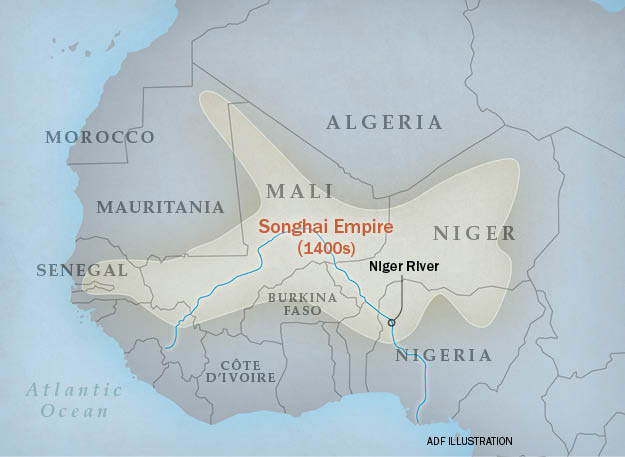
When Moroccan Sultan Ahmad al-Mansur invaded the sprawling Songhai Empire to the south in 1591, his 3,000 to 4,000 troops faced an army 10 times its size.
But the sultan’s troops had a technological advantage: gunpowder. The two sides met at the Battle of Tondibi, and the Songhai soldiers’ spears and arrows were no match for the Moroccans and their clumsy, but deadly, shoulder-fired guns. The sultan’s troops won the battle and the subsequent war that dragged on in the following months. The war is now recognized as the end of the empire, and a major turning point in West African history.
Dating to the 1400s, the Songhai Empire, in what is now Mali and Niger, was the dominant force in West Africa, controlling key commercial trade routes, including those used by Saharan caravans. The empire was centered on the Niger River, West Africa’s trade superhighway, and included major cities Gao and Timbuktu. It was a key trade hub for goods moving between Africa and Europe, handling gold, salt, slaves, textiles and kola nuts. But by the late 1500s, it was engulfed in regional rebellions and civil wars and was beginning to unravel around the edges. Disputes within the ruling family threatened to divide the empire. The kingdom was no longer a fortress.
In North Africa, al-Mansur ruled the Saadi dynasty, having come to power after beating Portugal in battle in 1578. But his empire was limited, and his treasury was thin. He needed new sources of wealth to maintain his army and stay in power, but most of his possible areas of expansion already were under the thumb of the Ottoman Empire. He looked instead to the south and the Niger River region, said to be rich with gold. And although Songhai no longer produced gold, it still controlled gold trade routes. It was an obvious choice for the sultan’s plans for conquest.
The sultan sent his troops south into what is now Niger. The Moroccan army first had to cross the Sahara, a journey that took months and claimed the lives of many soldiers and pack animals. When they finally arrived in Songhai territory, the Songhai Askia, or ruler, Ishaq II, mobilized his army, estimated at 30,000 infantrymen and 10,000 cavalrymen.
The Moroccans’ primary weapon was the arquebus, an early gun that was a crude precursor to the musket. It was deadlier than bows and arrows and more accurate than the older hand cannons.
The Songhai launched a huge frontal attack, including driving 1,000 cattle into the battle to disrupt the Moroccan forces. But the sound of the Moroccan gunfire terrified the animals, making them turn and stampede the Songhai forces instead. The Battle of Tondibi ended in disaster for the Songhai.
Over the next months, Moroccan forces advanced as Songhai forces retreated. The sultan captured Gao, Timbuktu and Djenné, the centers of the empire. But it was not a quick death for the Songhai Empire, as its ruling class continued to resist, fragmenting the region. The Moroccan troops, cut off from their capital of Marrakech, began to mutiny and disperse, even putting down roots in their conquered land and marrying locally. They formed a new military class that ruled parts of the Niger River Valley for decades.
The invasion marked the eventual end of the Songhai Empire, but it could not be regarded as a complete success for the sultan. The anticipated gold instead was dispersed to European merchants. The sultan now controlled only fragments of the former empire. The logistics of controlling a vast territory across the Sahara proved to be an impossible task, and Morocco lost control of the Songhai cities in the coming years.
The collapse of Songhai marked the end of a long era of large empires throughout the Sahel, showing the difficulty of controlling any region that includes the vastness of the Sahara. It changed global trade patterns, permanently altering African power structures.