

ADF STAFF
A string of devastating attacks by Sahelian terror groups in Burkina Faso, Mali and Niger have shown Russian mercenaries’ inability to provide security. Now, Russia appears to be pivoting to an alternate strategy.
Joseph Siegle, director of research at the Africa Center for Strategic Studies, said the Kremlin is using its well-established blueprint of deploying propaganda and false information as a precursor to expanding its presence.
The target: coastal West Africa.
“Russia’s Sahel strategy is collapsing, but that hasn’t slowed its ambitions in Africa,” he wrote in a July social media post. “Even as its influence in the Sahel unravels, Russia is doubling down on fomenting distrust in democratic institutions and building the case for military rule — in an effort to gain a foothold in coastal West Africa’s democracies.”
This year, terrorist groups affiliated with al-Qaida have mounted audacious attacks on Bamako, Mali, and Niamey, Niger, while choking off Mali’s capital from fuel and other critical deliveries. In all three junta-led countries, competing terrorist groups have expanded territorial control over large swaths of countryside.
Meanwhile, Siegle said: “Social media accounts linked to Russia and the juntas extol the fictional development and stability realized under the military regimes.”
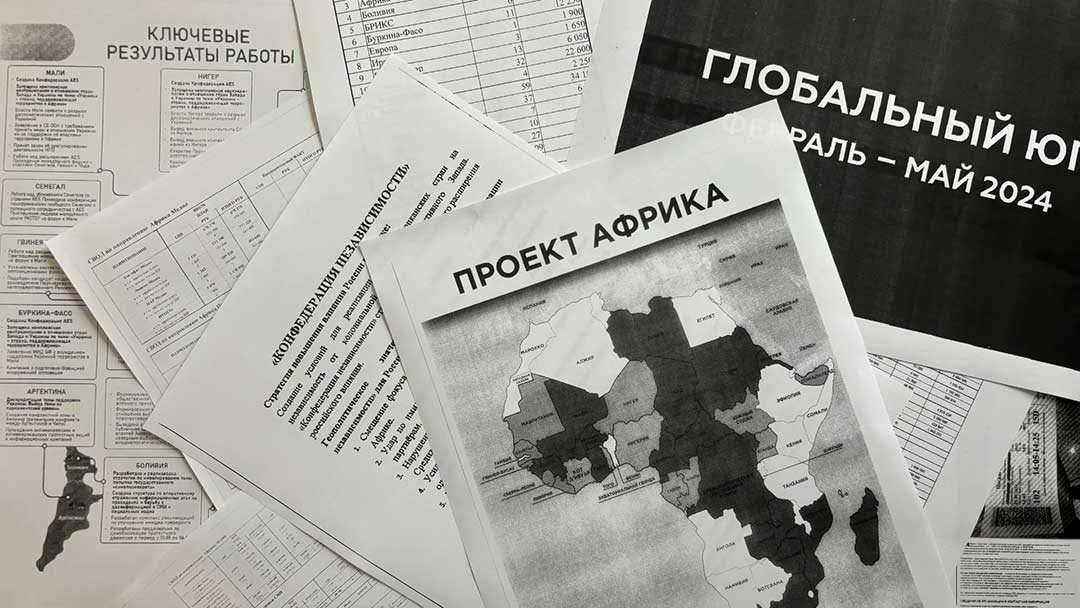
A 1,400-page data leak obtained by pan-African media outlet The Continent and shared with several international newsrooms detailed a Russian influence network that referred to itself as “The Company.” The documents revealed how Russian agents have planted hundreds of articles in West African media outlets as part of its ongoing “Project Afrika,” wherein the network identifies, recruits and co-opts journalists, activists and nongovernmental organization members.
According to the documents, the Company planted 644 articles containing propaganda or false information in at least 35 media outlets across Central and West Africa between June and November 2024. The campaigns cost more than $300,000.
Senegal is a key target of the Kremlin with its Atlantic Ocean access and shared border with Mali, but its relatively stable democracy stands in the way. In March, France 24 reporters told Ibrahima Lissa Faye, news director of the Senegalese media outlet PressAfrik, that his news site had published 13 articles featuring Russian propaganda.
“These articles appear to have slipped through our editorial validation process,” Faye told France 24 television for a July 17 feature. “When you read articles like this, you definitely get the impression they are intended to manipulate opinion. We immediately unpublished the articles because they got onto the site without our knowledge.”
Leaked documents showed that the Russian company paid PressAfrik $6,500 to publish the 13 articles, but Faye denied that the money ever reached the outlet’s bank account.
Russia’s influence in the region has been amplified by coordinated false information projects, including pro-Russia media outlets and online campaigns on Facebook, TikTok and Telegram that can overwhelm the information landscape. But Jean-Hervé Jezequel, Sahel project director for the Crisis Group think tank, said Russia’s desire to expand its physical presence is limited by a lack of opportunities in the region’s more secure countries.
“The expansion of Russian influence in coastal West Africa has been less impressive so far than in the central Sahel,” he wrote in a February essay for the Carnegie Russia Eurasia Center. “This may reflect a structural limitation: Russia’s appeal is strongest where violence and political disorder open doors, and weaker where political institutions remain relatively resilient.”
Jezequel believes that Russia may already have reached the height of its appeal as a security and economic partner. Its military presence has not decisively turned the tide of terrorism in the Sahel, and its tattered war economy limits it from offering development aid or large-scale reconstruction.
“Information campaigns can help sustain its image, but they cannot substitute for concrete results on the ground,” he wrote.
Siegle urged “democratically oriented governments” in coastal countries targeted by Russia such as Benin, Côte d’Ivoire, Ghana, Nigeria and Senegal to band together to expose the Kremlin’s “Project Afrika.”
“African democrats and international proponents of stability have an imperative to support the West African countries targeted by Russian destabilization,” he wrote. “Toward this end, they should collectively work to expose inauthentic Russian-sponsored narratives and educate citizens to resist the siren call of authoritarianism. West Africa’s legacy of military government is already long and dark enough.”