

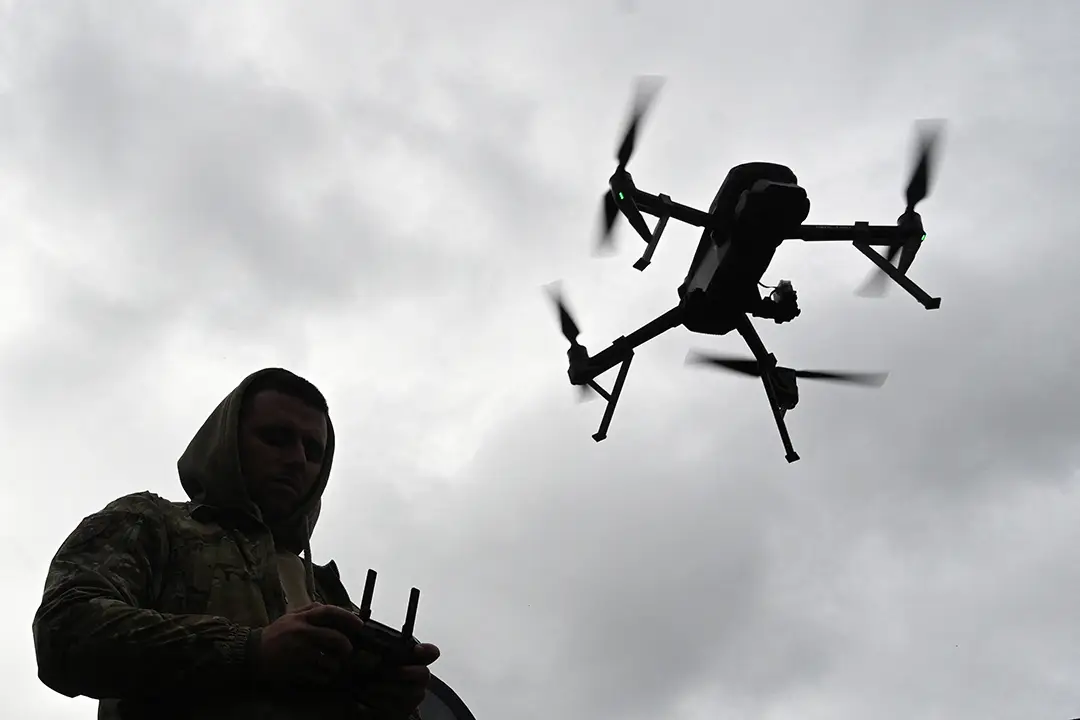
Over the past three years, insurgent groups across Africa increasingly have deployed weaponized drones against security forces, leaving militaries racing to develop methods to counter them.
In 2025 alone, analysts recorded nearly 60 incidents of unmanned aircraft system (UAS) attacks, nearly triple the number from the year before. More than half of those attacks were conducted by Mali-based Jama’at Nusrat al-Islam wal-Muslimin (JNIM) and the Azawad Liberation Front (FLA).
Islamic State West Africa Province (ISWAP) deployed armed drones that same year against security forces in Cameroon and Nigeria. In Somalia, both al-Shabaab and Islamic State Somalia are working with Houthi rebels across the Red Sea in Yemen to develop their own drone capacity, although it remains largely oriented toward reconnaissance.
In January, Islamic State Sahel Province (ISSP) deployed nearly a dozen armed drones against Nigerien troops when it attacked Niamey’s international airport. JNIM and FLA deployed armed drones alongside ground fighters during their coordinated assault against military outposts, airports, and strategic locations across Mali.
Over the past five years, insurgent groups have shifted rapidly from using commercial off-the-shelf (COTS) drones for reconnaissance and targeting to deploying them in kamikaze-style attacks. Burkina Faso, Mali and Niger have borne the brunt of that transition along with northern Nigeria, according to analysis by Military Africa.
Weaponized attacks account for 41% of drone uses, with intelligence-gathering accounting for about 22%. The remainder combines both uses.
“The weaponization of civilian drones represents a shift in asymmetric tactics as armed groups circumvent the conventional military superiority of the region’s armed forces,” researchers Hassane Koné and Fahiraman Rodrigue Koné wrote for the Institute for Security Studies (ISS).
Militaries involved in conflicts across the globe have invested in offensive drone platforms, but very few have acquired the capability to intercept low-flying, armed COTS drones, according to Military Africa analysts.
Nigeria is rapidly evolving its anti-drone capabilities as it tries to counter attacks from Boko Haram and ISWAP in the northeast and JNIM in the northwest. The Air Force last year began training personnel on the 612A Anti-UAV Radar System designed to detect, follow, and disable drones. Nigeria has also deployed the Lithuanian-made EDM4S SkyWiper, a handheld jamming device designed to disrupt the radio link between drones and their operators.
The Nigerian military is working with Abuja-based Terra Industries to develop homegrown drone technology that can be deployed against terrorist groups.
South Africa is in the early stages of developing of an AI-based counter-UAS system that combines electronic and kinetic weapons to take down drone-based threats.
Porous borders and weak controls over importing commercial-style drones have made it easy for terror groups to acquire the technology. Online instructions have helped them turn those drones into guided aerial munitions capable of evading physical defenses such as walls and moats around attack military outposts and civilian communities.
“This emerging threat warrants serious attention from Sahelian governments,” the two ISS researchers wrote. “Even though they are costly, anti-drone systems are needed to protect critical infrastructure and civilians.”
If militaries fail to invest in defensive systems, they will see a continued rise in drone attacks by JNIM, ISWAP and other terror groups, analysts say.
“The trajectory is unambiguous. Drone incidents by non-state actors in Africa are doubling or tripling year on year,” Military Africa reported. “Every month without a systematic C-UAS response is a month in which the enemy’s drone program grows more sophisticated while African defensive doctrine stands still.”