

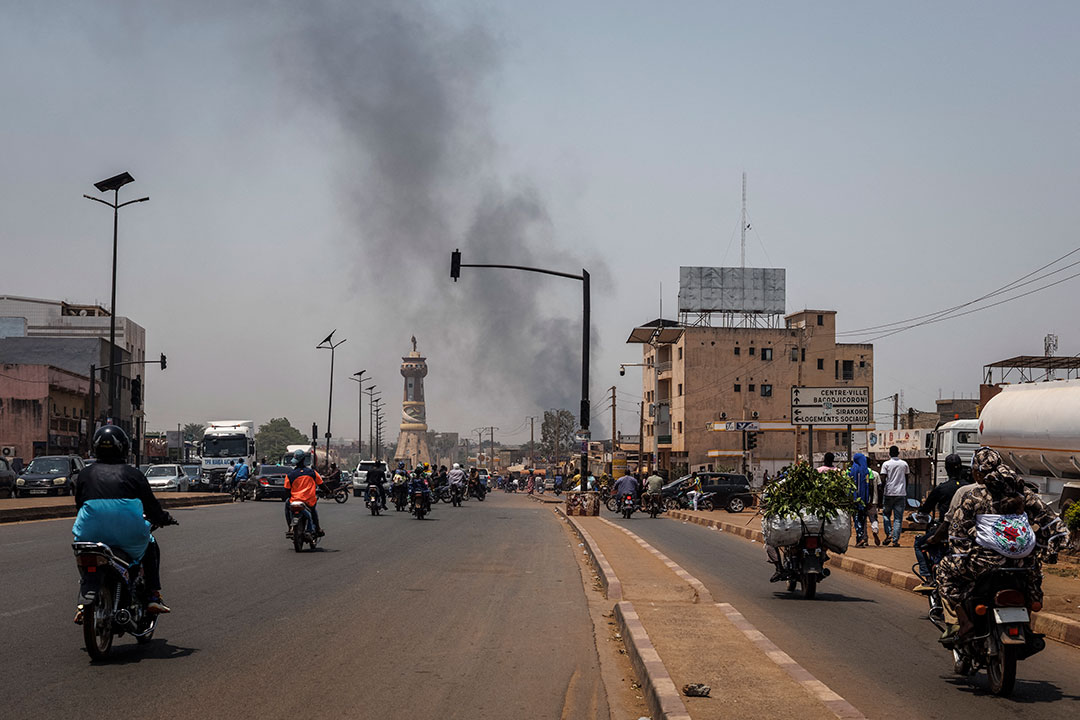
When two armed groups launched coordinated attacks across Mali on April 25, including a stunning assault on the capital, Bamako, Saheed Babajide Owonikoko thought of Nigeria.
A researcher with the Centre for Peace and Security Studies at Modibbo Adama University in eastern Nigeria’s Adamawa State, Owonikoko said Mali and Nigeria have much in common:
multiple extremist insurgent groups, porous borders and minimal government presence in rural areas that renders both countries vulnerable to attacks.
“As a scholar who has followed the unfolding events in the Sahel, I draw lessons for Nigeria from the April attacks in Mali,” he wrote in a May 24 article for The Conversation. “Those lessons include the possibility of alignment among armed groups, the danger of the jihadists advancing to other Sahelian countries, the audacity of the groups, and the possibility that gains of JNIM [Jama’at Nusrat al-Islam wal-Muslimin] in Mali could incite rival groups in Nigeria.”
JNIM has evolved in recent years from a rural terrorist group into an insurgent force capable of waging complex urban and economic warfare. Its primary objective is to topple Mali’s military government. Among its broader goals is to expand south to West Africa’s commerce-rich Gulf of Guinea coastal states.
In October 2025, JNIM claimed its first attack in Nigeria, killing a Soldier in the remote village of Nuku, Kwara State, about 10 kilometers from the border with Benin. Experts noted with alarm that the group’s expansion beyond its strongholds in the Sahel to threaten Nigeria could signal a new chapter in regional terrorism.
The most important lesson to take from JNIM’s April attacks in Mali is that the group continues to evolve, independent security analyst Daniele Garofalo said.
“The organization is progressively evolving into a hybrid armed actor capable of integrating guerrilla warfare, coordinated large-scale assaults, tactical cooperation with other armed groups, drone-enabled operations, strategic communication and psychological influence into a coherent military campaign,” he told ADF in an email.
“Equally important is the fact that JNIM increasingly operates simultaneously across multiple domains. … This represents a significant evolution in the nature of the threat.”
With JNIM pushing to overthrow Mali’s military government, Owonikoko worries that state collapse would turn Mali into a safe haven and training ground for terrorists that threaten the wider region.
“If Mali falls, Burkina Faso and Niger will be threatened,” he wrote. “The threat to Niger is a significant problem because it is a buffer zone for Nigeria.”
If armed groups in Nigeria join forces, as JNIM did with the Azawad Liberation Front in their latest Mali offensive, Owonikoko said such alliances could prove exceedingly difficult for Nigeria’s security forces to contain.
“There is evidence of an unfolding alliance between terrorists in the northeast and bandits in the north-central and northwest areas of Nigeria,” he wrote. “Such alliances have often been in terms of tactical cooperation as well as exchange of members and arms.”
Armed groups thrive in borderlands and remote areas where government and military presence is sparse. They prey upon local grievances and typically position themselves as an alternate system of authority.
“There is a localisation of jihad in the central Sahel,” Jean-Herve Jezequel, project director at the Crisis Group think tank, told Agence France-Presse for a June 24 article. “There is a serious governance crisis … states have often neglected rural areas and failed to address conflicts over land and resources.”
Experts have urged governments to employ a combination of military and nonmilitary approaches to combat the spread of armed groups. Many say that addressing economic issues would strengthen rural areas that are vulnerable to extremist groups.
Others insist that Nigeria and other coastal countries should take leadership roles in a region that desperately needs more security collaboration. In Nigeria, Owonikoko believes that security forces should take the offensive.
“Nigeria also needs to rejig its counter-terrorism to be more responsive,” he wrote. “Rather than its current defensive posture, which gives jihadists the opportunity to plan, Nigeria ought to adopt sophisticated and strategic offensive counter-terrorism that takes the war to the jihadists.”