
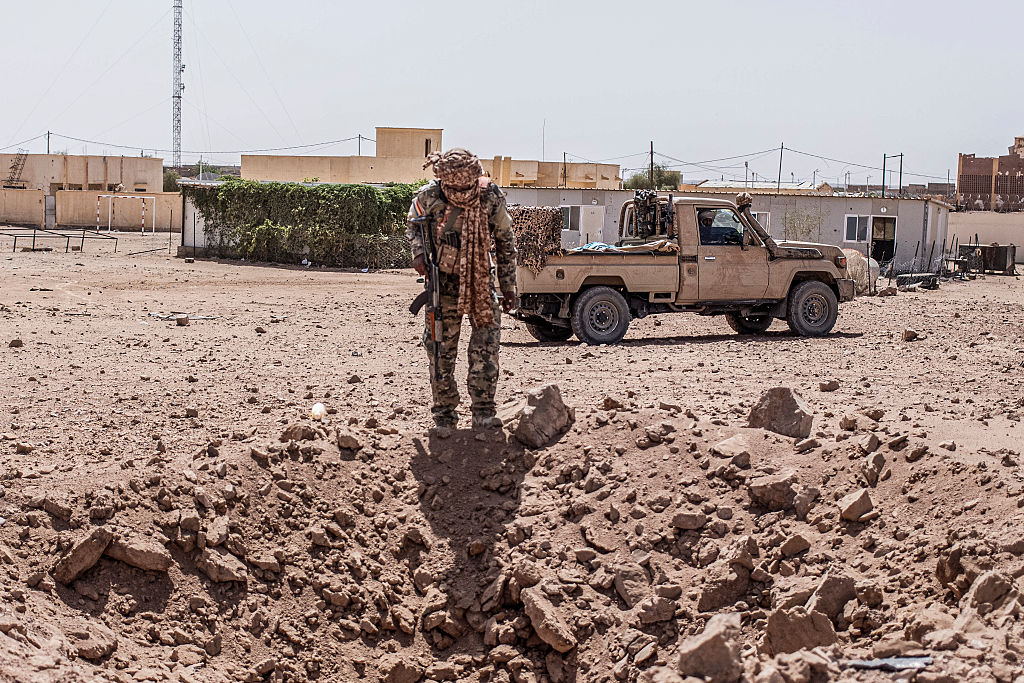
Mali’s ruling junta and its Russian backers recently launched airstrikes on Kidal, the northern city controlled since late April by the Tuareg-dominated Azawad Liberation Front, known by its French acronym, FLA.
The attack was a response to losing control of the city after a joint force of fighters from the FLA and Jama’at Nusrat al-Islam wal-Muslimin (JNIM) drove out the Malian Army and Russia’s Africa Corps, which had held the city since 2023.
Kidal is the heart of the Tuareg homeland, which spans parts of the Sahara Desert and Sahel and includes sections of Algeria, Mali, Mauritania and Niger. While previous Tuareg groups have collaborated with terror groups, the operation to drive the military from Kidal was the first time the FLA and JNIM worked together against the government. The Malian government has declared the FLA a terrorist group on par with JNIM and Islamic State Sahel Province — a claim the FLA denies.
“The FLA is simply the continuation of a struggle that has long been waged by this population, which has suffered so many massacres and is now resisting,” FLA spokesman Mohamed Elmaouloud Ramadane said.
For more than 60 years, the Tuaregs of northern Mali have demanded an independent state that they call Azawad. Their movement has taken various names and shapes over the years, the latest being the FLA.
The 2015 Algiers Accords peace agreement ended the Tuareg uprising that began in 2012. Under that agreement, Tuareg rebels avoided armed confrontations with the government and shunned violent groups.
Despite the growth of JNIM and Islamic State in central Mali, the junta has focused its attention on subduing the north. It conquered Kidal in late 2023 with the help of Africa Corps. Soon thereafter, it voided the Algiers Accords and revived the Tuareg rebellion.
The FLA officially declared itself on Nov. 30, 2024. The next day, Malian military drones killed Fahad Ag Almahmoud, one of the group’s top leaders. With that, the junta went from fighting two groups, JNIM and ISSP, to fighting three as the FLA took up arms against the government.
In July 2024, six months after the junta tore up the Algiers Accords, FLA fighters ambushed a joint Mali-Africa Corps (then known as the Wagner Group) operation outside the city of Tinzouatin on the Algerian border. The retreating forces quickly found themselves in territory controlled by JNIM. Dozens of soldiers and mercenaries died. Soon after, Wagner declared it was leaving Mali to be replaced by Africa Corps.
The FLA’s association with JNIM is a marriage of convenience, according to analyst Bulama Bukarti.
“The two groups have a common enemy, which is the Malian government,” Bukarti told the BBC’s Focus on Africa. “But they do not have a common project.”
The FLA is seeking independence for the Azawad region while JNIM wants to drive out the ruling junta and, ultimately, take control of the government. The FLA, which has popular support in the north, gives JNIM a veneer of legitimacy as it engages in economic blockades, hostage-taking and other actions aimed at reducing support for the government, Bukarti added.
“It is a tactical military coordination to confront a common enemy,” Ramadane said. “The FLA is in no way responsible for the actions carried out by JNIM.”
Ahmadou Touré, director of the Bamako-based Centre for Research on Governance, Mediation and Security in the Sahel, described the FLA-JNIM alliance as “hybridization of separatism and international jihadism.”
Touré told Radio France International (RFI) that the FLA’s association with JNIM terrorists tarnishes its claim to be a political movement.
“Through its violent methods, the FLA threatens Mali’s territorial integrity, causes population displacement and undermines national stability,” Touré told RFI. “Genuine peace talks require disarmament as a precondition and a clear rejection of terrorism.”