
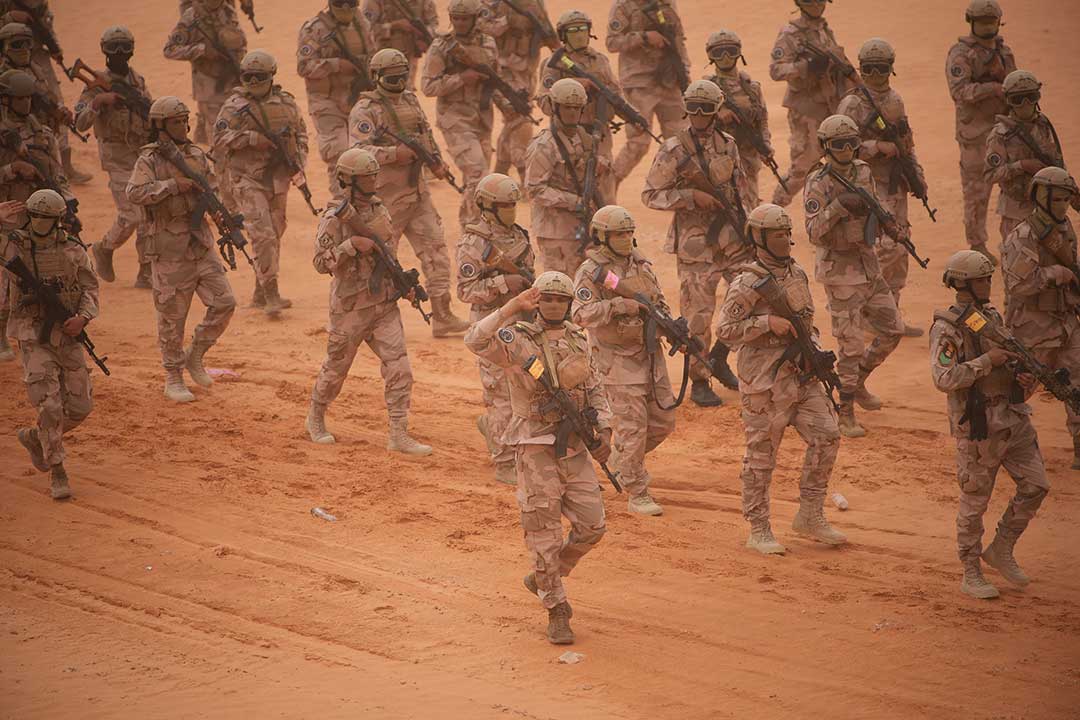
Flintlock 26 wasn’t just a military exercise. For co-host Libya, it was a historic event that brought together Libyan soldiers from the country’s Government of National Unity (GNU) and Libyan National Army (LNA) governments, building tangible momentum toward stabilizing and potentially reunifying security forces in the North African country.
The focus of Exercise Flintlock was enhancing counterterrorism capabilities and improving regional security coordination. But in Libya, all eyes were on the divided country’s military forces, which came together for joint drills.
Some 1,500 service members from more than 30 nations participated in the 21st iteration of Exercise Flintlock, which also took place with Soldiers training in a second location in Côte d’Ivoire. Started in 2005, Flintlock is U.S. Africa Command’s (AFRICOM) flagship special operations exercise on the continent.
Before the exercise began in the coastal city of Sirte, Undersecretary of the Ministry of Defense Abdelsalam Al-Zoubi in the Tripoli-based GNU government celebrated the importance of collaborating with former foes in the east.
“With African and international participation, and under the auspices of AFRICOM, the event transcends its geographical boundaries, placing Libya at the centre of a regional scene that recognizes its role and affirms that its stability is not only an internal affair, but a pillar of the security of the entire region,” he said in an April 10 statement. “This exercise is the beginning of a phase in which power is written in the language of unity, and sovereignty is preserved by the will of the people of the country.”
Speaking to reporters while traveling to Sirte, AFRICOM Deputy Commander Lt. Gen. John Brennan was gratified to see Libya take a major step toward more cohesive and unified national military institutions.
“The Libyan people deserve unified security forces to protect them and their interests,” Brennan said.
During the exercise in Sirte, Libyan forces raided a staged village, freed hostages and took out terrorists, while Libyan military doctors exchanged best practices for treating trauma casualties with U.S., British and German military health professionals.
“Lots of the Libyan medical team here are highly specialized doctors, they’ve got general surgeons, internal medicine physicians,” British Maj. Rich Cumpsty said in a U.S.-produced video on April 19. “Working as a team with the Libyans and doing some shared teaching has really helped both sides to have a collaborative approach.”
Flintlock 26 also saw the establishment of a multinational Joint Operations Center in Sirte, where regional partners exchanged information and managed assets during joint exercise operations.
Zoubi, who also serves as commander of the Western-based 111 Brigade, noted the significance of conducting drills in Sirte, symbolically separating the eastern and western sides of the country.
Sirte also is a symbol of overcoming Islamic State group terrorists, who in 2015 seized the city and turned it into their largest stronghold outside Iraq and Syria. After months of heavy fighting, Libyan forces liberated the city in December 2016.
“The city, which has witnessed the harshest seasons, is repainting the scene in a different way: units from different regions of the country, melting distances and breaking down the barriers of yesterday, to say with one military voice: There is no place for division among those who swore to protect Libya,” Zoubi said.
Saddam Haftar, deputy commander of the Libyan National Army, said in a speech before Flintlock that the event “reaffirms Libya’s position as a reliable partner in supporting regional and international peace and security.”
He praised Italy for playing a significant role in choosing Sirte and planning activities there, which marked a “historic milestone” and supported “the continued development of a unified Libyan military.”
A committee supporting Libyan joint forces efforts, known as the 3+3 Libyan Joint Military Committee, also played a key role in Flintlock, which concluded on April 30.
“Due to the investment of visionary leaders on both sides and the diligence of the 3+3, it is now a reality,” Brennan said during the opening ceremony. “Security breeds prosperity, and this is clearly visible in Libya today and as you’ve seen on the demonstration field in front of you.”